
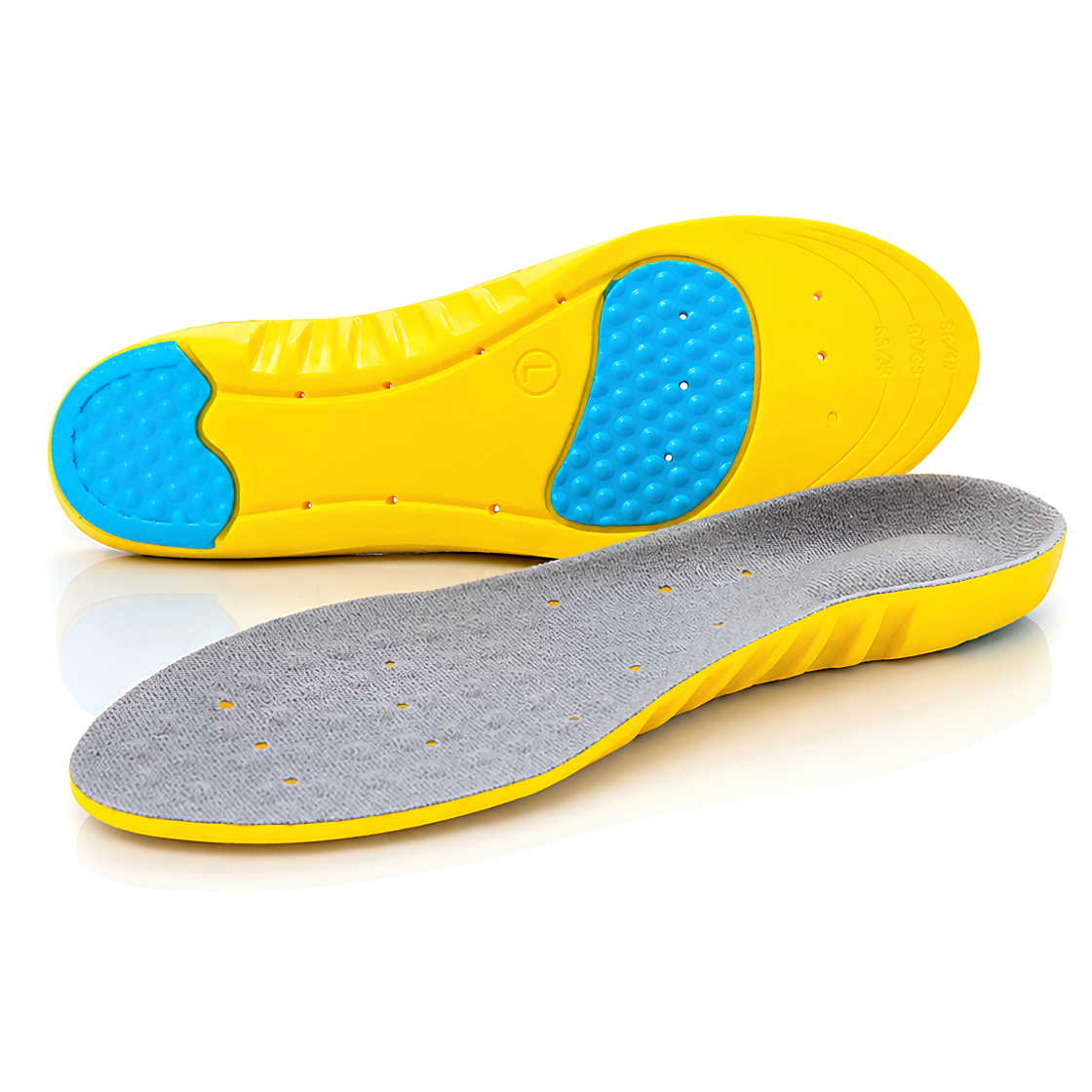

FootReviver™ Work boot insoles
£12.99
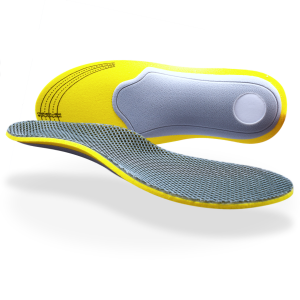
- One pair of shaped insoles for work boots, for men and women, in UK sizes 5–7 and 8–10
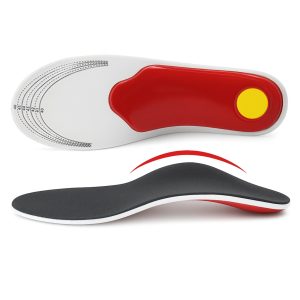
- Supportive arch cradle beneath the midfoot
- Deep heel cup with raised edges at the sides and back
- Firmer base shell made from EVA, with cushioning zones at the heel and the ball of the foot
- Memory foam top layer that moulds to the shape of your foot
- Ventilation holes and a moisture-wicking top surface
- Made for adults who spend long shifts standing or walking on hard floors
- The arch support reduces strain on the band under the arch during push-off
- The heel cup takes pressure off one spot and limits side-to-side movement at the heel
- The cushioning zones absorb some of the impact before it reaches the heel and forefoot
- Worn inside the boot against the existing footbed
- Allow a few days of wear for the foam to adapt to your foot
- Support and cushioning only, not a treatment for a diagnosed condition
- 30-day money-back guarantee
When your feet start to hurt by the end of a shift
There comes a point in a long day when your feet are hard to ignore. This usually happens in the second half of a shift, when a dull ache in your arches becomes sharper. Your heels throb with every step. By the time you take your boots off, your legs feel heavy and tired, and you are not sure whether sitting down helps or makes things worse.
If you work on concrete, or on old wooden floors worn smooth by years of use, you may recognise this pattern. The worst of it rarely comes in the middle of a shift. The ache builds through the day and is usually most noticeable in the last hour or two. For many people, it is sharp again the next morning, when their feet touch the floor and they take the first few steps.
This reflects cumulative strain rather than a sudden breakdown. Your feet are absorbing more load than they can adapt to, day after day, with too little time to recover between shifts. The effect builds gradually, and the strain is repeated with each shift.
The soreness tends to build in two main areas: the heel and arch at the back of the foot, and the ball of the foot and toes at the front. From either area, discomfort can travel into the ankle, shin, knee, hip and lower back. Once you understand how your foot bears load with each step, and how a hard floor and a stiff boot affect that, choosing what to put inside your boot becomes a more informed decision.
How a normal step is meant to work
Follow a single step from the moment your heel touches the ground to the moment your toes leave it, and the mechanics behind that step become clear.
The landing. Your heel makes contact first, slightly on the outside edge. The fat pad under your heel — a natural cushion of tissue, not bone — compresses and takes the initial impact. It’s the first of several shock absorbers your foot uses, and it takes the most concentrated load.
The inward roll. As your weight transfers forward, your foot rolls gently inward. The arch lowers, the ankle dips slightly towards the inside, and the midfoot spreads to take your body weight. This inward roll is called pronation. It’s a normal, healthy part of walking, and it’s how your foot softens the landing.
The push-off. Then the foot reverses. The arch lifts back up, the ankle straightens, and your toes take the load and drive you forward. The energy stored in that recoiling arch is returned to your leg.
To understand why that recoil works, it helps to know what the arch is made of. The arch is a curve of small bones in your midfoot, tied together by strong ligaments and held in shape by the pull of muscles and tendons. Running lengthways underneath them, from your heel to the base of your toes, is a thick band called the plantar fascia. That band is the main tie holding the curve in place. When you put weight through the foot, the band stretches slightly and the arch flattens. As you push off, the band recoils and lifts the arch back up, and that recoil is part of what drives you forward.
The outward roll. Just before your toes leave the ground, your foot rolls slightly outward again. This is supination, and it’s normal too. It stiffens the foot at the moment you need a firm lever rather than a floppy one, so your push-off travels through the bones instead of being lost in soft tissue.
Pronation and supination aren’t problems in themselves. Everyone pronates and everyone supinates, on every step, thousands of times a day. They become a problem when the amount is excessive — when the foot rolls in too far and stays there too long, or when it rolls out so much that you never get a proper cushioning roll at all. A foot that stays rigid never cushions the landing, because the arch isn’t flattening to take any of it.
Problems start when the roll goes too far in either direction, and how far it can go depends a good deal on the shape of your foot.
If you have flat feet, your arch is low or almost absent even when you’re standing still. It still has some spring, but less room to travel before it bottoms out. The foot tends to roll in further and for longer than it should — the pattern called overpronation. The ligaments and tendons on the inside of your ankle end up doing more work than they were designed for, on every single step.
If you have high arches, the opposite happens. Your arch is tall and rigid. It doesn’t flatten much to cushion the landing, so the impact travels through the foot instead of being absorbed by it. A foot with this shape tends to roll outward — sometimes called underpronation — so each landing arrives with less cushioning behind it.
Neither shape is a fault in itself. What differs is where the load lands. Flat feet tend to complain along the inside of the arch and ankle; high arches tend to complain at the heel and the ball. Two people doing the same job in the same boots can end up sore in quite different places.
Why it builds up instead of settling down
Your foot relies on several shock absorbers working at once — the fat pad under the heel, the arch, the ankle joint and the pads under the ball. Each one takes a share of the load on every step.
Together they were designed for ground that gives a little. Soil, grass, sand, even a worn dirt path — surfaces that give slightly under your weight and take some of the load themselves.
Concrete doesn’t give at all. Neither does steel plate flooring in a plant or a warehouse, or a solid timber floor. Every bit of force that a softer surface would have absorbed travels straight up into your foot, through your ankle and into your leg.
On its own, one step on a hard floor is nothing. The problem is how many of them there are. A working day of walking and standing might mean many thousands of steps, and each one delivers a small load your foot has to absorb because there’s nothing else to absorb it. Across a shift that adds up to a great many small loads, and across a week, a month or a year it adds up to far more again.
Two kinds of load are worth separating. A single sharp landing — a jump, a stumble — is something a healthy foot handles well, because the force is brief and the tissue has time to recover afterwards. What wears tissue down is a moderate load repeated far more often than the tissue can recover from. Working all day on a hard floor produces the second kind, not the first. The impacts are small, but they arrive more often than the tissue underneath has time to recover between one and the next.
Recovery is the other half of it. Soft tissue adapts when it’s loaded and then rested. Shrink the rest — shorten the gap between one shift and the next, add a double shift, add a long walk from the car park — and the same load starts to cause damage instead of prompting repair. It’s why a job you’ve done comfortably for years can start hurting when your hours change. The load hasn’t changed much, but the tissue coping with it has less time to recover. Foot pain from long standing tends to develop this way: gradually, and not all at once.
Where it hurts, and why it hurts there
The soreness tends to collect in two regions — the back of the foot and the front — and each has its own explanation.
The heel and the arch
The band under your arch comes under strain each time your foot rolls in too far and stays there, or each time a stiff high arch takes impact without flattening. The place it pulls hardest is where it anchors into your heel bone, and that’s usually where you feel it: a sharp, local pain right under the heel, often slightly towards the inside, sometimes a deeper ache along the inside of the arch itself.
Pain in that spot is often called plantar fasciitis — a band of tissue strained past what it can comfortably tolerate, again and again across weeks, not injured in a single moment.
The pattern is what gives it away. It’s usually at its worst with the first few steps after rest — getting out of bed, or standing up after a long sit. Overnight the band sits in a shortened position and gradually stiffens, because it isn’t being stretched or loaded. The first stretch of the day asks it to lengthen quickly from that state, which is when the pain is sharpest.
The return of pain partway through the day is a useful sign — after another sit-down, after a break in the canteen, after driving to a second job. Ordinary tiredness doesn’t behave that way. Tired feet ache and then stay aching. A strained plantar fascia eases once it has been moving for a while, then flares again the moment it’s asked to stretch from cold.
Heel spurs are often mentioned alongside plantar fasciitis. A heel spur is a small bony change where that band anchors, and it’s often found in people who’ve had prolonged strain in the area. What hurts is the strained tissue itself and not the bony change, which is why the soreness can settle while the spur is still there.
The front of the foot and the outer midfoot
Every push-off loads the front of the foot considerably, and the outer midfoot keeps adjusting as the foot meets the ground. Neither area has much cushioning underneath it in a stiff boot.
If pressure across the ball gets concentrated rather than spread, the result is often called metatarsalgia — a broad, bruise-like ache under the ball, most often beneath the heads of the second and third metatarsals, the long bones running from your midfoot towards your toes. Some people describe it as feeling like they’re walking on a pebble. It gathers through a shift, eases when you get off your feet, and tends to be worse in boots with thin, flat soles and little underneath the forefoot.
Morton’s neuroma feels different. A small nerve runs between the metatarsals, and as the forefoot widens on push-off — the bones fanning apart — that nerve can get squeezed between the bone ends. It most often affects the space between the third and fourth toes, and it gives a sharper, burning or stinging pain that can feel like something’s caught in your sock or a fold of leather. Tight footwear makes it worse, and taking your boots off usually eases it quickly.
Bunions sit at the base of the big toe, where the joint drifts out of line over time. That drift changes the lever you push off with. The big toe can no longer take its share of the load in a straight line, so the rest of the forefoot has to take more, which is why the whole ball of the foot can become pressure-sensitive and not just the joint itself. A bunion also changes the shape of the forefoot inside a boot, so the boot may press on the joint in ways it didn’t before. The rubbing and the joint drift are two separate problems, and a bunion usually brings both at once.
Cuboid syndrome is less commonly discussed and sits a little further back, on the outer edge of the midfoot. It’s irritation around a small joint there, and it commonly appears when the way your foot moves has changed, often after an ankle sprain or in a foot that rolls too far inward. The pain is usually a dull ache along the outer edge that’s worse when you’re weight-bearing, and uneven ground tends to bring it on because the foot has to keep adjusting to the slope.
The common thread is load and direction. Where the pressure lands, and how much of it there is, decides which structure complains first.
How a foot problem travels up the body
Your foot doesn’t work in isolation. It’s the base of a chain — ankle, knee, hip, lower back — and what happens at the bottom changes the angle everything above it has to work from.
This is what clinicians mean by the kinetic chain: movement passes through a linked series of joints, and a change at one link alters the load at the next. It’s why a problem that starts in your foot so often ends up being felt somewhere else. Your body is very good at keeping your head level and your eyes on the horizon. If the foot keeps rolling as the body pushes off, everything above it adjusts to compensate, and those adjustments have a cost.
The ankle and lower leg take the first share. The Achilles tendon runs down the back of your ankle and attaches your calf to your heel. If your foot rolls inward excessively, the ankle works at an angle it wasn’t built for, and that tendon takes repeated strain — Achilles tendonitis, which usually shows as pain and stiffness at the back of the ankle, often worst first thing in the morning. Shin splints, the aching strain along the front or inside of the shin bone, follow similar logic: repeated load through a leg that’s trying to control a foot that keeps rolling inward. Ankle sprains belong here too, because a foot that rolls too far is more likely to roll off the edge of the boot and take the ankle with it.
The knee comes next. The knee is a hinge, and it prefers to work in a straight line. If your foot rolls in, your lower leg rotates inward slightly, and that rotation travels up into the knee. The joint then tracks at a slight angle on every step instead of straight, and over thousands of steps that shows up as discomfort around the kneecap or along the inside of the knee. Stairs and slopes tend to bring it out, because that’s when the knee has to control the most body weight through the greatest movement range.
The hip and lower back sit at the top of the chain. To keep your head level while your foot rolls excessively, your body has to compensate somewhere, and that usually means rotation at the hip or a shift in the lower back. The muscles around the hip work harder to control a foot that keeps rolling inward, which is why people with long-standing foot problems often describe a vague lower back ache they can’t place, or a hip that feels tight on one side but not the other.
None of this means every foot problem causes back pain. It means the link exists, and it’s worth knowing about if you’ve been treating your feet and your knees as separate problems and neither has settled.
An arthritic joint copes with less load than a healthy one, so the same pressure through the foot feels heavier than it used to. Reducing the peak force arriving through the foot doesn’t change the joint itself, but it can make the load sitting on it easier to carry through a shift.
Why work boots and hard floors make all of this worse
Most work boots are built for protection, not comfort. The toe cap is there to stop something heavy. The sole is stiff to stop a nail or a sharp edge. The ankle support keeps the foot steady on uneven ground.
Each of those choices has a trade-off that builds up over a long shift.
The footbed inside most boots is flat and thin. There’s very little shaping under the arch and very little cushioning under the heel or the ball. You’re standing on a firm, flat base with nothing underneath taking a share of the load, and on a floor that doesn’t give either, every impact of the day travels straight up through your feet.
The sole is stiff, which means it doesn’t flex much as your foot rolls through. On a neutral foot in a well-fitting boot, that’s fine. On a foot that already overpronates, a stiff sole restricts how much the foot can move through its natural range, so the movement gets pushed up into the ankle and knee instead. A boot that suits a neutral foot can work against a foot that tends to roll inward.
You may not be able to change the floor, and you may not be able to change the boot. What you can change is the base your foot stands on inside it.
Once tiredness joins in, your legs feel heavy and achy by the end of the day. The heaviness is usually muscular tiredness and not a separate problem. The muscles in your feet and calves have been working harder than they should, for longer than they should, because the load isn’t being shared with anything underneath.
Why a shaped insole helps
If the problem is that your foot is working from a flat, thin base with nothing shaped under the arch, the most direct thing you can change is that base.
A well-shaped insole puts a supportive surface between your foot and the boot’s own footbed, with a cradle under your midfoot where there was nothing, cushioning under the places that take the most impact, and a steadier platform for your foot to work from.
It doesn’t change the shape of your foot and it doesn’t fix the floor. What it changes is the surface your foot works against, and that changes how much strain travels through the arch, the heel and the ball on every step. It works best alongside the practical things that help at the same time — splitting up the longest stretches of standing and walking rather than doing them all in one go, boots that fit properly and don’t pinch, keeping your calf and foot muscles moving — and not as a substitute for them.
How these insoles are designed to help
A solid base shell made from EVA
The foundation is a firmer outer layer made from EVA — ethylene vinyl acetate, a lightweight rubber-like material widely used in footwear because it holds its shape and absorbs impact well.
The firmer base is what gives the insole its structure. If the whole thing were soft, it would squash flat under your weight and give you very little support. A firm shell with softer material on top holds its shape while still cushioning against it, and it’s what takes the edge off the repeated low impacts coming up through a stiff boot.
An arch support that cradles the midfoot
Underneath the arch section sits a shaped support that rises to meet your midfoot. Instead of your arch pressing down onto a firm base, it’s held in a more supported position through the roll and the push-off.
This is where the plantar fascia benefits most. The band is being asked to do less work when the arch is supported from beneath, so the strain at the point where it anchors into the heel is reduced. Less strain on each step means less accumulated irritation across a shift, and a better chance for the tissue to settle between days. Reducing that strain is the main reason an arch support of this kind is used for heel pain.
A deep heel cup with raised edges
Around the heel, the insole rises into a cup, with edges wrapping the sides and back of your heel instead of stopping flat.
The shape does two jobs. It cups the heel, taking the pressure of each footfall off one spot and spreading it around the whole heel, which matters when the heel is already sore and every step lands on the same tender patch. It also holds the heel steadier inside the boot, reducing the side-to-side movement that strains the ankle and lower leg. Less movement at the heel means less of the rolling that puts the ankle tendon and shin under extra load, and fewer of the positions that lead to sprains.
Cushioning zones at the heel and the ball of the foot
The two places your foot takes the most concentrated load are the heel at landing and the metatarsal area — the ball of the foot — at push-off. The insole has extra shock-absorbing material built into both.
This is the layer doing the work the floor won’t. Instead of the load travelling straight from the floor into your heel and forefoot, it meets material designed to absorb some of it first. It won’t remove the load, but it softens it and spreads it, which can be the difference between a throb and a manageable ache by the end of a shift. For metatarsalgia and forefoot pressure in particular, spreading that pressure across more of the ball rather than the same few spots is the realistic benefit. The insole isn’t going to change the shape of a bunion or widen a narrow toe box.
A memory foam top layer
Memory foam is a soft, slow-recovering material that moulds to whatever presses into it and holds that shape for a moment when the pressure lifts.
On top of the insole, it takes on the contours of your own foot instead of asking your foot to fit a generic shape. Over the first days of wear it gradually forms around the particular outline of your heel, arch and forefoot, so the support becomes a little more personal to you. The foam also distributes weight more evenly, giving slightly at the highest points of your foot and firming up in the hollows, so pressure isn’t concentrated on the same few spots.
Moisture-wicking and ventilation
Feet inside work boots get warm, and warm feet sweat. The top surface draws moisture away from your skin and absorbs it, and ventilation holes run through the insole so air keeps moving around your foot.
The practical result is drier, fresher feet through a shift, and less of the clammy, sliding feeling that builds up inside a boot over a long day.
Fitting, sizing and what to expect
These insoles come as a pair, in UK sizes 5–7 and 8–10, sized for both men and women. They’re designed to sit inside work boots, laid flat against the existing footbed with the heel cup sitting snugly around the back of the boot.
Give yourself a few days before you form a view. Your feet have been working from a flat factory footbed, and a shaped insole will feel noticeably different at first — more support under the arch, more material under the heel. Some people notice it straight away. Others find it takes a week or so before it stops feeling like something new in their boot. The support itself doesn’t need breaking in; the foam does.
It’s tempting to judge them by how your feet feel when you wake up, but that gives a misleading answer. Tomorrow morning reflects today. What you loaded your feet with all day is what they’re reacting to when you get out of bed.
Judge them on two other things instead. First, how your feet feel at the end of a shift: whether the ache arrives later, whether the last hour is more manageable, whether your legs feel less heavy on the way home. Second, how the following mornings change over the first few weeks of regular wear. As each shift delivers a little less strain, the gap between shifts becomes enough for the tissue to make some ground, and that shows up as mornings that are gradually less sharp.
What you’re looking for is that gradual shift, not an overnight fix. These insoles support and cushion your feet. They don’t treat a condition, and they won’t undo years of strain in a fortnight.
When to get some help
These insoles are a support, not a diagnosis. If your pain is severe, came on suddenly instead of building gradually, is getting worse despite rest, or comes with new swelling, numbness or tingling that doesn’t settle, speak to a GP or a podiatrist.
The same applies if you’ve been managing a foot problem for a while and it simply isn’t shifting. Persistent pain deserves a proper look, not another few months of putting up with it. An assessment is usually straightforward. Someone watches how you stand and walk, feels where the tenderness sits, checks how far your foot moves in each direction, and asks about your work and footwear — often enough to separate one problem from another and point you at the right approach.
Where to go from here
If your days are spent on hard surfaces in protective boots, and your feet and legs are telling you about it by the end of every shift, changing what sits between your foot and the boot’s own footbed is a straightforward place to start. These insoles give you support under the arch, a deep cup to hold your heel steady, extra cushioning where the impact lands heaviest, and a soft top layer that settles into the shape of your own foot.
They come with a 30-day money-back guarantee, so you can put them through a run of real shifts and judge them the way they should be judged — by how the end of the day feels, and by how the mornings after change. Check the sizing against your boot before you start, and if your pain is new, unexplained or getting worse rather than better, speak to a clinician before relying on an insole to manage it.
Important information about this guidance
What’s written here is general guidance for adults, not personal medical advice, diagnosis or treatment. It isn’t a substitute for an assessment of your own feet and circumstances. If you’re unsure whether these insoles suit you, or you have new, unexplained or worsening symptoms, speak to a GP, physiotherapist or podiatrist for advice tailored to you. No specific outcome is promised or guaranteed.
Additional information
| Size | 5-7, 8-10 |
|---|


Reviews
There are no reviews yet.