
No products in the cart.
Running insoles
Running Insoles: Support for the Strain Running Puts on Your Feet and Legs
Running looks simple. In practice, every stride sends force through your foot, ankle, shin, knee, hip and lower back, and your feet take that impact first and hardest. If your technique isn’t quite right, or your shoes don’t give your feet enough support, the repeated pressure adds up. Over time it can contribute to nerve pain in the ball of the foot (Morton’s neuroma), pain under the ball of the foot (metatarsalgia), heel or arch pain from strain in the band beneath the arch (plantar fasciitis), pain where the calf meets the heel (Achilles tendinitis), pain along the shin (shin splints), pain around the kneecap (runner’s knee), and hip or lower back pain.
That list looks alarming, but one thread runs through it: load. Load is the force your foot has to carry with each step. Running repeats it hundreds of times a session, often on hard ground, and often when you’re tired and your technique has drifted.
You aren’t making a conscious decision about any of it, which is part of the difficulty. Gait is the pattern of how you walk and run — the heel making contact, your weight passing over the foot, the heel lifting, then the push forward into the next step. Once you’re moving, your body runs that sequence without asking you. That’s useful, because it lets you cover distance without thinking about every footfall. It also explains why a repeated fault goes unnoticed. If your foot lands slightly the wrong way, or your arch drops further than it should because your shoe gives it nothing to rest on, the same small error happens several hundred times before you finish a run. On its own, one of those steps is nothing. Thousands of them a week, for months, is where the strain builds.
Push-off is the end of each stride, when your heel lifts, your toes bend and you drive forward. That’s the moment the arch takes the most load and the tissue beneath it is stretched furthest, and it’s where several of these problems begin.
Your arch is the curved section between your heel and the ball of your foot. It flexes under your weight and springs back as you drive forward, absorbing some of the force of each step. Support it and that work is shared more evenly. Leave it unsupported and the soft tissues around it take more strain, while pressure moves into areas less able to cope.
Where the Load Lands on the Foot
The first sign of plantar fasciitis is often the first few steps out of bed, or the first steps after sitting for half an hour. The heel or the inside of the arch feels sharp and stiff, eases as you keep moving, then returns after a run or a long spell on your feet. The band involved runs from your heel to the ball of your foot and holds the arch in shape, and every push-off stretches it. Repeat that stretch with nothing underneath to support the arch, and the point where the band attaches to the heel becomes sore to load.
Those first steps are sore for two reasons that work together. Overnight the tissue rests and tightens, and the first steps stretch it abruptly after hours of not being loaded, which stings. If it’s still sharp in the morning, that also tells you the day before asked more of the tissue than it could settle from while you slept. An insole doesn’t change those first barefoot steps, because it isn’t on your foot yet. What it changes is the rest of the day. Filling the space under the arch limits how far the band stretches on each push-off, so once you’re in your shoes and walking or running, less additional strain reaches the sore spot — the strain that would otherwise land on top of what’s already there.
Metatarsalgia is easier to picture as a concentration problem. The ball of your foot is where the long bones of the foot meet the toes, and during push-off it carries a large share of your body weight through a small area. A thin, flat sole does nothing to spread that share out, so the same patch takes the load every time you drive off. The result is a bruised, burning ache under the ball that builds through a run and lingers the next morning. A contoured insole widens the area taking the pressure, which takes the sharpest edge off it. The load is still there, but it stops landing in one place.
With Morton’s neuroma, the description people reach for is a stone in the shoe, or a fold in the sock that won’t flatten out. Sometimes it burns or tingles into the toes. What’s happening is that one of the nerves running between the long bones of the foot is being squeezed each time the foot takes weight, and a nerve squeezed repeatedly becomes sensitive. The squeeze comes from the bones above and the ground below, so how much room the nerve has depends on how the sole is supported. More even support under the ball reduces how concentrated that pressure is. Whether the nerve then settles isn’t something an insole can guarantee, and pain of this kind that keeps returning or spreads into the toes is worth having looked at rather than run through.
How It Travels Up the Leg
It helps to see the leg as one connected line rather than a set of separate parts. Your foot, ankle, shin, knee, hip and lower back pass movement and force from one to the next — physiotherapists call this the kinetic chain — so a change at the bottom doesn’t stay at the bottom.
At the back of the ankle, the Achilles tendon joins your calf to your heel and takes the full drive of push-off, which is why hills, stairs and faster running tend to bring it on. The pain is usually sharp or stiff behind the ankle and worst in the minutes after you stop. The tendon isn’t working alone at that moment. The whole lower leg steadies the foot as the heel lifts, and if the arch has no support the foot shifts under that load, leaving the calf making constant small corrections. A supported arch gives the foot something firm to push from, so those corrections get smaller. That can leave the back of the ankle feeling less worked during a run. A tendon that’s already sore still needs calf strengthening and a gradual return to distance, not an insole on its own.
Shin splints are felt along the inner edge of the shin bone, where muscle and connective tissue attach to it. That attachment is where impact arrives, and it explains the way the pain behaves: it builds through a run, eases with rest, and returns when you go back to the same distance on the same hard surface. Your shin bone itself is usually fine. The tissue anchoring to it is being asked to absorb more than it can recover from between runs. Changing how the foot meets the ground spreads the force of each step over a wider area, so the same attachment isn’t struck in the same way, step after step.
Going downstairs, running downhill, or standing up after sitting a while are the situations where runner’s knee is usually noticed, because all three load a bent knee. The ache sits around or just under the kneecap. What often gets missed is how much arrives at the knee from below. As the foot takes weight and the leg turns slightly inward, that rotation travels up, and the kneecap is pulled against the thigh bone rather than gliding smoothly. A more stable foot reduces the amount of rotation passed upward, which can make those stairs and downhill sections feel less sharp. Knee pain of this kind usually needs strength work around the hip and thigh as well, so treat the insole as removing part of the irritation rather than as the whole answer.
The chain carries on past the knee. Your hip and lower back sit at the top of the same line and pick up whatever the foot and leg haven’t absorbed. With poor support underfoot, the jarring that reaches them is more noticeable, and people often describe it as a tired, heavy ache after longer runs rather than a sharp pain. These insoles aren’t designed to treat hip or back pain directly. But because the force starts at the ground, easing how it’s taken at the foot can take some of the edge off what arrives higher up — sometimes enough to make the day after a run feel closer to normal.
There’s a sequence many runners will recognise, and few plan for. Once a spot hurts, you start protecting it without meaning to. You shorten the stride on that side, land more heavily on the other foot, or hold yourself a little stiffer through the hip to reduce the jolt. Those adjustments do take pressure off the sore spot, and they put it somewhere else. A few weeks later a second area starts to hurt, you’re running less than you were, and the fitness that made running feel comfortable has begun to slip. The way out is usually to deal with the original irritation instead of absorbing it upward, and better support under the foot is one of the simpler ways to do that.
What an Insole Changes Inside Your Shoe
Your foot takes a lot of load when you run, and the sole of a running shoe is built to suit a range of feet rather than yours specifically. On most feet that means too much support in one place and too little in another. An insole sits between your foot and the sole of the shoe and changes the shape your foot rests on. It fills a space the shoe leaves empty, or adds contour where the shoe is too flat, so your foot meets support where it needs it instead of sitting on a surface that leaves it unsupported.
How This Range Is Designed to Help
These insoles are a support for adults dealing with common running-related foot and lower-limb complaints. They aren’t a treatment for a diagnosed condition. If you already have a diagnosis such as plantar fasciitis, metatarsalgia, Achilles tendinitis, shin splints, runner’s knee, or hip and lower back pain, an insole may reduce some of the pressure that aggravates it. It won’t replace a proper assessment, a rehabilitation plan, or footwear advice from a qualified professional.
Every shape in the range is built with inbuilt arch support, which means the section under your arch is shaped rather than left flat. The aim is to work with the way your foot and leg move together, not to force your foot into a position it doesn’t want. That support holds your foot in a more comfortable position through each stride, spreads pressure across the sole, and keeps strain away from the areas that get sore.
The range covers more than one shape because feet and shoes don’t all need the same thing. Full-length insoles run from heel to toe and support the whole sole. Three-quarter-length insoles stop just behind the ball of the foot and leave your toes free, which helps when a full-length insole makes a shoe feel tight. Arch support insoles give the general support described above. Gel insoles add cushioning, which suits the ball of the foot when metatarsalgia is the main complaint. A metatarsal pad does a related job in a more targeted way: rather than cushioning the whole sole, it puts a raised pad directly under the ball. Foam insoles give a softer feel underfoot. Shock-absorbing insoles are aimed at runners who want more cushioning through impact. Heel cups, heel pads and heel lifts focus on the heel rather than the whole foot: a cup cradles the heel, a pad cushions beneath it, and a lift raises the heel so your ankle sits at a slightly different angle.
Choosing between them comes down to two things: where you feel the pressure, and how much room your shoe has. If the discomfort is spread across the sole and you want the arch supported through every stride, a full-length or three-quarter-length arch support insole is the usual starting point. If the sore spot sits under the ball of the foot, a gel insole or a metatarsal pad puts cushioning where you need it and leaves the rest of the foot as it is. If the heel is the sore part, a heel cup or heel pad concentrates support in that one place. Runners in snug shoes often do better with a three-quarter-length insole, simply because it doesn’t crowd the toes.
Getting the Fit Right and What to Expect
Place the insole inside your running shoe so it sits flat, with no bunching at the heel or toes. Many running shoes come with their own removable insole, and taking that out first usually gives the new one room to sit properly while keeping the fit close to what you’re used to. Then check the toe area. If the insole makes the shoe too tight, your toes press against the front and you’ve created a new problem instead of solving one.
Start with shorter runs, or a mix of walking and running, rather than a long run on the first day. Your foot needs a little time to adjust to a different shape beneath the arch, and a gradual start makes it easier to judge whether the support is helping. If you feel pressure points or rubbing, stop and adjust the position, or speak to a podiatrist or physiotherapist before carrying on.
Expect a change in how your foot is supported rather than an end to the impact of running. The forces are still there; they’re just handled differently. What people tend to notice is that pressure under the arch or ball of the foot feels easier, that a familiar route feels less jarring, or that they’re less sore the following day. If nothing has changed after a couple of weeks of regular use, the shape may not suit your foot or your shoe, and a podiatrist can help you work out which would.
An off-the-shelf insole isn’t built to last indefinitely. With regular running, most pairs last somewhere between six months and a year before the cushioning flattens and the arch shape compresses, and a pair worn several times a week will go sooner than one worn once a week. Wash them by hand in warm water with a little mild soap and let them air dry away from direct heat, because a radiator or tumble dryer will warp foam and gel and spoil the shape. Replace them once the arch has flattened, the edges have begun to curl, or you can feel the sole of the shoe through the cushioning under the heel or ball of the foot.
When to Get Help
Most running-related foot pain settles once you match how much you’re running to what the tissue can currently cope with, but some situations need a person rather than a product. Speak to a GP, physiotherapist or podiatrist if your pain is severe, if it keeps returning after rest, if it’s getting worse rather than better, if you develop new or unexplained symptoms, or if you’ve stopped running for a few weeks and the pain still hasn’t settled.
The Short Version
Running asks a lot of your feet and lower limbs, and the strain repeats automatically with every stride, often without you noticing where it lands. Good technique, sensible training and supportive shoes all play a part. This range adds support inside your running shoe — full-length and three-quarter-length arch support insoles, gel, foam and shock-absorbing options, plus heel cups, heel pads and lifts for the heel alone. The aim is to spread load across a wider area, keep pressure off the spots that hurt, and help your foot hold a more comfortable position through each stride, so less of that force travels up the leg. Pick the shape that matches where you feel the pressure and how much room your shoe has, start with shorter runs, and replace them once the cushioning goes flat. If your symptoms are new, severe or getting worse, get them looked at rather than running through them.
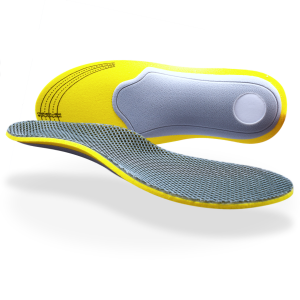
FootReviver™ Orthotic Plantar Fasciitis Insoles
- Designed specifically for plantar fasciitis heel and arch pain: Sharp first‑step pain in the morning, aching after time on your feet, or soreness along the arch that keeps coming back.
- Targets the real source of the problem – how your foot is loaded: Supports the band under your foot (plantar fascia), steadies the heel, and helps stop the arch dropping and rolling in more than it can comfortably cope with.
- Firm 3/4‑length support where you need it, not a hard block under your whole foot: A structured base under the heel and arch holds its shape to support you, while the front of the insole stays softer and more flexible for natural push‑off.
- Deep heel cup with cushioning to calm sore heels in shoes: Cradles the heel, holds the fat pad under the heel bone, and spreads impact away from the tender spot where the plantar fascia attaches.
- Shaped arch support with gentle control of extra inward roll: Meets the arch earlier in the step so it cannot collapse as far, and reduces extra rolling‑in that repeatedly tugs on the fascia at the heel.
- Full‑length cushioned top layer to protect the forefoot as well as the heel: Runs from heel to toes, gradually shaping to your foot to share pressure under the ball of the foot and give space for wider or splayed toes.
- Helps on hard floors, long periods of standing or walking, and higher‑impact days: Combines firm rearfoot support with cushioning under heel and forefoot to make standing, walking, and even light running or sport more manageable.
- Trim‑to‑fit design for most closed‑back shoes: Cut to size at the front, drop into your usual shoes, and the anti‑slip base helps keep them in place under your heel and arch.
- Normal to feel them at first – then expect steadier, more comfortable steps: Start with a few hours a day and build up. A mild awareness under the arch and heel is common at first; as your feet adjust, many people find standing and walking become easier and less painful.
- One practical part of managing plantar fasciitis – clear support, not a magic cure: Works best alongside sensible changes in time on your feet and any exercises or advice from your GP, physiotherapist, or podiatrist.
£9.99