No products in the cart.
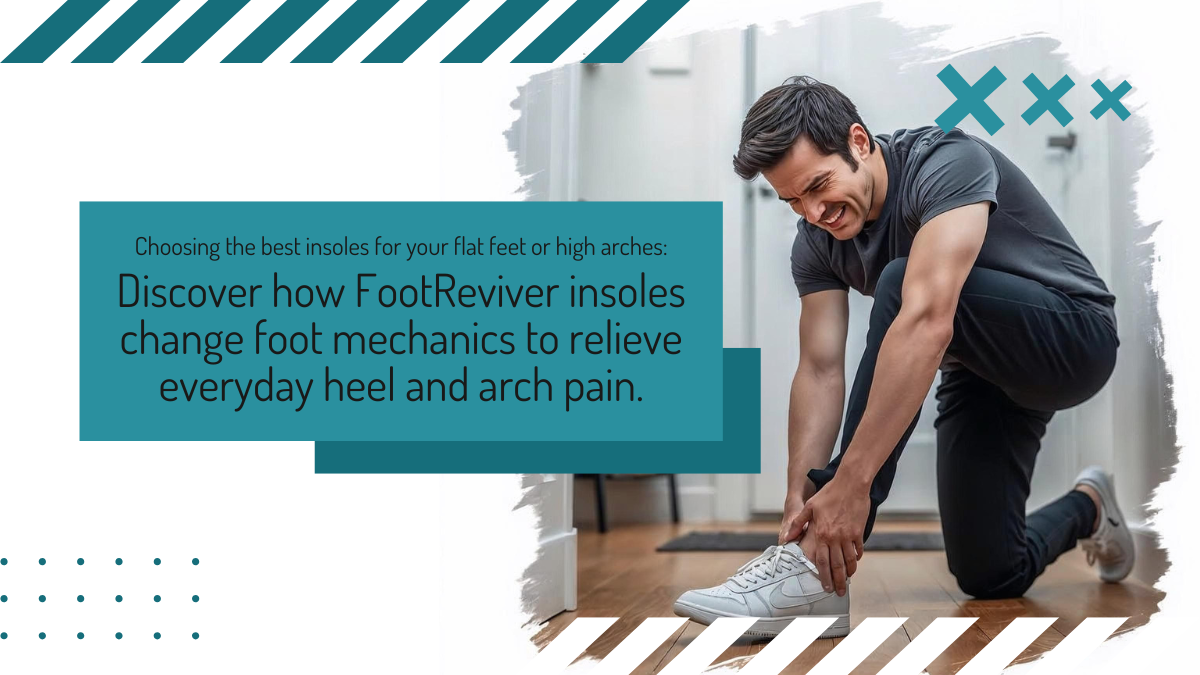
When flat feet or high arches leave your feet aching
If you have very flat feet or high arches, your feet can feel sore at the start of the day and worn out by the end of it. Many people with these foot types recognise the pattern. The first few steps after getting up or putting shoes on send a sharp pain through the heel. As the day goes on, a deep ache builds across the arches and middle of the foot. By evening, there can be a burning tiredness under the ball of the foot and a nagging pull through the Achilles or shins. For some, there is also a dull ache around the knees or across the lower back after long spells on hard floors.
Often, this comes down to how much the arches flatten or stay high and how far the feet roll in or out as you walk. When the arch is very low and collapses in, or very high and tips out, the band under the arch and heel, the soft fat pad under the heel, and the small joints in the middle of the foot are all put under extra strain. Over time, that can make ordinary standing and walking feel much harder than they should.
It is understandable to feel fed up when your feet limit how long you can stand or walk. This guide takes the common questions people with flat or high arches ask, explains what is going on in the feet, and then shows how FootReviver orthotic insoles for flat feet and high arches are designed to change the way the heel and arch are supported, and when they may be worth trying in your own shoes.
This is general information. It does not replace advice from a GP, physiotherapist or podiatrist. Later on there is a clear safety section for situations where it is important to get your feet checked.
Understanding your foot type and how your feet move
What exactly are flat feet and how do they affect walking?
Flat feet usually means the arches look very low or sometimes almost touching the ground when you stand. Instead of the arch lifting and lowering a small amount, it may flatten more, with the heel and ankle tending to roll inwards. That inward roll is a normal part of walking, but in flatter feet it can be larger and quicker.
This pattern is usually linked with over‑pronation, where the foot rolls inwards more than the soft tissues can comfortably control.
When this happens, the thick band under the arch and heel (the plantar fascia) and the ligaments along the inside of the foot are stretched more with each step. The muscles along the inside of the shin work harder to try to slow the rolling in. Some people never have any problems from this. Others develop sharp pain where the band joins the heel bone, aching across the mid‑foot, or a tired pulling feeling along the inner shin after time on their feet.
How can you tell if you have high arches and need arch support?
High arches look more lifted even when you are fully weight‑bearing. The gap under the arch is larger, and more of the pressure is often felt on the heel, the outer border of the foot, and the ball of the foot. The feet may appear narrower, and shoes can feel as if they press on a few points rather than contacting the whole sole.
These feet often feel stiffer, with less natural “give” as weight moves from heel to toes. Because the arch does not lower much, the plantar fascia and mid‑foot joints do not share impact in the same way. As a result, the heel pad, the outer edge of the foot and the forefoot can take higher pressure with each step, especially on firm surfaces. That can lead to soreness, burning, or a bruised feeling after longer walks or standing for long periods.
This pattern is often linked with supination or under‑pronation, where the foot stays more on its outer edge and does not roll inwards as much as average.
What are over‑pronation and supination, and how do they affect your feet?
Pronation is the natural inward roll of the foot as it accepts weight. It helps absorb shock and lets the foot adapt to the ground. Over‑pronation is when that inward roll is bigger, quicker or lasts longer than the ligaments and tendons can comfortably handle. It often shows as the heel dropping in and the arch flattening more than average when you stand or walk.
Supination is the outward roll of the foot. A small amount is normal as you push off, when the foot becomes a firmer lever. Excess supination (also called under‑pronation) is when the foot stays more on its outer edge and does not roll inwards enough to share shock. More of your weight is then carried on the outer border of the foot, the outer ankle ligaments and certain parts of the heel and forefoot.
If you notice your heel tilting inwards a lot when you stand, or you feel as if you are landing more on the outer edge of your foot, these are often simple clues to how your feet are rolling with each step.
Can arch height change in adult life, and is it normal for one foot to be different from the other?
Some people are born with very flat or very high arches and stay that way. Others notice their arch shape changing gradually in adulthood. As we get older, ligaments can become a little looser and muscles may tire more easily. Previous ankle or foot injuries can alter how joints move. Weight change and more time on hard floors can also make a flatter arch more obvious. Starting a new job or routine that keeps you on your feet more is a common moment when people suddenly become aware of their arches.
It is common for one foot to be slightly flatter, higher arched, or more painful than the other. Most of us have small differences in leg length, joint mobility or strength between sides, so one foot may work harder. A slow change on one side is often just part of that pattern. A quicker change, or new pain on one side only, is a good reason to get things checked.
If your arches seemed fine and then, at a time when your feet had to cope with more standing, walking or extra load, one or both feet became noticeably flatter or more painful, it is sensible to speak to a clinician before relying on insoles alone.
Where flat feet and high arches hurt – and why
Many of the pains described here – around the heel, across the arch, under the ball of the foot and up into the legs – can appear with either flat feet or high arches. The way the strain builds up is different, but the end feeling can be surprisingly similar.
How do flat feet or high arches cause heel pain and plantar‑type pain?
Heel pain is one of the most common reasons adults with flat feet or high arches start to seek help. Both very flat and very high arches can play a part in pain under or around the heel.
With a very low arch, as the arch collapses and the heel drops in, the plantar fascia band is pulled harder where it joins the heel bone. That repeated pulling can irritate this attachment point and the tissues around it.
With a high, stiff arch, the heel can act more like a firm point of contact. More of your weight may land directly on the heel pad and bone each time you take a step, especially in shoes with thin soles on hard flooring. This extra impact can make the fat pad and deeper structures feel bruised.
After resting or sleeping, the plantar fascia and calf muscles tend to tighten slightly because they are not being used. When you first stand up and start walking around the room, that band is suddenly asked to lengthen as the arch lowers and the toes bend. If the area where it joins the heel is already sore, this first load can feel sharp and stabbing. A few steps later, as tissues warm up, the pain often eases, even though the irritation is still there.
That is why those first few minutes on your feet often feel so sharply worse than the rest of the day. Once you are in shoes, a FootReviver orthotic insole for flat feet and high arches is designed to support the arch and reduce how far it can drop, and to cushion the heel area. Together, those changes aim to reduce stretching and soften impact on the sore part of the heel.
Why do flat feet or high arches cause aching arches and mid‑foot pain?
A deep ache across the arch and middle of the foot after long spells on your feet is very common.
When the arch is low and flattens a lot, the ligaments and small joints across the mid‑foot are held under extra stretch and pressure for long periods. They are working hard to stop the arch from flattening completely.
When the arch stays high and stiff, the mid‑foot joints move less, so they cannot share impact as smoothly. Instead, certain areas are pressed together more firmly each time you step. After hours of walking or standing, this repeated strain can produce a dull ache or a sense that your feet are heavy and tired, especially by the end of a work day.
The arch support in a FootReviver insole is shaped to share the pressure more evenly across the mid‑foot, so no single joint or ligament has to work at its limit all day. That often means you can stand or walk a bit longer before the ache builds, and when it does, it may feel less intense.
Ball of foot pain (metatarsalgia) in flat or high‑arched feet – what’s going on?
The ball of the foot is where the long bones in the forefoot (metatarsals) meet the toes. When you push off, these bones and the soft tissues and small nerves underneath take a lot of load.
When the arch collapses and the foot rolls in, the forefoot can spread and twist slightly. This can put extra pressure under particular metatarsal heads, especially the second and third. When the arch stays high and stiff, more of your body weight may be pushed towards the front of the foot because the arch does not lower to help with shock absorption. That concentrates pressure under the ball of the foot.
Over time, repeated pressure can irritate the soft tissues and nerves in this area, leading to burning, hot or sore feelings under the ball of the foot. The term metatarsalgia is often used to describe this type of pain under the metatarsal heads, whatever the exact cause.
By improving how the heel and arch are supported and how smoothly weight moves forwards, orthotic‑style supports such as FootReviver insoles can reduce the amount of force that ends up focused under these small areas. If you recognise that hot, burning feeling under the front of the foot on longer walks or hard floors, this is usually what is going on underneath.
Why do my symptoms feel worse later in the day than in the morning?
Most tissues cope better with short spells of strain than with hours at a time. As you stand and walk through the day, the plantar fascia, mid‑foot ligaments, Achilles tendon and leg muscles all work continuously. A little fluid can also collect in the feet and lower legs by the evening.
By later in the day, these tissues are often more sensitive and slower to recover. The same amount of standing that felt fine in the morning can now feel sore or tiring. A FootReviver insole cannot undo a very long day on your feet, but by reducing peak strain on key areas and making movement a bit more efficient, it may help delay or reduce this build‑up of discomfort.
Other foot and ankle problems linked to flat feet and high arches
Alongside the common heel, arch and forefoot pains already described, some people with very flat or very high‑arched feet also notice more specific problems.
Tibialis posterior tendon pain at the inner ankle
The tibialis posterior tendon runs down the inside of the lower leg, behind the inner ankle, and helps support the arch. In very flat, over‑pronating feet, it may work harder to hold the arch up and slow the heel dropping in. Over time, repeated strain can irritate the tendon, causing pain or tenderness along the inside of the ankle and sometimes further up the shin. An insole that limits excessive arch collapse and supports the heel, such as a FootReviver insole, can reduce this daily demand, but new inner‑ankle pain still needs assessment.
Outer foot and ankle ache in high arches
If your foot stays more on its outer edge, the joints and soft tissue along that outer border have to work harder. Repeated stress can cause a dull ache along the outer foot or make the outer ankle feel as if it is taking too much force, especially after longer walks or time on pavements and other firm surfaces. By centring the heel more and helping the arch share load, a FootReviver insole can reduce how often you land heavily on the outer border of the foot and may make the ankle feel more secure during day‑to‑day walking.
Bunions and forefoot crowding in long‑term over‑pronation
In some people with long‑standing flat, over‑pronating feet, the way the forefoot twists and spreads can contribute to the big toe drifting towards the second toe (a bunion or hallux valgus). This changes how pressure is shared across the ball of the foot and can lead to soreness over the bunion itself or under the lesser toes. Better heel and arch support cannot reverse a bunion, but it can reduce some of the ongoing strain that contributes to forefoot crowding.
Recurrent ankle sprains in very high arches
Very high‑arched, supinated feet can feel less stable on uneven or sloping ground. Because the foot is already more on its outer edge, it may be easier to roll the ankle and strain the outer ligaments. People with this pattern sometimes report repeated “turning” injuries on the same side. A supportive insole that helps centre the heel and share load through the arch can give a more secure base inside the shoe, but frequent sprains still warrant assessment.
How can the way my feet roll affect my Achilles, shins, knees or lower back?
The way your feet move affects the rest of the leg. When the heel rolls in and the arch collapses, the lower leg may twist inwards and the knee can drop slightly towards the midline. When the foot stays more on its outer edge and rolls out, the lower leg can twist the other way.
With a low, collapsing arch, the Achilles tendon can be pulled slightly off‑centre as it attaches to the back of the heel, and the muscles along the inside of the shin work harder to slow the inward roll. This can lead to a tired or pulling feeling along the tendon or the inner shin.
With a high, more supinated arch, the outer ankle and outer shin muscles can be asked to do more, and the outer border of the foot can take more impact. Over time, this may cause aching along the outer shin or around the ankle.
Further up, these twists can change how the kneecap tracks and how the pelvis and lower back muscles hold you upright. Some people notice aching at the front or inside of the knee after long standing, or a dull ache across the lower back. When your feet roll in or out more than feels natural to you and you then get these leg or back aches after being on your feet, it is understandable to wonder whether better foot support could help.
FootReviver insoles focus on centring your heel as you land and holding the arch in a more supported range. That can reduce how much twist is passed up to the knee and hip, which may ease some of these knock‑on aches for some people.
Do you need insoles for flat feet or high arches – and what can they do?
Who is most likely to benefit from insoles for flat feet or high arches?
Not everyone with flat feet or high arches needs insoles. Many people with these foot shapes never develop pain. Insoles become more relevant when:
- You have ongoing heel pain, arch ache or forefoot burning similar to the problems described above.
- Your pain clearly flares when your feet roll in or out more, or when you are on your feet for longer.
- Your work or daily life involves long spells of standing or walking on hard floors.
In these cases, changing how your arch and heel are supported inside the shoe can reduce day‑to‑day strain. Insoles then sit alongside other simple steps, such as wearing shoes that suit your foot type, breaking long spells on your feet into shorter blocks with brief pauses or short breaks off your feet, and doing basic calf and foot exercises where a clinician advises.
How do insoles for flat feet and high arches actually work?
Supportive insoles mainly help in three ways.
First, they give you a shaped surface under the arch and middle of the foot instead of a completely flat liner. That helps hold the arch a little higher and slows how quickly it collapses, so the plantar fascia and ligaments are not stretched as far on each step.
Second, they cradle the heel so it lands nearer the middle rather than tipping sharply in or out. That reduces twisting through the ankle and shin and gives a steadier base for the rest of the step.
Third, they add cushioning under key areas such as the heel and the ball of the foot. This spreads pressure over a slightly larger area and softens the impact from hard surfaces, so the same small areas are not taking all the pressure all day.
FootReviver orthotic insoles for flat feet and high arches are built around these three jobs. They give your joints and soft tissues a better position to work from without taking the job away from your muscles. You still have to use your feet and legs to walk; what changes is the angle your joints sit in and how much strain the tissues feel with each step.
Soft gel insoles vs firmer orthotic insoles for flat feet and high arches
Soft foam or gel insoles mainly soak up some impact. They can feel comfortable at first, particularly under the heel, but if they squash fully under your weight they no longer help much with how your foot moves. Many people find that very soft inserts feel nice for a short time but do not change their pain much. In some flat feet, they may even allow more arch collapse because there is nothing firm underneath to limit the drop.
Firmer orthotic‑style insoles use a shaped shell that keeps its form when you stand and walk on it. The shell is what changes how the heel and arch move. A softer top layer can sit over it so the insole does not feel harsh, but the structure underneath is doing the main work.
FootReviver insoles are designed to sit between these extremes: a firm, shaped base under the heel and arch to change mechanics, with cushioning over the top so they can be worn comfortably through a working day. That balance is often what adults with flat or high arches need – enough structure to make a difference, without a rigid feel that is hard to tolerate. If you have tried very soft gel insoles before and found they helped only briefly, this is often the reason.
Can insoles help with plantar‑type heel pain even if my feet still look flat?
Yes. The aim is usually to reduce strain and improve comfort rather than dramatically change how your feet look. If the insole supports your arch so the plantar fascia is not being pulled as far, and softens the impact under the heel when you are in shoes, the sharp “first‑step” pain and end‑of‑day soreness often ease, even if the arch is still visibly low.
Your feet may still look flat in the mirror, but the tissues under the arch and around the heel can be working in a kinder range during the times you rely on your shoes the most.
Is it better to wear insoles all day or only for certain activities?
That depends on when your pain is worst. If standing and walking at work are your main triggers, it makes sense to use insoles in your work shoes. Some people then add them to their main casual pair as well. Others start with the longest or hardest parts of the day and only move to all‑day use once their feet and legs have adapted.
If your feet are very sore to begin with, or if you have other joint conditions, it can be helpful to discuss a plan with a clinician so you do not change too much at once.
Will arch support insoles make my feet weaker over time?
For most adults with painful flat or high arches, sensible use of insoles does not weaken the feet. Your muscles still need to work to control and push off. The support simply gives them a better starting position and lowers the peak strain on already irritated areas.
If your pain settles, it often becomes easier to stay active and, where advised, to do simple strengthening and balance exercises. Insoles can be a support for activity, not a replacement for it.
FootReviver insoles vs custom orthotics for flat feet and high arches
FootReviver insoles are ready‑made insoles that are shaped around the way flat and high‑arched feet commonly move. They offer structured support under the heel and arch for many common types of heel, arch and forefoot pain, and can be used straight away in suitable shoes.
Fully custom orthotics are made or adjusted for you after a detailed assessment. A clinician will look at your foot shape, how you stand and walk, your footwear and your medical history, then design or adapt a device to target your particular issues.
If your pain is severe, longstanding, or has not improved with good‑quality ready‑made insoles like FootReviver and suitable footwear, it is worth talking to a clinician about whether a custom device is needed.
How FootReviver insoles support flat feet and high arches
The same mix of firm shell, shaped arch and cushioning is designed to help in slightly different ways depending on whether your arches are very flat or very high. In flatter feet, the focus is on limiting excess collapse and roll in. In higher‑arched feet, the focus is on spreading pressure and replacing some of the natural shock absorption that is missing.
What makes FootReviver one of the best insoles for flat feet and high arches?
The FootReviver orthotic insole for flat feet and high arches combines a firm, shaped shell under the heel and arch with a softer cushioning layer and a smooth, breathable top cover. In flatter feet, the shell limits how far the arch can drop and helps keep the heel from rolling in as much. In higher‑arched feet, it helps share load along the arch instead of letting most of the pressure fall on the heel and ball of the foot.
The heel pad and heel cup soften and guide heel contact, which is helpful in both patterns, and the full‑length cushioning takes the edge off walking and standing on hard floors. The shell, arch contour and heel cup have been shaped with the same goals podiatrists and physiotherapists aim for when they prescribe orthotic supports for flat and high‑arched feet, but in a form you can place straight into everyday trainers, walking shoes and work or safety boots.
If you are looking for one of the best insole designs for flat feet or high arches that roll in or out, it is worth looking for insoles that offer this mix of firm shell, shaped arch and cushioning, as FootReviver does.
How does the firm ¾‑length carbon‑fibre shell under the heel and arch change how my foot moves?
The firm ¾‑length carbon‑fibre shell sits under your heel and arch as a shaped platform. In flatter feet, it stops the arch from sinking as far when you stand and when your weight moves forwards. That reduces how much the plantar fascia and mid‑foot ligaments are stretched on every step and helps keep the heel from dropping in as sharply.
In higher‑arched feet, the shell gives the arch more contact, so pressure can fall along its length rather than being concentrated at the heel and ball. Because the shell stays firm under your weight when you stand and walk on it, it alters how strain is shared with every step, instead of simply squashing flat.
The shell stops before the ball of the foot, so your toes can still bend naturally. The front part of the insole is cushioning only, not rigid, which helps comfort and fit inside trainers, walking shoes and work boots.
How does the shaped arch support in this insole reduce strain on the plantar fascia band?
The arch support is curved to follow the underside of the arch more closely than a flat liner. As your weight rolls forwards over the foot, this contour supports the plantar fascia along its path from heel to forefoot instead of letting it bridge a gap between them.
By holding the arch a little higher and slowing how fast it flattens, the insole reduces the sudden stretching of the band where it joins the heel when you first stand and start moving in shoes. It also lowers the peak strain through the mid‑foot as you walk or stand for longer spells. In many cases, that means the sharp pain on early steps in footwear and the deep ache across the arch at the end of the day feel more manageable.
How do the built‑in heel pad and heel cup work together to ease heel pain and guide each step?
Under the heel bone, the FootReviver insole has a built‑in cushioned pad within a medium‑depth heel cup. The pad softens impact exactly where many people feel their heel pain, as it is part of the shell rather than a loose insert that can move around. When your heel lands, the pad compresses slightly and spreads the force over a larger area and a slightly longer time.
The heel cup wraps gently around the back and sides of the heel. It helps keep the heel sitting in a more central position rather than sliding towards the inside or outside edge of the shoe. In a pronating foot, this resists that early drop inwards. In a supinating foot, it reduces sudden tipping outwards.
Together, the cup and pad make each heel‑strike less jarring and more controlled. That can ease strain on the plantar fascia and heel pad and reduce the twisting demand on the shin and Achilles with every step you take in supported footwear. This is one of the main reasons people with first‑step heel pain often notice a clear difference in how those early minutes feel when they change to a FootReviver‑style insole.
What does the full‑length cushioning and breathable top cover add beyond basic support?
On top of the shell there is a layer of softer foam from heel to toes, finished with a smooth, breathable cover. This layer spreads pressure from sharp points under the heel and metatarsal heads over a wider area, so you feel less as if you are standing on a small hard spot. It also softens each contact on firm flooring.
Under the front of the foot, where there is no rigid shell, this cushioning gives the toes a comfortable base to bend against as you push off. The top cover helps keep the surface under your foot smooth, which is useful for long shifts or days when you are on your feet a lot.
Why do FootReviver insoles feel firmer than basic inserts but not rigid?
Very soft inserts can feel nice at first touch, but once they have flattened under your weight they no longer help much with how your heel and arch move. Very rigid shells hold everything firmly but can feel unforgiving and hard to wear all day.
The FootReviver insole sits between very soft inserts and rigid shells. The shell under the heel and arch is firm enough to support and guide, and the cushioning on top is soft enough that it does not feel harsh. This reflects the way podiatrists and physiotherapists often think about orthotic support: limit excessive arch drop and heel roll, give the mid‑foot a stable base, and spread pressure away from sore points, but do it in a way you can realistically tolerate for hours at a time.
Which everyday shoes work best with this insole and which types should be avoided?
A FootReviver insole works best in shoes that:
- Have a removable factory liner or insole you can take out to make space.
- Have enough depth at the heel and mid‑foot to fit the shell and heel cup without squashing your foot.
- Have a reasonably firm sole and a secure upper, such as trainers, walking shoes and work or safety boots.
It is not a good fit for very tight dress shoes or traditional high‑heeled shoes. These are often too shallow and already hold the foot at a sharp angle that does not match the curve of the shell. Trying to squeeze a shaped insole into them can distort both the shoe and your foot position, and feel uncomfortable.
How does this insole cope with heavier body weight or carrying loads during the day?
If you have a higher body weight or spend much of the day carrying heavy bags or equipment, the forces through your feet are greater. A firm shell under the heel and arch is less likely to collapse under that extra demand than a purely soft insert. The cushioning on top will compress more, but the shell underneath still holds the arch and heel in a supported path.
Combining a FootReviver insole with robust footwear that has a firm sole can make a noticeable difference to how your feet feel by the end of a long shift.
Will these insoles change how my toes work or how much they have to grip?
In unsupportive or very soft shoes, many people unconsciously curl their toes or grip the insole to feel more stable. By giving the heel and arch a more secure base, a FootReviver insole can reduce the need for that gripping. You may find your toes feel less tense once you get used to the support, particularly during longer walks or a full day at work.
Because the firm section stops before the ball of the foot, your toes can still bend freely. The front cushioning gives them a comfortable surface to push against, without a hard edge under the toe joints.
Can this type of insole help if I have slightly different foot shapes left and right?
Most people have some difference between their feet. If both feet broadly follow the same pattern – for example, both relatively flat but one a little flatter – a pair of FootReviver insoles can still be helpful. Each foot will sit into its shell slightly differently, but both get more support than they had.
If there is a big difference in arch height or pain from one side to the other, or if one foot has changed shape more suddenly, it is worth discussing this with a clinician. In some cases, a small extra adjustment on one side or a more tailored device may be advised.
Can FootReviver insoles help with knee or lower‑back ache that seems to be linked to my feet?
Moderating excessive roll at the feet can, in some people, reduce how much the knees tilt in or out and how much the pelvis has to twist to keep you upright. If your knee or lower‑back ache tends to come on after long periods standing or walking and you also have the heel, arch or forefoot issues described earlier, improving foot support with an insole like FootReviver may ease some of that discomfort.
However, knee and back pain can stem from many different issues. Insoles are one possible part of easing strain through the legs and spine; they are not a full solution on their own. If your knee or back pain is significant, spreading, or not improving, speak to a GP, physiotherapist or other specialist.
Are FootReviver insoles suitable if I’ve had plantar fasciitis or heel pain in the past?
If you have had plantar fasciitis or similar heel pain in the past, an insole that supports the arch and cushions the heel can be a useful way of reducing the chance of a flare‑up, especially if your work or hobbies put a lot of strain on your feet.
If your current heel pain is very severe, feels different to previous episodes, or is linked to new swelling, colour change or loss of feeling, it is important to get it checked before relying on insoles alone. A clinician can help confirm that the pain fits a typical plantar‑type pattern and that this kind of support is appropriate for you.
Using FootReviver insoles for flat feet and high arches day to day
How should I build up wearing time with a new pair of insoles?
When you first introduce structured insoles, it is usually best to build up gradually. A simple way to start is to wear them for a couple of hours on the first day in a comfortable pair of shoes, then add an hour or two each day if your feet and legs cope well.
Think of the first week or two as an adjustment period for your feet and legs rather than a full test of the insole. This gives the plantar fascia, ligaments, tendons and muscles time to get used to the new support and slightly changed angles. Going from no support to all‑day use overnight can leave your feet feeling more tired or achy at first, even if the insoles are right for you.
What should a correct fit feel like?
A good fit usually feels like this:
- Your heel sits comfortably in the heel cup without the edge digging into the sides.
- You can feel the arch support under the inside of your foot, but it does not feel as if one small spot is being jabbed.
- The front of your foot rests on the cushioning, with the front edge of the insole sitting just behind the ball of the foot, not under your toes.
You should be aware of the support, but you should not feel as if you are being forced onto a lump under your arch. It is normal to be more aware of the arch area and the heel cup for the first few days, especially if you are used to very soft or flat footwear. That awareness should settle into a sense of steady support rather than sharp pressure. If you get numbness, strong pinching, or rubbing that does not ease, it is worth taking the insoles out and checking size, position and shoe choice, or speaking to a clinician.
What are the signs that an insole is the wrong type or fit for my feet?
Warning signs include:
- Persistent sharp pressure under a small part of the arch or heel that does not settle as you get used to them.
- New blisters, rubbing or patches of hard skin where the edge of the insole meets the foot.
- Toes feeling squashed or pushed into an awkward angle because there is not enough space in the shoe.
- New or clearly worse pain higher up, such as in the knees or hips, that began soon after you started using the insoles.
If you notice any of these, first check that the insole size matches the shoe, the original liner has been removed where needed, and the shoe itself is suitable. If problems continue, cut back or stop using them and speak to a GP, physiotherapist or podiatrist. If you find yourself “fighting” the insole or wanting to twist your foot away from it, that is also a sign to pause and reassess.
Do I need to change my shoe size, and can I swap these insoles between different pairs of shoes?
Often you can use your usual shoe size if the shoe has a removable liner and enough depth. In closer‑fitting styles you may need half a size up or a slightly wider fit to avoid cramping your toes over the insole.
You can move the insoles between different suitable shoes as long as each pair has enough room and a removable liner. Many people use one pair of FootReviver insoles between their main work shoes and walking shoes. When you swap them, make sure the insole lies flat, and that the heel cup sits firmly against the back of the shoe.
How do I clean and look after these insoles without damaging the support?
You can wipe the insoles with a damp cloth and a little mild soap if needed, then let them dry naturally at room temperature. Avoid soaking them, using very hot water, or putting them on a radiator or in direct heat. Excess heat and wet can warp the shell or break down the foam.
Taking the insoles out of your shoes from time to time and letting them air can also help keep them fresher.
How long do FootReviver insoles usually last before they need replacing?
There is no fixed time that suits everyone. It depends on your weight, how often you wear them and how demanding your days are. Over time you may notice that:
- The heel and forefoot cushioning feel flatter and less protective.
- The arch support feels lower and less distinct.
- Your old patterns of ache or pain return more quickly even when you wear the insoles.
These are signs the materials have compressed and the insole is not giving you the same support it did when new. At that point, it is reasonable to think about replacing them.
Can I use the same insoles for work, walking and light exercise?
One pair of supportive insoles is often fine for work, general walking and light exercise such as brisk walking or gentle fitness sessions, as long as your shoes for each activity can accommodate them. You may choose to keep them mainly for the activities that place the most strain on your feet.
For higher‑intensity sports or specialist activities, you might need more sport‑specific footwear or inserts. If you are unsure, especially if you have had previous injuries, it can be helpful to discuss this with a physiotherapist, podiatrist or GP.
What you may notice over time with FootReviver insoles
What realistic improvements can I expect in my foot comfort over the first few weeks?
With regular use in suitable shoes and a gradual build‑up of wear time, many adults notice that:
- The sharp, catching pain under or around the heel when they first start moving in shoes in the morning is less intense, because the plantar fascia is not being pulled as far or as suddenly at the heel.
- The deep ache across the arch and mid‑foot after long spells on hard floors eases, as the ligaments and small joints are not working at their limits all day.
- Burning or soreness under the ball of the foot during longer walks settles, as pressure is shared more evenly and impact is softened.
How quickly these changes appear varies. Improvements also depend on how much time you spend on your feet, how hard the surfaces are, how suitable your shoes are, and whether you break long tasks into shorter spells with brief rests. A FootReviver insole is one part of easing the strain; it is not a complete answer on its own. For many people, though, those changes are enough to make a long day on hard floors feel more manageable.
What if my feet feel better in the insoles but my calves or hips feel more tired at first?
When the way your feet move changes, the work done by muscles higher up can shift as well. If the insoles reduce strain on your feet and lower legs, your calves and hips may take on slightly different roles to keep you steady.
It is quite common to feel new or different tiredness in these areas when you first start wearing insoles more. This should feel like normal muscle fatigue that settles with rest, not sharp or worsening joint pain. If it goes on for more than a few weeks, becomes severe, or feels worrying, it is worth getting it checked.
How long should I give new insoles before deciding if they’re helping?
Most people give insoles a few weeks of regular, gradual use before judging the effect, paying attention to key moments such as the first few minutes on their feet in the morning, long spells at work, and longer walks.
If there is no sign of improvement in your main problem areas after this, or if pain is clearly worse despite you using them sensibly, it may be that this style of insole is not right for you and that further assessment is needed.
When FootReviver insoles aren’t enough on their own
What if my pain feels worse when I first start using the insoles?
A little extra tiredness or a sense that things feel different for the first few days can be part of your body adjusting, especially if you were in very soft or flat shoes before. That should ease as your tissues get used to the new support.
If your original pain becomes clearly sharper, more localised, or spreads, or if you develop new, marked pain in another area soon after starting the insoles, it may mean:
- The insole is not the right shape or firmness for your feet.
- The shoe is too tight or too shallow for the insole.
- Another problem is present that needs medical attention.
At that stage, it is better to reduce or stop using the insoles and get some advice, rather than hoping it will settle on its own.
Should I stop using the insoles if I notice blisters, rubbing or callus in new places?
Yes. New blisters, rubbing or patches of hard skin suggest that the insole is not sitting well in the shoe or against your foot. Continuing to use it in the same way can make skin problems worse and may change the way you walk to avoid the sore spots.
Check that the insole is flat in the shoe, that the original liner is removed if it needs to be, and that the shoe has enough room. If discomfort or skin changes continue, stop using the insoles and seek advice.
Important information, safety and when to get your feet checked
This guide gives general information about flat feet, high arches, related pains and the use of FootReviver insoles. It is not personal medical advice and does not replace assessment or treatment from a GP, physiotherapist, podiatrist or other qualified professional. Pain in the feet, legs or back can have many causes, and no specific result is guaranteed from using this product; people respond differently.
You should avoid using FootReviver insoles, or stop and seek medical advice, if:
- You have open wounds, ulcers or a suspected infection on your feet or lower legs.
- You have marked swelling, warmth or redness in the foot or ankle that is not improving.
- Pain started after a significant fall, twist or blow and you cannot comfortably put weight through the leg.
- You notice new numbness, tingling, weakness or colour change in the feet or toes.
- Pain is severe at rest or at night and is getting worse.
- You have had recent foot or ankle surgery and have not been told that insoles are suitable.
If your pain matches the heel, arch or forefoot problems described in this guide but there is no real improvement after a few weeks of sensible steps – including appropriate footwear, breaking up long periods on your feet, and trying suitable insoles – it is also wise to get more tailored advice.
FootReviver insoles are intended for adult use. If you have other health conditions that affect circulation, joint health or feeling in your feet, or you have been advised to use a particular type of support, it is a good idea to check with a GP, physiotherapist or podiatrist before introducing anything new.
Are FootReviver insoles the right choice for my flat feet or high arches?
By this stage, you may be asking a very simple question: are these the right insoles for your feet?
Flat feet and high arches change how your heel and arch move with every step. When the arch collapses in or stays stiff and high, the band under the foot, the mid‑foot joints and the soft tissues around the heel can all be strained again and again. Over time, that can produce familiar problems: sharp heel pain in the first few minutes on your feet in shoes, aching arches after long periods on hard floors, burning under the ball of the foot, and tiredness up through the Achilles, shins and sometimes the knees and lower back.
A FootReviver orthotic insole for flat feet and high arches is designed to change those mechanics. Under the heel, it cushions and guides contact so it is less jarring and more centred. Under the arch and mid‑foot, the firm carbon‑fibre shell and shaped contour support the plantar fascia and ligaments so they are not stretched as far on each step. Under the forefoot, the full‑length cushioning helps spread pressure and soften push‑off. The shell, heel cup, integrated heel pad and cushioning are combined to reflect the same mechanical aims clinicians use when prescribing orthotic supports for flat and high‑arched feet, refined for trainers, walking shoes and work boots.
If you have flat feet or high arches that tend to roll in or out, and you recognise the heel, arch or forefoot problems described here, FootReviver insoles are one of the best‑suited insole designs to try in your own footwear. The 30‑day money‑back guarantee means you can test them at home and return them in original condition within that period if they are not right for you.
If your pain is severe, sudden or changing quickly, or if there are worrying features such as marked swelling, colour change, loss of feeling or joints giving way, the priority is to speak to a GP, physiotherapist or podiatrist. For many others with ongoing heel, arch or forefoot discomfort linked to flat or high arches, understanding the mechanics and adjusting how the feet are supported can be an important step towards easier days on your feet.