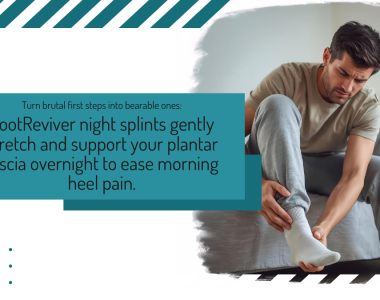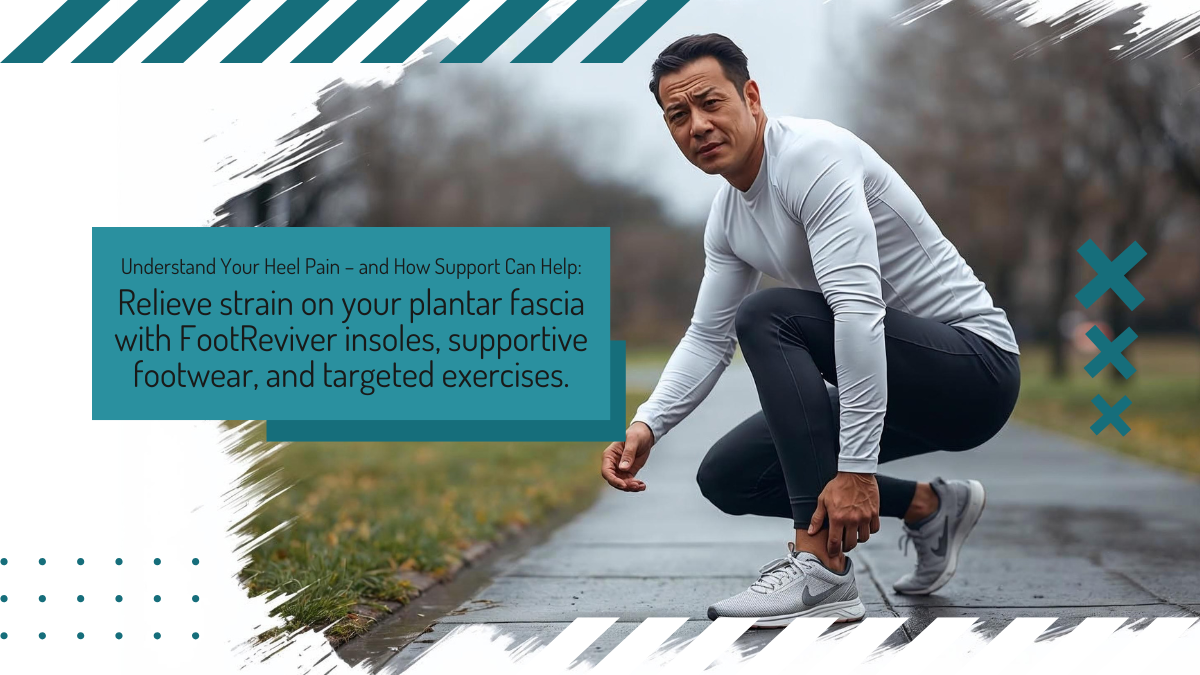
Does that first step out of bed deliver a sharp, shocking pain under your heel? Many describe it as stepping onto a stone or a shard of glass. This jarring sensation often follows a telltale pattern: easing as you move, only to creep back after long hours on your feet—particularly on hard surfaces or in unsupportive shoes.
For many people, this pattern signals irritation of the plantar fascia, the strong band of tissue that supports your foot’s arch. The discomfort typically centers where this band anchors into the heel bone, a spot that can become sore when asked to manage more tension and pressure than it can bear.
This guide walks through that pattern. We’ll explain what is happening within the structures of your foot, which daily habits and footwear choices tend to aggravate it, and how mechanical support can change the way force travels through your heel and arch. Our aim is to help you make sense of your symptoms and show where practical changes, including structured arch supports, fit into a sustainable recovery plan.
Recognising the Pattern of Heel and Arch Pain
Why is my first step in the morning so painful?
That sharp, stabbing pain with your initial steps is a classic sign of plantar fasciitis. Here’s why it happens: overnight, your plantar fascia rests in a slightly shortened position. When you stand and take that first step, your foot naturally lifts and the band under your arch tightens rapidly. This sudden pull concentrates stress on its anchor point at the heel bone. Since the tissue has stiffened overnight, that first strong stretch can feel like a sharp jab.
As you walk more, blood flow increases, the fascia gently lengthens, and the nerves become less sensitive, often turning the sharp sting into a duller ache.
Why does the pain ease with movement, then come back later in the day?
Many people describe this daily cycle: after the painful first steps, movement brings relief. However, as the day progresses and you spend more time on your feet, a deep ache or burning sensation can build under the heel and sometimes into the arch.
This happens because each step applies tension to the plantar fascia. When the band is irritated, the cumulative “load”—the total strain from walking, standing, and pressure—can exceed what the tissue can comfortably handle. If the daily load is too high, you get that familiar rhythm: pain after rest, relief with warming up, and a return of aching once you’ve been active for too long.
Can long periods of standing really cause heel pain?
Absolutely. Jobs that keep you on your feet for long shifts—like in retail, healthcare, or manufacturing—are a strong contributing factor for this type of heel pain, particularly on hard floors. When you stand still:
- The plantar fascia is held under constant, static tension.
- The heel’s natural fat pad is continuously compressed.
- There’s less rhythmic muscle movement compared to walking, so tissues don’t get a chance to recover.
Over hours, this steady strain can leave the heel feeling bruised and sore. Brief sitting may offer temporary relief, but those first few steps after getting up often feel sharp again as the fascia is re-stretched. Shoes without proper cushioning or arch support worsen this by letting the foot collapse and transferring more impact directly to the heel.
What does it mean if I can find one very sore spot under the heel?
Finding a specific, very tender spot when you press under the heel (usually on the inner side) is a key indicator. This point is precisely where the plantar fascia anchors to the heel bone.
When this spot is significantly more tender than the surrounding area and recreates your standing pain, it suggests the anchor point is highly irritated and that repetitive pulling is driving your symptoms. Some people also feel tenderness that extends along the band into the arch, which can occur in longer-standing cases.
Could a recent change in my activity be the cause?
A sudden increase in how much or how intensely you use your feet is one of the most common triggers. Examples include:
- Transitioning from a sedentary routine to long daily walks.
- Rapidly increasing running distance or intensity.
- Starting a job that requires much more standing or walking.
- Taking up a new sport with lots of jumping or sharp directional changes.
The plantar fascia can adapt to greater demands, but it needs time. A sharp uptick in activity suddenly subjects the band to more pulling and compression than it’s accustomed to, which can overwhelm its ability to repair itself between sessions. This overload frequently leads to the cycle of sharp morning pain and persistent aching.
What Plantar Fasciitis Is and Why It Hurts
What exactly is the plantar fascia and what does it normally do?
The plantar fascia is the main band of tissue that supports your arch. It’s a thick, fibrous strap running along the bottom of your foot, connecting your heel to the base of your toes.
This band has a vital role: when it’s healthy, it does two important things:
- It holds your arch up, preventing it from collapsing when you stand or walk.
- It tightens and releases as you move, turning your foot into a stable, rigid lever for efficient, powerful movement.
In a healthy foot, this band stretches and springs back with each step, managing this cycle smoothly and without pain.
So what is plantar fasciitis?
Plantar fasciitis occurs when that band—particularly where it anchors into the heel—becomes irritated and painful. It’s rarely one sudden injury; it’s typically a build-up of small, repetitive stresses over time.
In the earlier stages, the attachment point becomes inflamed and sensitive, and the nerves in the area become more reactive.
If it continues for months, the fascia itself can thicken and its fibers lose elasticity. This makes it less able to handle everyday demands and more likely to flare up when you do a bit more than usual.
What this often feels like day-to-day:
- A sharp, stabbing pain under the heel with the first few steps in the morning or after rest.
- A persistent ache or tightness under the heel or through the arch after prolonged standing or walking.
- Discomfort that feels notably worse on hard, flat surfaces or in unsupportive footwear.
Why does my foot type or arch height matter?
Your basic foot shape can change how the fascia is stressed.
If the arches are on the lower side and the foot tends to roll inwards a lot when you stand and walk:
- The fascia is stretched more and more often.
- The band is pulled tight as the arch collapses with each step.
- Over time that extra stretch can irritate the heel attachment.
If the arches are higher and the foot is quite stiff:
- The fascia can be held in a tighter position.
- The foot may not absorb impact as well.
- Forces are then concentrated in smaller areas under the heel and forefoot, which can make the fascia and the fat pad under the heel work harder to cushion each step.
Neither foot type is “wrong”, but both can increase strain on the fascia in different ways. One of the jobs of a shaped insole, like those in the FootReviver range, is to reduce excessive arch drop in flatter feet and to support a more even spread of pressure in stiffer, higher‑arched feet.
How do tight calves and ankles fit into this?
The muscles at the back of the lower leg (the calf) and the Achilles tendon attach into the heel from above. If they are tight, they limit how far the ankle can bend upwards. During walking and standing:
- When the ankle cannot move easily, the body often compensates by allowing the foot to roll inwards and the arch to fall.
- That rolling movement pulls on the plantar fascia with each step.
- The tighter the calf and Achilles, the more the foot usually has to roll in to make up the movement.
Tight calves do not cause plantar fasciitis on their own, but they are often part of the chain that increases tension through the fascia and keeps the heel attachment irritated. This is why calf stretching is such a common part of treatment.
Does what I do all day really make that much difference?
Yes. The fascia responds to how much and how often it is loaded. Common themes in people with this problem include:
- Long periods standing at work, particularly on hard floors.
- Regular running, especially when mileage or speed has gone up quickly.
- Less structured days spent mostly on the move in very flat, unsupportive shoes.
- A recent change, such as returning to impact exercise after a long break.
In each of these, the band under your foot is being asked to cope with many more pulls and compressions than it was used to before. If that increase comes faster than it can adapt, the heel attachment starts to hurt.
Can body weight play a role?
Extra body weight increases the force passing through the feet with every step. That means:
- The heel fat pad is more heavily compressed.
- The plantar fascia is under greater tension when it supports the arch.
- Any lack of shock‑absorbing footwear or any tendency for the arch to drop has a larger effect.
This does not mean everyone with a higher body weight will get plantar fasciitis. It simply reduces the margin for sudden changes in activity, poor footwear, or long hours on hard ground before the fascia becomes overloaded.
My X‑ray shows a heel spur – is that what’s causing my pain?
It is very common to be told after an X‑ray that there is a “spur” under the heel and to worry that this is the main problem.
A heel spur is a small extra lump of bone that can form where the fascia attaches into the heel. It usually develops over a long period when that area has been under increased pulling force.
Many people have heel spurs visible on X‑ray but no heel pain at all. In plantar fasciitis, the pain almost always comes from the irritated fascia and surrounding soft tissues, not from the spur itself. Treatment therefore focuses on reducing strain on the fascia and protecting the heel, rather than on removing the spur.
So even if a spur is seen on a scan, it is usually better thought of as a sign that the area has been under tension for some time, rather than as the main driver of pain.
Could this pain be something else, like arthritis or a nerve problem?
Other conditions can cause heel pain, and it is worth being aware of them:
- Arthritis in the joints around the heel tends to cause more widespread aching, sometimes in both feet or other joints, and often with a feeling of stiffness.
- Nerve‑related pain is more likely to feel burning, tingling, or electric‑like, sometimes with numbness or altered sensation.
- A stress fracture of the heel bone typically causes deep, constant pain, often very sore when the heel is squeezed from the sides, and can be painful at rest.
- Inflammatory conditions affecting several joints can cause heel symptoms alongside problems in other parts of the body.
If your pain pattern is very different to the typical “first‑step then load‑related” picture, or if there are worrying features such as night pain, marked swelling, redness, warmth, or feeling generally unwell, it is important to have it checked. The next section looks at assessment, red flags, and realistic recovery expectations.
Getting Assessed Safely: Diagnosis, Red Flags, and Recovery Horizon
Who is the best person to speak to about this heel pain?
For most people, the starting point is a General Practitioner. A GP can:
- Take a careful history of how and when your pain started.
- Examine the foot, ankle and leg.
- Rule out many of the more serious causes of heel pain.
If the pattern looks consistent with plantar fasciitis, a GP may manage it directly or suggest seeing:
- A Podiatrist – who specialises in foot mechanics, footwear and insoles.
- A Physiotherapist – who looks at how the whole leg and body move and share load.
In more stubborn or unusual cases, a musculoskeletal or orthopaedic specialist may be involved, usually after referral from a GP or other clinician.
What happens in a typical assessment for heel pain?
An assessment usually has three parts.
First, there is a conversation about your history. You will be asked when the pain started, where you feel it, what brings it on, and how it behaves through the day. Questions often cover your job, hobbies, recent changes in activity or footwear, and any other medical conditions.
Second, there is a hands‑on examination. The clinician will press under and around the heel and into the arch to find the most tender spots. They will check for swelling, warmth or redness, and may gently squeeze the heel from different angles. The shape of the foot and arch will be looked at, along with how flexible the ankle and calf muscles are.
Third, they will usually watch how you stand and walk. You may be asked to stand on one leg, rise onto your toes, or walk up and down. This helps show how much the foot rolls in or out, how the arch behaves, and how forces are being passed up through the leg.
Taken together, this gives a clear picture of whether the plantar fascia is likely to be the main source of pain, and what is driving the extra strain.
Do I need an X‑ray or ultrasound scan?
Not everyone with heel pain needs a scan. If the story and the examination strongly fit plantar fasciitis and there are no worrying signs, the first step is usually to start with non‑surgical treatments such as stretching, footwear changes and insoles, and see how things respond.
Imaging is more likely to be considered when:
- Pain is very severe or has changed rapidly.
- The pattern does not match the usual plantar fasciitis picture.
- There is concern about a stress fracture, infection, or another diagnosis.
In that situation:
- An X‑ray can help rule out bone injury and may show a heel spur, although, as described earlier, spurs themselves are not usually the main cause of pain.
- An ultrasound scan can show if the plantar fascia is thickened and whether there are any other soft‑tissue problems around the heel.
If you are not sent for a scan straightaway, it is usually because your symptoms and examination clearly fit a mechanical plantar fascia problem and a scan would not change the first stages of care.
When is heel pain a sign I should seek urgent advice?
Most plantar fascia‑type pain is not dangerous, but there are certain situations where you should contact a GP or other appropriate clinician promptly. These include:
- Marked swelling, redness, or warmth around the heel or foot.
- Severe pain at rest, or pain that wakes you from sleep.
- Numbness, tingling, burning, or weakness in the foot.
- Sudden, intense heel pain after a fall, jump or other clear injury.
- Heel pain along with fever or feeling generally unwell.
- Pain and stiffness in several joints, or both feet at once, particularly with long‑lasting morning stiffness.
If any of these are present, do not try to self‑manage alone. Seek medical assessment so more serious causes can be ruled out or treated.
How long does plantar fasciitis usually take to settle?
The plantar fascia is a thick, tough structure, and it changes slowly. It is common for recovery to be measured in months rather than days or weeks.
With a consistent plan – stretching, sensible activity changes, better footwear and, where needed, structured insoles – many people notice:
- Some reduction in morning pain within a few weeks.
- Better tolerance of standing and walking over 3–6 months.
- Ongoing but milder twinges that gradually become less frequent.
If the heel has been sore for many months before any treatment starts, or if the underlying issues (for example very tight calves or long shifts on hard floors) are difficult to change, it can take 9–12 months or more for symptoms to settle fully.
Progress is rarely a straight line. Flare‑ups after long days, lapses in stretching, or a sudden jump in activity are normal. The key is whether the overall trend, over several weeks, is towards less intense and less frequent pain.
Will ignoring it cause permanent damage?
Relying on rest alone and making no changes can allow:
- The fascia to become thicker and stiffer, which often makes future change slower.
- The heel to remain sensitive, so smaller loads continue to flare it.
- You to alter how you stand or walk to avoid pain, which can irritate other joints and tissues over time.
In most people, these changes are mechanical and can improve, but they are easier to deal with earlier on. Addressing load, footwear, calf flexibility and arch support sooner rather than later gives the fascia a better chance to settle.
First Steps at Home: Easing Pain and Calming the Tissue
What are the most important things I can do straight away?
There are four main areas to focus on in the early stages.
First, reduce the strain on the fascia. That means cutting back a little on the activities that clearly make your pain much worse – long runs, jump‑heavy classes, or hours of continuous standing – while keeping up some gentle movement. For example, if you usually run five days a week, you might drop to two shorter runs and fill in with cycling or swimming while things calm down.
Second, use cold after heavier use to settle irritation. After more demanding periods on your feet, a wrapped ice pack or a frozen bottle under the heel and arch for 10–15 minutes can help damp down irritation. Always keep a cloth between skin and ice, and leave at least an hour between sessions to protect the skin.
Third, stretch the calf and plantar fascia regularly. Gentle, regular stretching helps reduce the extra pulling force on the heel attachment. A typical starting point is a few rounds of calf and plantar fascia stretches, two or three times per day, within a comfortable range.
Fourth, avoid very flat, unsupportive footwear. Indoors and outdoors, moving out of thin, floppy shoes and into more structured ones immediately reduces arch collapse and heel pounding. This makes each step less provocative for the sore area.
These changes sound simple, but when they are built into each day and kept up over weeks, they create a better background for the fascia to recover.
How exactly should I change my activity?
The idea is not to stop moving completely but to:
- Cut back the sharpest peaks in load.
- Break up very long standing or walking stints.
- Swap some impact exercise for lower‑impact options.
If standing all day at work is unavoidable, look for chances to sit for a minute or two, or at least shift weight and move the ankles during quieter moments. If you are a runner, temporarily shorten runs and add rest days, rather than stopping all exercise.
A simple guide is:
- Mild discomfort that settles within a few hours and does not make the next morning clearly worse is usually acceptable.
- Activity that brings on strong pain and leaves the heel much more tender for the next day is a sign you are doing too much for where the fascia is at that moment.
How do I use ice and frozen bottle rolling safely?
Cold is most useful for short spells after the fascia has been loaded.
Sit comfortably and place a thin cloth over a frozen water bottle. Roll the underside of the foot over it, from heel to forefoot and back, for up to 10–15 minutes. You should feel firm pressure and cold, but not burning or numbness. Alternatively, a wrapped ice pack can be held under the heel for the same period.
Do not apply ice directly to the skin or leave it in place for long stretches, as this risks cold injury.
Which stretches should I start with, and how should they feel?
Two stretches for the calf and one for the plantar fascia are usually enough to begin with.
For the upper calf, stand facing a wall with both hands on it. Put the sore side leg behind you, knee straight, heel on the floor. Gently lean your body forwards until you feel a strong but comfortable pull high in the back of the calf. Hold for 30–45 seconds, then relax and repeat several times.
For the lower calf, start in the same position, bring the back leg slightly closer and bend both knees. Sink your hips down a little until you feel a stretch lower in the calf, nearer the Achilles. Again hold for 30–45 seconds and repeat.
For the plantar fascia, sit and place the ankle of the sore foot across the opposite knee. With your hand, gently pull the toes back towards your shin until you feel a stretch or firm pulling feeling along the arch. Hold for 30–45 seconds, then relax and repeat.
You should feel a firm, tolerable pull in the muscle or band, not a sharp stab in the heel. If you do get sharp heel pain, ease off the force and speak to a clinician for advice on adjusting the exercises.
Can I keep exercising while doing this?
Often, yes – but you may need to adjust what you do and how often.
Lower‑impact options such as cycling, cross‑trainer work, or swimming usually place less direct strain on the plantar fascia. Brisk walking on forgiving surfaces in supportive footwear is often tolerable and can help maintain general fitness. High‑impact activities that trigger sharp pain during, or leave you struggling to walk comfortably the next day, are best reduced for a while.
The aim is to stay as active as you reasonably can, without repeatedly aggravating the fascia faster than it can quieten down.
Where do supports and wraps fit into home management?
Some people use fabric wraps or sleeves around the midfoot and arch to give a sense of support. These can provide gentle compression and a clearer sense of where the foot is as it moves. If they include built‑in straps or panels, they may offer a small degree of extra support under the arch.
They are not a substitute for a structured insole or a supportive shoe, but they can add a bit of comfort, especially when you are barefoot for short periods indoors. For more direct mechanical control of the arch and heel, orthotic insoles such as FootReviver are generally more effective.
Footwear and Surfaces: The Platform Your Foot Works On
How much difference do my shoes really make?
A great deal. Every step you take, whether around the house, at work, or outside, is taken through your shoes. They affect:
- How firmly your heel is held and how much it can tilt.
- How far your arch can drop or roll inwards.
- How well an insole can sit and work inside the shoe.
Supportive shoes do not cure plantar fasciitis on their own, but they can reduce the strain on the fascia with every step. Shoes with very little structure tend to have the opposite effect.
What should I look for in a supportive shoe?
It helps to think about four main areas.
For the heel, the back of the shoe (the heel counter) should feel firm if you press it. When you put the shoe on and fasten it, your heel should feel snug and held, not loose or sliding.
For the arch and midfoot, if you twist or bend the shoe in your hands, it should flex mainly at the ball of the foot, not sag in the middle. A stable midfoot helps stop the arch collapsing excessively, and it gives a solid base for a FootReviver insole.
Under the heel there should be enough sole thickness to soften impact, but not so much very soft foam that the heel sinks and wobbles. On very thin soles you tend to feel every step; on overly spongy soles the foot can become unstable.
Fastening also matters. Laces or straps allow you to snug the shoe around your foot so it moves with you. Loose slip‑ons encourage your toes and fascia to grip to keep the shoe on, which adds strain.
Putting this together, a reasonably firm, laced shoe with a supportive midsole is often a better choice than a flimsy, flat pump or a worn‑out trainer.
Are there shoes I should avoid while my heel is sore?
In the more painful phases it is usually wise to limit:
- Very flat, thin‑soled shoes that offer almost no cushioning or structure.
- Old trainers where the heel is visibly worn down or the sole is twisted.
- Loose slip‑on shoes such as backless slippers or very soft loafers.
- Very high heels that push weight heavily onto the front of the foot and alter how the heel is used.
These types of shoes tend to let the arch collapse more, reduce heel control, and pass more impact straight into the plantar fascia.
Do I really need supportive shoes indoors as well?
In many homes, the flooring is hard – tiles, laminate, or wood. Walking barefoot or in soft, floppy slippers on these surfaces means:
- The heel fat pad takes the direct impact.
- The arch has no support at all.
- The heel bone can tilt more easily with each step.
Over the course of an evening, that can add up to a lot of extra strain on the fascia. Using a dedicated pair of more structured indoor shoes or supportive slippers, ideally with space for a FootReviver insole, can make a noticeable difference to how the heel feels by the end of the day.
How do night splints fit into all this?
Night splints or special socks for plantar fasciitis are designed to hold the ankle and toes in a gently stretched position overnight. The idea is to:
- Stop the fascia from shortening as much during sleep.
- Reduce the sudden stretch it experiences with the first steps in the morning.
Some people find that this helps reduce severe morning pain. Others find the devices uncomfortable or difficult to sleep in. They are best seen as an optional extra, usually considered later on if morning pain remains stubborn, and used alongside the daytime changes in footwear, stretching and support discussed above.
Arch Supports and FootReviver Insoles: Changing the Forces Under Your Foot
How are FootReviver insoles different from simple cushioned inserts?
Soft, flat inserts mainly add padding. They can feel nicer underfoot at first, but they tend to compress quickly, do little to stop the arch from dropping, and rarely change how the heel sits or moves inside the shoe.
FootReviver insoles are designed differently. Across the range, they use:
- A shaped arch section to match and support the midfoot.
- A defined heel cup to cradle and steady the heel.
- A firmer core to hold that shape under body weight.
- Comfort layers on top to soften contact without undermining support.
This means they do more than simply soften the step. They change how your heel and arch are loaded.
How does arch support help the plantar fascia specifically?
When you stand or walk on a flat surface in an unsupportive shoe, the arch can drop further than it needs to and the foot can roll inwards more. Each time this happens:
- The plantar fascia is stretched as the arch flattens.
- The heel attachment is pulled away from the forefoot.
- Tension builds at the sore spot.
The contoured arch in a FootReviver insole is there to limit how far the arch can drop with each step and to reduce excessive inward rolling of the foot. By sharing load through a broader area of the midfoot, it helps stop the band under the foot being pulled as far or as abruptly each time you step, so the heel attachment is subjected to less repeated strain.
What role does the heel cup play?
The deep heel cup found in many FootReviver insoles is designed to hold the heel bone more centrally under the leg, reduce excessive sideways tilt or rolling at the heel, and gather and centre the natural fat pad under the heel bone.
Mechanically, this means:
- The soft fat pad is better positioned to cushion the heel.
- Pressure is spread more evenly under the heel instead of being concentrated on a small, sore area.
- The direction and amount of pull on the fascia’s attachment are more controlled.
People often describe this as feeling more held or stable around the heel, rather than as if they are walking on a sharp point.
Do FootReviver insoles just cushion the heel, or do they change how my foot moves?
They do both, but the change in movement and load distribution is usually more important for plantar fasciitis.
The cushioning in a FootReviver insole helps soften impact, especially on hard floors. The shape and the firmer core guide how your foot sits and moves in the shoe. The heel cup and arch contour together reduce the repetitive stretching and twisting that have been irritating the fascia.
Softness alone rarely solves plantar fasciitis. It is the combination of shape, support and cushioning that tends to make the real difference.
Are off‑the‑shelf insoles like FootReviver often enough, or do I need custom orthotics?
For many adults with plantar fascia‑type heel pain, a well‑designed off‑the‑shelf insole is all that is needed on the insole side. Good ready‑made supports:
- Are shaped around common mechanical issues seen in plantar fasciitis.
- Can be chosen in different sizes and profiles to suit a range of feet.
- Are much more affordable and quicker to try than custom devices.
Custom orthotics – made individually by a Podiatrist after detailed assessment – are sometimes used when foot shape is very unusual, there are several structural issues together, or symptoms have not improved despite good use of supportive shoes, FootReviver‑type insoles, stretching and load changes.
Even then, custom devices are not automatically “better” than good off‑the‑shelf supports for typical plantar fasciitis. Most people will never need custom orthotics. Starting with a well‑designed insole such as those in the FootReviver range is a practical first step.
How do I introduce FootReviver insoles into my routine?
When you first start using structured insoles, it is worth giving your feet a little time to adjust.
A simple approach is to begin with an hour or two of wear in your most supportive shoes during light activities. If that feels comfortable, increase to half a day for a few days. Build towards full‑day use over a week or two, depending on how you feel.
You may notice new pressure points compared with flat insoles, or mild muscle ache in the foot or calf as things start to work a bit differently. These usually settle as your body adapts. If you experience sharp pain, rubbing, or a clear worsening of your plantar fasciitis symptoms, it is worth checking the size, shoe choice, and fit, or seeking advice about whether a different FootReviver model might suit you better.
How long will they last, and when should I replace them?
How long a pair of FootReviver insoles lasts depends on how often you wear them, your body weight, and the types of activities you do in them.
Over time, you may notice that the top cover has flattened or worn through, the insole no longer feels as supportive under the arch, the heel cup does not feel as firm or defined, or heel pain begins to creep back despite no change in your activity. These are signs the insole is no longer providing the same level of support and may need replacing.
Many people find they need a new pair after several months to a couple of years, depending on the intensity of use.
Will using FootReviver insoles weaken my feet?
There is no good evidence that wearing appropriate arch supports causes the muscles of the foot to become weak. In fact, by calming an irritated fascia, FootReviver insoles can make it easier for you to do strengthening and flexibility exercises properly. They help you stand and walk more comfortably, so you can stay more active overall.
The best results usually come when insoles and exercises are used together – the insoles reduce excessive strain on the fascia, and the exercises help the muscles and joints cope better with day‑to‑day demands.
Rehabilitation and Advanced Non‑Surgical Treatments
When should I think about seeing a Physiotherapist?
It is worth seeking Physiotherapy if:
- You have put consistent effort into self‑care, footwear and FootReviver insoles for several weeks and things are not moving in the right direction.
- Pain is stopping you from doing essential daily tasks or work.
- You can feel clear stiffness, weakness or imbalance in the leg or hip.
A Physiotherapist can assess how your whole leg and trunk are contributing to the way forces reach the heel, spot issues such as weak calf muscles, poor hip control or stiff ankles, and design an exercise programme to tackle these.
What does Physiotherapy usually involve for this type of heel pain?
Physiotherapy often combines strengthening, control work, flexibility and pacing advice.
Strength work may include heel raises, controlled lowering from a step, and exercises to strengthen the small muscles inside the foot. Balance and control training might start with standing on one leg and progress as you improve. Stretching programmes are often adjusted over time as your calf and fascia flexibility change. Guidance on pacing helps you plan walking, running or sport in a way that allows the fascia to adapt rather than flare.
The aim is not to replace the support from footwear and insoles, but to help your body work better with them.
Where do injections fit in?
Some clinicians may discuss steroid injections around the heel in cases where pain is severe and ongoing, and non‑surgical measures have been used properly for a reasonable period but symptoms remain very limiting.
A steroid injection can reduce local inflammation and pain for a period of weeks or sometimes months and make it easier to stretch and strengthen during that window. However, it does not address the underlying mechanical issues such as poor footwear or tight calves. It can occasionally cause a short‑term flare in pain, and repeated injections in the same area are usually avoided because of a small risk of weakening the fascia.
Decisions about injections are made with the prescribing doctor, taking into account your overall health and goals. They are not provided by FootReviver.
What about shockwave therapy or platelet‑rich plasma?
Extracorporeal Shockwave Therapy (ESWT) involves directing pulses of energy through the skin to the sore area. It is usually considered when pain has been present for many months and a good period of stretching, insoles, footwear changes and Physiotherapy has already been carried out, but symptoms remain stubborn.
Some people notice gradual improvement over a series of shockwave sessions; others do not notice much change. It is most often used alongside ongoing conservative treatment, not in isolation.
Platelet‑rich plasma (PRP) injections involve injecting concentrated platelets from your own blood around the fascia in an attempt to stimulate healing. Evidence for PRP in plantar fasciitis is mixed, and it is not usually something that is tried early on. It is generally considered only in specialist settings after more established measures have been tried.
These more advanced treatments, where they are available, are planned and carried out by specialist clinicians. FootReviver’s role is on the conservative, mechanical side of managing load and support.
Staying on Top of It: Long‑Term Habits and Preventing Recurrence
Once my heel settles, how do I stop it flaring again?
When pain starts to ease, it is tempting to drop all the things that helped and assume it is fixed. In reality, the tendencies that stressed the fascia in the first place – such as tight calves, long time on hard floors, or very flat shoes – often remain.
To reduce the chance of the pain returning it usually helps to:
- Keep a lighter version of your stretching routine going, perhaps a few times a week.
- Replace shoes before they become very worn or lose their structure.
- Use FootReviver insoles for days you know will involve a lot of standing or walking, or for impact exercise.
- Increase any running or sport gradually rather than in big jumps.
These small, ongoing choices make it easier for the fascia to cope without frequent flare‑ups.
What does a long‑term exercise routine look like?
In the long term, exercises usually shift from a daily focus on pain relief to a less frequent focus on maintenance. For example, you might keep a couple of sessions per week of calf stretching (both straight‑ and bent‑knee), use occasional plantar fascia stretches after busier days, and continue strengthening such as heel raises and balance work, progressed to a level that feels appropriately challenging.
The goal is to keep the band under your foot and the calf from tightening up again, and to keep the supporting muscles strong enough to help share load.
Where do FootReviver insoles fit in once things are better?
Think of them less as a temporary fix and more as part of your long-term strategy to keep your feet feeling good. Once the sharp pain is gone, that consistent support helps prevent the issue from creeping back.
Many people find it makes sense to keep them in their everyday shoes—the ones you wear most for work, walking, or daily life. For running or sports, they’re excellent for managing that higher impact comfortably.
You may not need them on short, easy days, especially if you keep up with your stretching and strength work. The best guide is your own comfort. Pay attention to how your heel feels with and without them, consider what your day demands, and notice how supportive your shoes are on their own.
There’s no single rule. It’s about listening to what your feet tell you and letting that guide your support. For many, that means making them a regular part of the routine, because that steady support is what helps maintain progress for the long run.
Can managing my weight or activity level help?
Yes.
For activity, the key is to introduce movement gently. If you’re recovering, the goal isn’t to push for intensity. Instead, focus on slowly increasing your walking, running, or standing time. This allows the plantar fascia to adapt without causing a flare-up, turning movement into part of the healing process.
For weight, aim for sustainable, manageable change. Even modest, consistent shifts here can meaningfully lower the impact force that travels through your heel with each step you take.
Together, they address the load on your feet from two sides. Gentle activity helps your tissues adapt and get stronger under the current load. Managing your weight sustainably works to reduce that load from the ground up. Over time, they create a positive cycle, each making the other more effective.
Ultimately, these two strategies form a powerful foundation for progress—creating the conditions that allow your body to strengthen while gently reducing the demands placed on it.
Rare Severe Cases: When Surgery Is Talked About
What counts as “persistent” plantar fasciitis?
Surgery is not part of the usual pathway for most people with heel pain. Plantar fasciitis might be called persistent if:
- Pain has been present for many months or longer.
- It remains clearly limiting daily life despite a proper period of stretching, FootReviver‑type insoles, supportive footwear, load management and, often, Physiotherapy and possibly shockwave therapy.
Even then, many people continue to improve slowly over time without surgery.
When is surgery discussed?
Only a small minority of adults reach the point where a specialist raises surgery as an option. This generally happens when:
- Heel pain is still severe and disabling after many months of consistent non‑surgical treatment.
- Other causes of pain have been carefully ruled out.
- The plantar fascia is clearly identified as the main ongoing source of symptoms.
At that stage, a foot and ankle specialist may explain the potential benefits, limitations and risks of surgery as part of a one‑to‑one consultation. It is never a first step.
What does surgery aim to do, in simple terms?
Operations for plantar fasciitis broadly aim to reduce the amount of constant tension and pulling through the fascia and to change how forces pass through the heel to make the area less irritable.
Surgery brings its own recovery period and risks, and even afterwards, supportive footwear, insoles and exercises usually remain important. For these reasons, the focus for most people remains on doing as much as possible with conservative care before surgery is even considered.
How Can FootReviver Insoles Fit Into My Recovery?
Why consider FootReviver insoles if I recognise this pattern of pain?
If your heel pain matches the picture described earlier – sharp with first steps after rest, aching with long periods on your feet, and worse in very flat or worn shoes – then the band under your arch is likely being pulled and loaded more than it can currently cope with.
The steps described in this guide work together:
- Activity changes and stretching reduce how hard the fascia is being pulled.
- Supportive shoes reduce how much the heel and arch move with each step.
- FootReviver insoles add a shaped arch and a steady heel cup inside those shoes, so the forces reaching the sore attachment are more controlled and spread out.
- Strength and balance exercises help the muscles around the foot and leg share more of the work over time.
Using a structured insole such as FootReviver in the shoes you rely on most on hard floors – for example work shoes, main walking shoes or trainers – is a practical way to start reducing the strain on the fascia in day‑to‑day life.
When should I still seek medical advice?
FootReviver insoles help with the mechanical side of plantar fasciitis, but they do not replace medical assessment. You should speak to a GP, Podiatrist, Physiotherapist or other suitable clinician if:
- Your heel pain is severe, rapidly worsening, or present even at rest or at night.
- There is swelling, redness, warmth, numbness, tingling or weakness in the foot.
- Several joints are painful or stiff, or you feel generally unwell.
- Symptoms do not begin to shift at all despite several weeks of thoughtful self‑care and mechanical support.
This blog provides general guidance. It is not a substitute for individual assessment and advice. FootReviver insoles are designed as part of conservative care to reduce mechanical strain on the plantar fascia and support your comfort alongside appropriate clinical input where needed.