
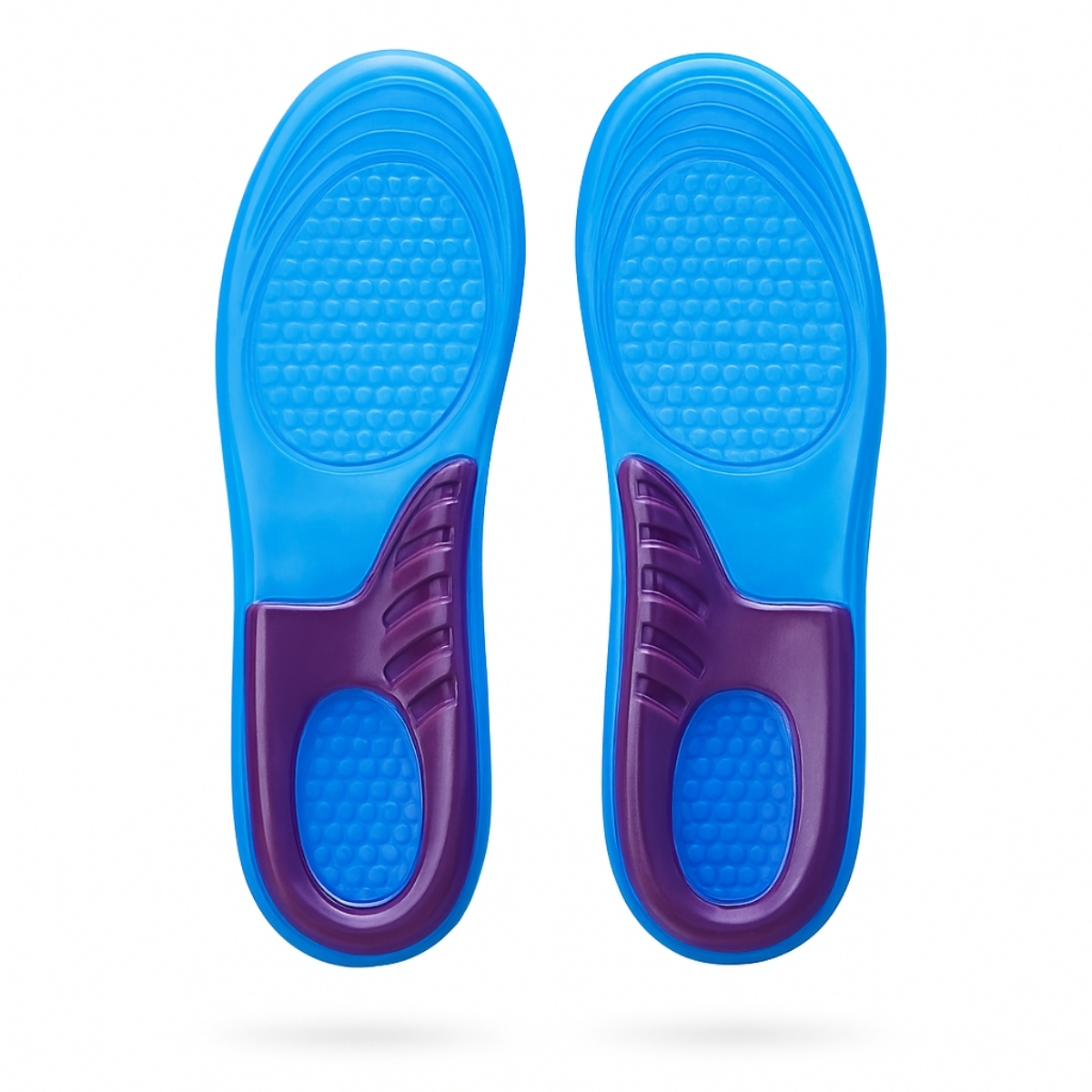
Massaging gel insoles
£10.99
- One pair of Shock Absorbing Massaging Gel Insoles, designed to be worn inside everyday shoes
- Aimed at adults with soreness under the ball of the foot, along the arch, or around the heel after standing and walking
- Adaptive silicone gel that moulds to the underside of your foot rather than staying rigid
- Targeted forefoot cushioning that spreads load across the ball of the foot rather than letting it land on one tender spot
- Conforming arch support that fills the space under the midfoot, so the arch does not have to collapse as far before it meets resistance
- Shaped heel cup with a shock-absorbing pad to soften the moment of heel strike
- Breathable, moisture-wicking top layer to help keep the foot cooler and drier inside the shoe
- Worn inside your shoes while you stand and walk, not against bare feet before your shoes go on
- Two UK sizes, 6–9 and 8–12, both trim to fit a little at a time
- Check the size against your usual UK shoe size before trimming anything
- Easy to wipe clean between wears and built to last through daily use
- If the shoe feels crowded once the insole is in, take the shoe’s own removable insole out to make room
- Speak to a clinician if pain persists or you notice new or unexplained symptoms
Relieving everyday foot pain with shock absorbing gel insoles
If you have started to notice a bruised feeling under the ball of your foot, tired arches, or a sharp ache in the heel, you may feel one of those three before the others. Foot pain usually builds gradually rather than appearing all at once. It might come on after a long shift on your feet, a regular daily walk, or a training session, then ache through the evening. For some people it makes shoes feel less comfortable than they used to. For others it is a sharper pain that changes the way you walk and makes ordinary movement feel like effort.
Foot pain rarely stays neatly in one place. A sore foot changes how you move, often without you noticing. You shift your weight, take shorter steps, or hold the foot differently to protect the sore spot. That eases the pressure briefly, but it also changes how your leg and back take load, which simply means the force they have to carry. Those changes are what turn a local problem into a wider one.
So it helps to know where that load is going as you stand and walk, and whether your foot is being asked to absorb more of it than it can comfortably manage. Once that is clear, a supportive insole makes sense.
Why foot pain can spread beyond the foot
The sequence of one step
Walking looks simple, but it is a repeated physical sequence. Clinicians call it the gait cycle, which simply means one full step: from the moment one heel meets the ground to the moment that same heel meets the ground again. Each cycle has two halves. There is the stance phase, when the foot is on the ground taking your weight, and the swing phase, when the leg is travelling forward through the air. Nearly all of the loading happens in stance. Within that loaded half, the heel lands first, the foot takes your body weight, that weight rolls forward through the sole, the arch compresses and springs back, and the ball of the foot pushes off to send you into the next step. Each part of the foot has a job, and every step asks it again.
One detail catches most people out. The force passing through your foot as you walk is greater than your standing body weight. Each step involves your body arriving on the ground and then pushing away from it, and both of those add to the load the foot carries. The increase is modest, but it happens hundreds of times on an ordinary day. On a hard surface, nothing in the ground gives to absorb any of it, so the cushioning has to come from your shoe and from the foot itself. That is the core reason why a long walk on pavement can leave the sole of your foot feeling sore in a way that the same distance on a softer path does not.
The foot is often described as the first link in the kinetic chain. The kinetic chain simply means the connected line of joints and muscles running from the foot and ankle up through the knee and hip into the lower back. These parts do not work in isolation. They pass load and movement along the line, so a change at the bottom of the chain is felt further up, and a change higher up can alter how the foot lands.
How a sore foot changes how you walk
A common pattern shows how this works. You develop a sore spot under the ball of the foot, so you start to walk more on the outer edge or take shorter steps, cutting short the push-off that hurts. That takes pressure off the sore spot, which is a natural instinct. But it also changes how your ankle, knee, and hip are loaded with every step, and the calf usually ends up working harder to produce a push-off the foot is now avoiding. Over hundreds of steps a day, that altered pattern can leave the calf feeling tight, the knee feeling achy on stairs, or the lower back stiff by evening. The original problem sits in the foot, but the consequences travel up the leg.
Once a spot is sore, the problem can carry itself forward. You move more guardedly to protect it, that altered pattern loads other tissue harder, and the whole foot becomes less efficient, so the aching can spread even though the original irritation has not.
Why the pain keeps coming back
How much load a tissue can take before it becomes irritated is called load tolerance. The structures in your foot adapt to what you regularly ask of them, but that adaptation needs recovery time between demands. A walk that felt easy last month can start to feel like too much if you have been doing more of it, or doing the same amount in less supportive shoes, without enough recovery in between. That is why pain often creeps up on people who have not changed much about their week.
Why rest alone rarely clears it
Taking weight off an irritated foot for a while can ease soreness, and sitting down when your foot is sore helps. But rest alone rarely solves the problem. When you sit, the foot is unloaded and the band under the sole and the calf both shorten. Stand up again and full body weight returns all at once, before either has had a chance to adapt. That sudden return of load is why the first steps after a sit-down or after getting out of the car often feel the worst, and why symptoms can ease during activity only to return once you stop. Support inside the shoe helps during the walking part of your day, once you are up and in footwear. The insole is not designed to be worn before your feet touch the floor, and it will not stop a stiff foot feeling stiff after a long rest. What it does is make the walking you do during the day less sore.
What happens when foot pain is left alone
When irritated tissue is never given long enough to recover between demanding days, it can stay in a low-level state of irritation that never quite resolves. What usually happens is quieter than a dramatic flare-up: the bad days come round more often, walks that used to be easy start to wear you down, and you find yourself planning your day around your feet. That pattern is easier to interrupt early than late.
How pacing helps
Spreading your walking and standing more evenly across the day, rather than cramming it into one long block, is often called pacing. It is one of the simplest ways to give sore tissue a fair chance to recover while you keep moving.
Why an insole can be a sensible support
Before the insole, the shoe. The shoe changes the load as well. Footwear that is tight across the forefoot concentrates pressure into one small area, and a stiff sole with little give underneath forces the foot to absorb more of the shock of each step itself. Soles also wear down and lose cushioning with use, so a shoe that felt supportive a year ago may not be doing the same job now. This is one of the most overlooked reasons why pain seems to appear out of nowhere when nothing else has changed: the shoes changed, just gradually enough that you stopped noticing.
An insole is a straightforward idea. It is a layer that sits inside your shoe, between your foot and the sole of the shoe. A well-designed insole adds cushioning, spreads pressure across a wider area rather than letting it gather in one painful point, absorbs some of the shock of walking, and gives the arch and heel something more supportive to rest on.
The midfoot is the section between the heel and the ball of the foot, and the forefoot is everything in front of it, including the toes. What makes an insole useful is the way pressure works in the foot. Your body weight does not spread evenly across the whole sole as you walk. It travels through the foot, momentarily loading the heel at landing, then the midfoot as you pass over it, then the forefoot at push-off. If one of those areas is already sore, that passing load is the part that hurts, and it hurts most on hard ground because the surface gives nothing back. Adding a softer, shaped layer under the sole widens the area that weight passes through and takes the sharpest edge off each impact. It is a modest mechanical change, but it is the kind that adds up over a full day of steps.
The other thing an insole can do is limit how far the foot sinks or rolls inside the shoe. If your arch collapses heavily under load or your ankle rolls inwards, a supportive layer under the midfoot gives the foot something firmer to press against. That shortens the distance the arch travels before it meets resistance, which can make a long stand in a queue or a long walk round a shop feel steadier rather than wobbly.
Because these problems sit in different parts of the foot, the insole supports the forefoot, arch and heel together rather than cushioning one point. The sore spot is rarely the only part taking strain.
An insole cannot diagnose anything, correct the structure of your foot, rescue a badly fitting shoe, or replace advice from a GP, physiotherapist, or podiatrist. What it offers is practical, everyday support for feet that are sore through standing and walking. It also fits around your existing routine: you put it in your shoe in the morning and it works while you get on with your day, with nothing extra to remember.
How these gel insoles are designed to help
You will see the word massaging in the product name. Here it refers to the soft, yielding feel of the gel underfoot rather than any active massage action, so read it as a description of the texture, not a treatment. What follows is how the cushioning and the pressure distribution are put together, feature by feature.
The main layer is adaptive silicone gel, a soft material that moulds to the underside of your foot rather than staying rigid. Under your weight it changes shape to match your sole, so contact is even rather than pressed into one point, and the load is shared across a wider footprint. It cushions the forefoot, where the ball of the foot carries a high load at push-off, and the heel, where the shock of each step passes up into the leg.
The forefoot area has targeted cushioning. At push-off your weight rolls onto the ball of the foot, so the same small area takes a concentrated burst of pressure hundreds of times a day, and if it is sore, every step can feel like a small bruise being pressed. The gel there widens the area that pressure passes through, so the load is shared across the forefoot rather than landing on the single point that hurts, and the highest force at that moment of each step is lower. For a forefoot that flares up after a long day of standing or a brisk walk on hard pavement, that can mean a longer stretch on your feet before the ache starts to build.
The arch support conforms to the shape of the foot. A healthy arch flattens slightly under your weight and recoils as you push off, which returns a small amount of energy with each step. When the arch sits low or collapses too far under load, it loses some of that recoil, so each step costs slightly more muscular effort than it should. A supportive arch fills the space under the midfoot so the arch does not have to sag as far before it meets resistance. Pressure that would have pressed down through a small area of the inner arch is then shared between the support and the ligaments and small muscles under the foot. The aim is not to force your foot into a different shape. It is to support the foot you already have as it takes load during walking, so you feel more settled on your feet and less tired.
The heel has a shaped cup and a shock-absorbing pad. The cup cradles the heel and helps stabilise the area around the Achilles tendon, the strong band at the back of the heel, while the pad softens the moment the heel meets the ground. The heel is normally the first part of the foot to make contact, and it meets the ground with the whole of your body weight arriving in an instant. If the heel is sore, a softer landing takes the edge off the start of every single step, and the cup around the sides of the heel reduces the small amount of side-to-side wobble that can tug on the tendon as you walk. That steadier hold is often more noticeable on stairs and uneven ground than on the flat.
The top layer is breathable and moisture-wicking, which means it helps move moisture away from the skin rather than holding it close. That keeps the foot cooler and drier inside the shoe. A drier foot rubs less, and less rubbing may help reduce the chance of blisters. That is a small side benefit rather than the main purpose, but a real one if you wear the insoles through long shifts.
The insoles suit daily wear and slot easily into everyday shoes. They come in two UK sizes, 6–9 and 8–12, and both are trim-to-fit so you can adjust the edges to suit the shape of your shoe. The fit needs some care, because the insole only works where it makes contact. It should sit flat, with no bunching under the arch or at the heel, since a bunched insole creates its own pressure points and can make a well-designed cushion feel worse than no cushion at all.
Matching the insoles to common foot patterns
The same insole helps for slightly different reasons depending on where your pain sits, because different parts of the foot are strained in different ways. These are the patterns the design is aimed at.
Forefoot pain: metatarsalgia and Morton’s neuroma
The two feel different, so the sensation is the place to start. Metatarsalgia is usually felt as a bruised, hot patch under the ball of the foot, as though you have walked on a stone and the tenderness has stayed behind. It comes on with time spent on your feet and eases when you sit down and take the weight off. Morton’s neuroma is a nerve-related pain in the forefoot, and it tends to feel sharper or burning, sometimes with a feeling that something is caught between the toes. It often eases quite quickly once you take the shoe off, because it is the squeeze of the shoe that provokes it rather than the load alone.
Where the pressure lands is what separates them. At push-off, your weight rolls onto the ball of the foot and passes through the heads of the long bones behind the toes. With metatarsalgia, that load lands on the row of bones hundreds of times a day and the tissue over them becomes tender. In Morton’s neuroma, a small nerve running between two of those long bones is being pinched as the bones press together, which is why a narrow shoe provokes it so sharply and why taking the shoe off relieves it faster. The targeted gel cushioning widens the patch that pressure passes through, so the load is shared across the whole forefoot instead of settling on one tender part, and the gel gives that area something softer underneath. Walking to the shops or standing through a long queue may feel less like a run of small impacts, and the ache afterwards may take longer to arrive.
Pronation: overpronation and underpronation
Pronation is the foot’s natural inward roll just after the heel lands. Some roll is normal and helps the foot absorb shock. Too much is overpronation, and too little is underpronation, which keeps the foot more on its outer edge. Pronation problems often show up in your shoes before they cause pain. If the inner edge of your sole wears down far faster than the outer, your foot is probably rolling in too far. If the outer edge wears fastest, it may be rolling in too little. Overpronation loads the inner side of the foot and ankle, and it can leave an ache along the inside of the arch or up the inner ankle after a longer walk. Underpronation asks the outer edge to absorb more shock than it is built for, which tends to show up as soreness along the outside of the foot and a jolting feeling on hard ground.
The question is where the load ends up. When the foot rolls in too far, the arch collapses and the inner ankle takes strain that the arch and midfoot would normally share. When it rolls in too little, the foot stays rigid and passes impact straight up the leg instead of softening it. A supportive layer under the midfoot gives the foot something to roll against, so it reaches the end of its inward roll slightly earlier and with less collapse, while the cushioning under the heel and forefoot takes the hard edge off the landings that an underpronating foot cannot soften for itself. Together that gives the foot a steadier base as it moves through each step.
Midfoot strain: flat feet or fallen arches
Arch pain tends to feel more like tiredness than sharpness, which is why people often describe it as their foot giving out by the afternoon rather than hurting in one place. It sits along the inner side of the midfoot, and it often arrives after hours of standing on hard floors, or after a day carrying shopping, where the extra weight goes straight down through the arch. With flat feet or fallen arches, a foot whose arch sits lower or collapses more under load than it does at rest, the midfoot is doing more work than it is comfortable with, and the small muscles and ligaments that hold the arch up are being asked to hold it for hours at a time rather than sharing the work with the bony arch above them.
That strain does not stay local. A foot that flattens under load turns the shin and knee slightly inward, and that can show up as tiredness in the knees, hips, and back by the end of the day. The conforming arch support gives the midfoot a lifted feel so the arch is not left to collapse the whole way before something stops it. It fills the gap beneath the arch, which takes some of the load off the muscles and ligaments that have been holding the arch up all day, and helps body weight spread more evenly across the sole. For a long day on your feet, that can mean reaching the evening with less of that ache along the inside of the foot.
Heel pain: plantar fasciitis and Achilles tendinitis
Heel pain has a recognisable rhythm. The worst steps are usually the first ones after sitting, resting in bed, or getting out of the car, because the tissue has stiffened while unloaded and load returns all at once. The pain often eases as you get moving, then builds again by the end of the day. Plantar fasciitis is irritation of the plantar fascia, the thick band of tissue running under the sole from the heel towards the toes, and the pain is usually felt under the heel towards the inside. Achilles tendinitis involves irritation of the tendon at the back of the heel, and the pain tends to sit at the back of the heel or just above it, where the tendon narrows.
What separates the two is not so much which task brings them on, since stairs and slopes can aggravate either, but which position of the foot loads the irritated tissue. The band under the sole is pulled when your toes bend back and your arch flattens, which is what happens as you move your weight forward over the foot. The tendon at the back is loaded when your ankle bends upward and your shin travels forward over your foot, which happens with every step, on stairs, and on any slope. Knowing which of those positions matches your pain tells you which part is irritated, and it also tells you why the shoe and the surface can change how much you feel it.
The heel cup and pad work on both. Absorbing shock at landing and holding the heel steady inside the shoe reduces the repeated tugging on the tendon, and the softer landing also spares the band under the sole the sharpest part of each impact, which is often the moment it hurts most. Worn inside your shoes once you are up and moving, they may help make the walk from the car park or the trip upstairs feel steadier.
Getting the fit right
Choose the size that matches your usual UK shoe size, either 6–9 or 8–12. If you are between sizes, or your shoe is on the narrow side, trim to fit. Trim a little at a time and check before cutting further, because you cannot add material back on. Place the insole flat in the shoe with the heel cup sitting at the back and the forefoot cushioning under the ball of your foot, then run a finger around the edge to confirm it is not curled or rucked up anywhere. If the shoe feels crowded once the insole is in, take the shoe’s own removable insole out to make room. A smooth, flat fit supports you far better than an insole forced into a shoe that is too tight.
The insoles go in the shoes you already walk in, so wear them as part of your usual routine. They wipe clean easily, which keeps them fresh between wears. If they feel unfamiliar for the first day or two, give yourself a short while to adjust rather than assuming they are wrong. A supportive feel is right; sharp pressure is not. If a spot rubs or presses, take the insole out and check where it sits before deciding they are not for you.
What to expect
With consistent use, the first change you are likely to notice is that pressure under the ball of the foot feels less concentrated, and the heel does not jar quite so much when you walk. The arch may feel more supported, and you may feel more settled on your feet. You will probably notice it most on the days you are on your feet longest, since that is when the load is highest and the difference between a cushioned shoe and an uncushioned one is easiest to feel. How much you notice, and how soon, varies from person to person, and depends more on your foot, your shoes, and your daily routine than on anything else.
These insoles are a support tool, not an instant fix. They change how load passes through the foot while you are wearing them. They work best alongside well-fitting footwear and a bit of rest when your foot is particularly sore. They do not replace an assessment and they do not promise a dramatic overnight change. The realistic aim is simpler than that: to make the standing and walking you already do feel more comfortable, so the ordinary parts of your day stop being something you brace yourself for.
When to seek help
Most foot soreness tied to standing and walking eases with better footwear, steady pacing and time. Some things deserve a closer look, because they point to something other than the everyday strain of standing and walking:
-
- sudden severe pain, particularly after a knock, twist, or fall
-
- new or unexplained swelling, or a change in colour or temperature in the foot that does not resolve
-
- numbness, tingling, or weakness that is spreading or getting worse
If foot pain is persistent, getting worse, or you have new or unexplained symptoms, speak to a GP, physiotherapist, or podiatrist. If you are unsure whether these insoles suit your foot, or a problem is not easing despite well-fitting footwear and support, ask a clinician for advice. Better to get the right assessment than to keep pushing through pain.
A sensible next step
If standing and walking have started to leave the ball of your foot, your arch, or your heel sore, the load is landing somewhere it cannot comfortably cope with, and a cushioned, shaped layer inside the shoe is a practical way to change that. Check the size against your usual UK shoe size, trim only a little at a time, and wear them in footwear that already fits well. Pair that with rest when your foot is sore, and seek advice if pain persists. Small, steady changes like these are often what makes everyday movement feel manageable again.
Disclaimer
This information is general guidance and is not a substitute for individual medical advice, diagnosis, or treatment. It is intended for adults in the UK. If you are unsure whether these insoles suit your feet, or if you have more complex, new, or unexplained symptoms, speak to a GP, physiotherapist, podiatrist, or another appropriate clinician for advice tailored to you. No particular outcome is guaranteed.
Additional information
| Size | 6-9, 8-12 |
|---|


Reviews
There are no reviews yet.