


Gel Orthotic insoles for Morton’s Neuroma
£9.99£12.99 (-23%)
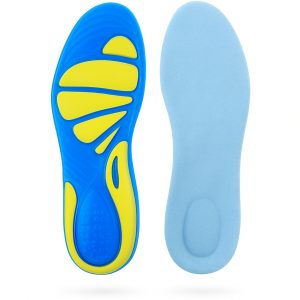
- Pair of full‑length gel orthotic insoles designed specifically to help with Morton’s neuroma and pain in the ball of the foot.
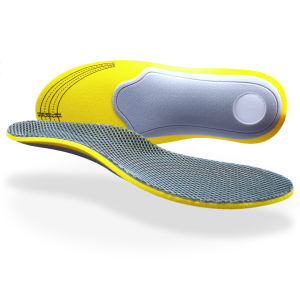
- Shock‑absorbing gel from heel to toe, combined with a supportive 3/4‑length plastic chassis, to soften impact and stabilise the foot with each step.
- Extra‑resistant heel and forefoot pads under the main pressure zones to give added protection where the heel strikes and where you push off through the toes.
- Contoured arch support and rearfoot stability to help limit excessive rolling in or out of the foot, which can overload the forefoot and aggravate neuroma.
- Suitable for adults with Morton’s neuroma, forefoot pain, or underlying issues such as flat feet, high arches, overpronation or supination.
- Trim‑to‑fit design in a range of UK sizes, so you can shape the insoles to sit smoothly inside everyday shoes, work shoes and casual trainers.
- Supportive alignment and cushioning may help ease strain up through the ankles, knees, hips and lower back during standing and walking.
- 30‑day money‑back guarantee, so you can try them in your own footwear with confidence.
FootReviver Gel Insoles for Morton’s Neuroma
Morton’s neuroma can turn ordinary walking into something you have to think about. A short walk on a hard pavement, a long day in work shoes or standing for long periods in one place can all end with the same type of pain: burning under the ball of the foot, tingling into the toes, and a sense that there is a small stone trapped under the front of the foot.
This page explains what is happening in the front of the foot when a neuroma develops, why certain feet and shoes make it worse, and how this particular FootReviver gel insole changes the way weight passes through the heel, arch and ball of the foot to give that irritated nerve a calmer, better‑supported experience with each step.
Morton’s neuroma – what it is and how it tends to feel
If you have burning or sharp pain under the ball of your foot between the toes, there is often a small nerve in that area that has become thicker and more sensitive. That is what is meant by Morton’s neuroma.
A Morton’s neuroma usually involves one of the small nerves that run between the long bones in the forefoot (the metatarsals). The most common site is between the bases of the third and fourth toes. Over time, repeated irritation causes that nerve and the soft tissue around it to thicken. The space it sits in becomes tighter and the nerve reacts more strongly to pressure and rubbing.
People often describe:
- A sharp, burning or electric‑type pain in the ball of the foot, usually between the third and fourth toes
- A feeling of standing on a stone, a crease in the sock or a small lump that is not actually there
- Tingling or “pins and needles” in one or more toes, sometimes followed by numbness after longer periods on the feet
- Pain that settles when shoes are taken off or loosened, then comes back once walking starts again
At first, this may only appear in narrower or higher‑heeled shoes, or after longer walks. As the nerve becomes more irritable, the same pain can appear earlier in the day, with shorter walks, and sometimes even when you are resting after a busy spell on your feet.
General soreness under the ball of the foot is often felt directly under one or several bones. Neuroma pain is more often described as sitting between the toes, with a sharper, sometimes electric or tingling quality. That difference can help distinguish a neuroma‑type problem from more general forefoot bruising.
What is going on inside the front of the foot
In simple terms, each step starts with the heel, rolls through the arch and finishes at the ball of the foot and toes.
At the front of the foot, the heads of the metatarsal bones form the ball of the foot. Between each pair of metatarsals there is a small space containing a nerve and soft tissues. The nerve that develops into a Morton’s neuroma usually sits in one of these spaces.
The nerve does not simply float in a gap between the bones. A strong band of tissue runs across the front of the metatarsal heads (the deep transverse intermetatarsal ligament), so the nerve sits in a small tunnel with bone underneath and this ligament over the top. When the toes bend and the metatarsal heads press down, that tunnel narrows and the thickened nerve can be caught between the bone and the ligament.
For that nerve, three things now matter on every step:
- How close together the metatarsal heads are
- How much of your body weight is pushed into the ball of the foot
- How sharply the toes bend at their base joints (the metatarsophalangeal joints)
As you roll forwards and push off, the metatarsal heads press down and the toes bend upwards. If the bones are already close together, or the sole under the ball of the foot is hard and thin, the thickened nerve is repeatedly squeezed and rubbed between the metatarsals and the ligament above. That repeated squeezing (compression) and rubbing (shear) produces the familiar burning, sharp or “stone‑under‑the‑foot” sensations.
This is often worse when:
- The front of the shoe is tight or pointed and pushes the metatarsals together from the sides
- The heel is raised, sending more of your body weight forwards into the ball of the foot
- The sole under the forefoot is thin and firm, passing impact straight into the metatarsal heads and soft tissues
On hard floors, a very thin or rigid sole gives the tissues under the ball of the foot almost no chance to spread the force out before it reaches the nerve. Over months and years, the nerve can become so reactive that even modest loads – a short walk on a hard surface or a spell standing in one spot – are enough to set it off.
Why some feet are more likely to develop a neuroma
Not everyone who spends long hours on their feet develops Morton’s neuroma. Two people can do similar work and wear similar shoes, yet only one ends up with this type of nerve pain. The difference often lies in how their feet are shaped and how they move.
A few common patterns include:
Feet that roll inwards and flatten
When the heel rolls inwards and the arch drops more than it naturally would, more weight drifts towards the inside of the foot. As this happens, the front of the foot twists slightly and some of the metatarsal heads press closer together. The space where the neuroma nerve sits becomes tighter. Each time the toes bend, that already narrow, slightly twisted tunnel closes again around the nerve.
Feet with higher, stiffer arches
In a high‑arched, less flexible foot, the middle of the foot does not come down to meet the ground as readily. The midfoot plays a smaller role in carrying load. Weight can pass more quickly from heel to forefoot, and the foot may roll a little outwards, focusing pressure on a smaller part of the ball of the foot. The metatarsal heads and any nerve between them then absorb a sharper, more concentrated load.
Footwear that squeezes or overloads the forefoot
Shoes with a tight or pointed toe box push the toes together. In a tighter toe box, the metatarsal heads start closer together, so it takes less bending of the toes and less time on your feet before the nerve tunnel narrows enough to make itself felt. Higher heels throw more body weight forwards onto the ball of the foot. Thin, rigid soles offer little cushioning. Even with a fairly normal foot shape, this combination of side‑to‑side squeeze, forward weight shift and hard contact under the ball of the foot can irritate a nerve that sits between two metatarsals.
Neuromas are particularly common in people who spend long hours on firm floors, who have used narrower or higher‑heeled shoes for many years, or whose feet either roll in strongly or have higher, stiffer arches. Impact‑heavy activities such as running or court sports on hard ground can add to that strain. Although a very flat arch and a very high arch seem like opposite shapes, they can both end up putting extra strain on the nerve between the metatarsals – either by pushing more weight forwards into the ball of the foot, or by sending that weight there more abruptly.
Why it is worth acting before pain becomes constant
In the earlier stages, neuroma pain often:
- Only appears in certain shoes
- Comes on after longer or faster walks than usual
- Settles reasonably quickly once shoes are removed and weight is taken off the foot
At this point, the nerve is irritated but can still calm down between loads. If the way the front of the foot is loaded is changed at this stage – by altering footwear, adding the right type of insole, or both – symptoms can often be reduced substantially.
If the nerve is left to be pinched in the same way, in the same spot, day after day, it tends to thicken further and become more sensitive. Over time, smaller loads can start to hurt, and pain can appear:
- With shorter walks
- Earlier in the day
- Sometimes even when you are resting after a busy period on your feet
As the nerve stays irritated, it can start to send pain signals more easily and for longer, even when the amount of pressure on it has not changed very much. If this continues for months or years, many people start to cut back on walking, avoid certain routes or shoes, and may notice that other joints, such as the knees or hips, become sore more easily as their walking pattern changes. These are good reasons to tackle how the front of the foot is loaded rather than simply putting up with it.
In most people, neuroma pain is closely tied to how much time you spend on your feet and how firmly the ball of the foot is pressed into the ground. This kind of load‑dependent pain is exactly the type that tends to respond to changes in footwear and insoles.
Pain‑relieving tablets or gels may take the edge off, but they do not alter the forces that are irritating the nerve. To change how the neuroma behaves, three things need attention:
- Giving the front of the foot and toes more room
- Reducing how sharp the impact is under the ball of the foot
- Helping the heel and arch share more of the work so the forefoot is not doing quite so much
Shoes influence the space and basic cushioning around the foot. Insoles influence what happens directly under the sole at each phase of the step. Both have a role, and they work best when considered together.
Why use a structured gel insole for Morton’s neuroma?
A soft pad under the ball of the foot can feel nice for a while, but it does not usually change:
- How far the heel tilts in or out when it first meets the ground
- How much the arch gives way or stays rigid
- How much of the final push‑off is taken by the neuroma area
A structured insole does more than add softness. The FootReviver gel insole is built around three linked ideas:
- A firmer support section under the heel and arch, to guide and steady those areas
- A full‑length, responsive gel layer that cushions impact and settles to the contours of your foot
- Slightly more resilient zones under the heel and ball of the foot, to protect the two places that take the highest loads
For Morton’s neuroma, the logic is straightforward:
- When the heel meets the ground more steadily, the rest of the foot is not twisted into such awkward positions before the forefoot takes weight.
- When the arch has a firm but forgiving surface to rest on, less of your body weight is pushed rapidly forwards into the metatarsal heads.
- When the ball of the foot is cushioned and the pressure is spread more widely, the small nerve between two metatarsals is less often singled out as the main impact point on every step.
The arch is meant to lower a little as you take weight to help absorb force. If it drops much further than that, more of your body weight is driven quickly into the ball of the foot. That is why support under the arch can make a difference even when all your pain seems to be at the front of the foot. Once you understand that the same part of the nerve is being squeezed in the same place as you push off, it becomes clear why changing how that part of the foot takes weight is central to easing the pain.
How this insole works with each step you take
Every step follows the same pattern:
- The heel contacts the ground.
- Your weight moves forwards over the arch.
- You push off through the ball of the foot and toes.
Morton’s neuroma is usually most noticeable in that last phase, but what happens at the heel and arch sets up how much stress reaches the nerve.
When the heel lands – softer impact, more controlled position
When your heel first meets the ground, there is a sharp impact and the heel can roll inwards or outwards more than is ideal. That early wobble can set the whole foot up at an angle before it has even taken full load.
Under the heel, this insole uses a shaped heel section backed by a firmer support piece, giving the heel a more secure base, and a slightly denser gel zone that takes more of the initial shock. For you, this means:
- The heel is less likely to collapse suddenly inwards or tip outwards when it first meets the ground.
- The first jolt up through the heel bone, plantar tissues and ankle is reduced, especially on hard floors.
By calming the way the heel meets the ground, the rest of the foot has a better starting point. The forefoot is less twisted before it takes load, and the arch is not dragged into such extreme positions from one step to the next.
As the weight moves over the arch – giving the midfoot a useful job
As your body weight moves forwards, the arch naturally lowers a little to help spread force along the sole. Problems arise at both extremes:
- If the arch drops too far and too often, more load is pushed quickly into the ball of the foot and the front of the foot twists.
- If the arch stays very high and stiff, the middle of the foot does not take much load, and pressure jumps more suddenly from heel to forefoot.
Across the arch, this insole uses a gentle arch shape built into the gel, resting over the support section, and continuous gel from heel to forefoot so there is no hard ridge or gap under the middle of the foot.
The support underneath stops the arch from dropping all the way down into the bottom of the shoe. The gel above deforms slightly under load and starts to settle to the shape of your arch within the first few days of wear. The result is a firm but cushioned contact that feels more like a cradle than a single lump.
If your arches tend to flatten, this reduces how far and how often they give way. The midfoot does more of the work of carrying body weight, so the ball of the foot is not loaded quite as abruptly. If your arches are higher and stiffer, the gel and arch shape fill in some of the gap under the middle of the foot, so forces are shared over a longer part of the step rather than jumping straight from heel to toes.
The key point is that your arch is doing a little more of the job and your neuroma is doing a little less.
At push‑off – protecting the ball of the foot and easing the squeeze on the nerve
Push‑off is usually when neuroma pain is at its most obvious. As the heel lifts and your weight rolls forwards:
- The metatarsal heads in the ball of the foot press down into the surface beneath you.
- The toes bend at their base joints so they can lever you forwards.
- The nerve between two metatarsals can be squeezed between the bones and the firm layers under the foot.
At the front of this insole:
- The firmer support section ends before the ball of the foot, so the forefoot can bend naturally.
- Under the metatarsal region is a slightly more resilient forefoot zone within the gel. It is broad and relatively flat, rather than a hard, peaked bump.
- The same medium‑firm gel continues under and around this zone so that there is a smooth surface, not a sharp step.
As you roll onto the ball of the foot:
- The gel and forefoot zone compress and spread.
- The pressure that would otherwise fall heavily onto one or two metatarsal heads, or directly over the neuroma space, is shared across a wider area.
- The upward bend of the toes is cushioned at the joints where they meet the forefoot, so the nerve is not driven as firmly between the metatarsal heads.
Some supports for Morton’s neuroma use a firm metatarsal “button” or dome that lifts a small area just behind the ball of the foot. This FootReviver insole takes a broader approach: the forefoot zone and gel form a flatter, more adaptive platform so the whole ball of the foot can share the load. For many people that feels more natural because the entire forefoot is supported instead of one small point being pushed up. If, after trying this broader support, there is still a very focal sore spot, a separate metatarsal pad can sometimes be added on top, just behind the painful area, with advice from a clinician so that it sits in the right place and does not create new pressure points.
Over the first few days of wear, the gel starts to follow the outline of your metatarsal heads and toe bases. With regular use it continues to compress and spring back with each step, giving a more personalised pressure pattern under the ball of the foot without the abrupt feel of a fixed dome.
How each part of the insole contributes
The insole only does its job because its parts work together. These are the main elements and their roles.
Support under the heel and arch – a steadier base for the forefoot
Inside the insole is a firmer support section that runs from the heel into the arch and stops before the ball of the foot. It is much more supportive than the gel alone but not completely rigid.
It:
- Gives the heel a more stable platform, reducing excessive rolling inwards or outwards when your heel first meets the ground
- Limits how far the arch can drop towards the shoe with each step, while still allowing some natural movement
If your feet tend to roll in and your arches flatten, this means the front of the foot is not dragged as far into a twisted, collapsed position. The metatarsal heads arrive at the ground in a more even alignment, so the space between them is not narrowed and skewed as much. If you have higher arches, the support section gives the middle of the foot something reliable to meet as the gel adapts, encouraging a smoother transfer of load.
Because this support stops before the ball of the foot, the front part of the insole can bend freely. That balance – structure behind, flexibility in front – allows the heel and arch to be guided without turning the forefoot into a stiff lever.
Full‑length gel layer – cushioning and contouring
Covering the support section and extending right to the toes is a layer of medium‑firm gel. This gel:
- Softens impact when the heel meets the ground, which is especially noticeable on hard floors or pavements
- Fills in the small gaps between your arch and the support section, so the arch rests on a continuous surface
- Adapts over the first days of use to the contours of your arch and forefoot, then continues to compress and spring back with each step
Under the ball of the foot, the gel spreads out as it is loaded and helps smooth out hot spots. Instead of one small area under the neuroma being the main contact point, neighbouring areas share more of the force. Under the arch, it reduces the sense of a single “ridge” and makes support feel more natural.
On top of the gel is a fabric layer. This gives a more comfortable surface against your sock than bare gel would and reduces sticking and friction as your toes bend, which is important when there is already an irritable nerve under that part of the foot.
Extra protection where you need it most – heel and forefoot zones
Within the gel are two slightly more resilient zones: one under the heel and one under the ball of the foot.
The heel zone:
- Sits under the main weight‑bearing part of the heel
- Takes a larger share of the impact when your heel first meets the ground
- Helps reduce the sudden pull on tissues like the plantar fascia that start from the heel and run forwards into the arch
The forefoot zone:
- Sits under the metatarsal region, where the ball of the foot contacts the ground
- Adds a little extra thickness and resistance so that area does not bottom out against the shoe
- Works with the surrounding gel to spread pressure across more of the ball of the foot
For Morton’s neuroma, that forefoot zone is especially important because it helps make sure the sore space between two metatarsals is not bearing all the force again and again. Instead, the whole ball‑of‑foot region acts more like a single, well‑supported platform, with the gel allowing subtle adjustments to your own foot shape over time.
Fit and positioning – avoiding new pressure points
The insoles are full‑length and can be trimmed at the front to fit inside your shoes. Any loose insole that came with the shoe should be removed first so there is a flat base. Place the FootReviver insole in the shoe to check the length. If it is too long, trim only the toe end using the size guidelines printed on the underside. Leave the heel and arch area as it is so the support and cushioning remain correctly shaped.
Correct fit matters because:
- If the insole is too long and bunches up, a ridge can form under the ball of the foot and create a new pressure point exactly where you are trying to reduce stress.
- If it is cut too short, the metatarsal heads can end up partly in front of the protective forefoot zone and the benefit is reduced.
- If the heel of your foot does not sit fully on the shaped heel area, the main heel pad and support section will sit too far forwards.
Once correctly trimmed, the insole should lie flat inside the shoe. Your heel should sit comfortably in the heel section and the ball of your foot over the forefoot zone. These insoles are sized for adult UK shoes and are intended for adult feet. This alignment allows the gel and the support parts to do the job they were designed for.
Who these insoles are especially suited to
So far the focus has been on Morton’s neuroma itself and how this insole changes the forces under your foot. Many people also recognise particular ways their feet move – rolling in or out, feeling very flat or very high – or other pains at the front of the foot. The sections below pick out some of the more common situations and explain how they fit with a neuroma and how this insole works in those settings. You do not need to read every section in detail; you can open the ones that sound most like your feet and your day‑to‑day life.
Other forefoot problems this design can help with
Morton’s neuroma often sits alongside other sources of pain in the front of the foot. The same design choices that support the heel and arch and protect the ball of the foot can make these problems more manageable as well.
Situations where this insole often makes a difference
The same support and cushioning that help Morton’s neuroma and related forefoot issues also matter in day‑to‑day situations where the feet are asked to do a lot of work.
Fitting and using your insoles
A supportive insole can only do its job if it sits in the right place, in suitable footwear, and is given a short period for your feet to adapt.
Fitting and trimming
Place the insole in your shoe to check the length. If it is too long at the front, trim only the toe end using the size guidelines printed on the underside. Leave the heel and arch area as it is so the support and cushioning remain correctly shaped. Remove any loose insole that came with the shoe so the FootReviver insole has a flat base to sit on.
Once trimmed, the insole should lie flat with no folds or curling. Your heel should sit fully in the heel section, and the ball of your foot should sit over the forefoot zone.
Choosing footwear
These insoles work best in closed‑back shoes that:
- Have enough depth to accommodate both the insole and your foot without feeling cramped
- Offer a reasonably firm heel counter
- Provide a toe box that lets your toes lie straight and spread, rather than being pinched together
Very narrow or high‑heeled shoes, or shoes with very little internal space, will continue to strain the neuroma even with a good insole in place.
Building up wear time
If your feet are not used to this level of arch and heel support, it is sensible to introduce the insoles gradually. On the first day, you might wear them for a few hours in the shoes you use most. If this feels comfortable, you can increase wear time over the next several days. A mild awareness of the support under the arch and heel in the beginning is common and usually settles as your feet adapt and the gel starts to match your contours.
What is not expected is new sharp pain, increasing discomfort, or significant soreness in new areas. If this happens, it is worth checking the trimming and shoe fit, and seeking advice from a clinician if you are unsure.
Using them consistently
Neuroma and related forefoot pains are driven by repeated loading, not a single bad step. Using the insoles on the days when you spend longer on your feet – at work, on walks, when shopping – helps provide the nerve and other tissues with more predictable, less intense loading patterns. Moving the insoles between suitable shoes rather than keeping them in one pair means your feet can benefit from the same support in the situations that matter most.
Safety, expectations and when to seek help
These insoles are designed as a straightforward way to change how your foot takes weight. They can reduce some of the mechanical stress on a neuroma and other forefoot structures, but they are not a guarantee of complete relief and they do not replace medical assessment.
What you can realistically expect
With sensible footwear and regular use, many people with load‑related Morton’s neuroma notice that:
- Standing and walking on hard surfaces feel less sharply painful under the ball of the foot
- The familiar “stone under the foot” sensation arrives later in the day or is less intense
- Shoes that previously felt harsh under the forefoot become more tolerable
These insoles are designed to:
- Steady the heel and arch so the forefoot is not repeatedly twisted and overloaded
- Ask the arch and midfoot to share more of the job of carrying your weight
- Cushion and spread pressure under the ball of the foot so one small area is not taking all the strain
They do not remove a neuroma or reverse structural changes in the nerve. In more advanced cases, or where pain is present even at rest and at night, additional treatments may be needed. Insoles still form a useful part of the overall management in those situations, but they are not the only step.
For some people, a realistic improvement is being able to stand or walk for noticeably longer before the familiar burning starts. For others, the difference is more modest but still important, such as being able to use shoes that previously could only be worn for very short periods, or finding that end‑of‑day pain is less draining than it used to be.
When to use extra care
It is especially important to speak with a clinician before changing insoles if you:
- Have diabetes with reduced feeling in your feet
- Have known circulation problems affecting your legs or feet
- Have open wounds, ulcers or fragile skin on the soles of your feet
- Have recently had surgery to your foot or ankle and have not yet been advised about insoles
In these settings, changes in pressure under the foot should be supervised.
When to speak to a clinician promptly
It is important to speak to a GP, podiatrist or physiotherapist if:
- Pain in the ball of your foot is severe, constant or wakes you from sleep
- You notice marked numbness, weakness, or a change in colour or temperature in one or more toes
- Pain came on suddenly after a specific injury, especially if there is noticeable swelling or bruising
- Pain is steadily worsening over several weeks despite sensible footwear and insole use
These symptoms may still be due to a neuroma, but other causes such as stress fractures, joint inflammation or circulatory problems can produce similar patterns. A clinician can examine your foot, consider your overall health and advise on whether further investigations or additional treatments are needed alongside insoles.
Is this insole a sensible option for you?
Morton’s neuroma is driven by how your forefoot is loaded step after step. A thickened, sensitive nerve sits in a narrow tunnel between the metatarsal heads and is repeatedly squeezed as the ball of the foot takes weight and the toes bend. Foot shape, footwear and the surfaces you walk on all influence how much strain that nerve is under.
The FootReviver gel insole has been put together to change those forces in several linked ways. A supportive section under the heel and arch steadies the rear of the foot and encourages the midfoot to share more of the load. A full‑length, responsive gel layer cushions impact and settles to the shape of your arch and forefoot. Slightly more resilient zones under the heel and ball of the foot add extra help at the two places that take the highest loads.
Used in suitable shoes and worn consistently on the days when you are most on your feet, this design aims to make each step less harsh on the nerve in the ball of your foot and to reduce the build‑up of irritation across the day.
If your pain under the ball of the foot follows the pattern described here – burning or sharp discomfort between the toes that builds with standing and walking and eases once you are off your feet – using this insole in the shoes you rely on most is a sensible next step to see whether changing how your foot takes weight makes day‑to‑day walking easier. You do not need a confirmed diagnosis of Morton’s neuroma to use this type of insole, but if your pain is severe, changing quickly or affecting your sleep, it is important to have your foot examined.
This information is general guidance and not a substitute for individual medical advice. A GP, podiatrist or physiotherapist who can examine your feet in person is best placed to give personalised recommendations.
Additional information
| Size | 3-9, 9-12 |
|---|



Reviews
There are no reviews yet.