
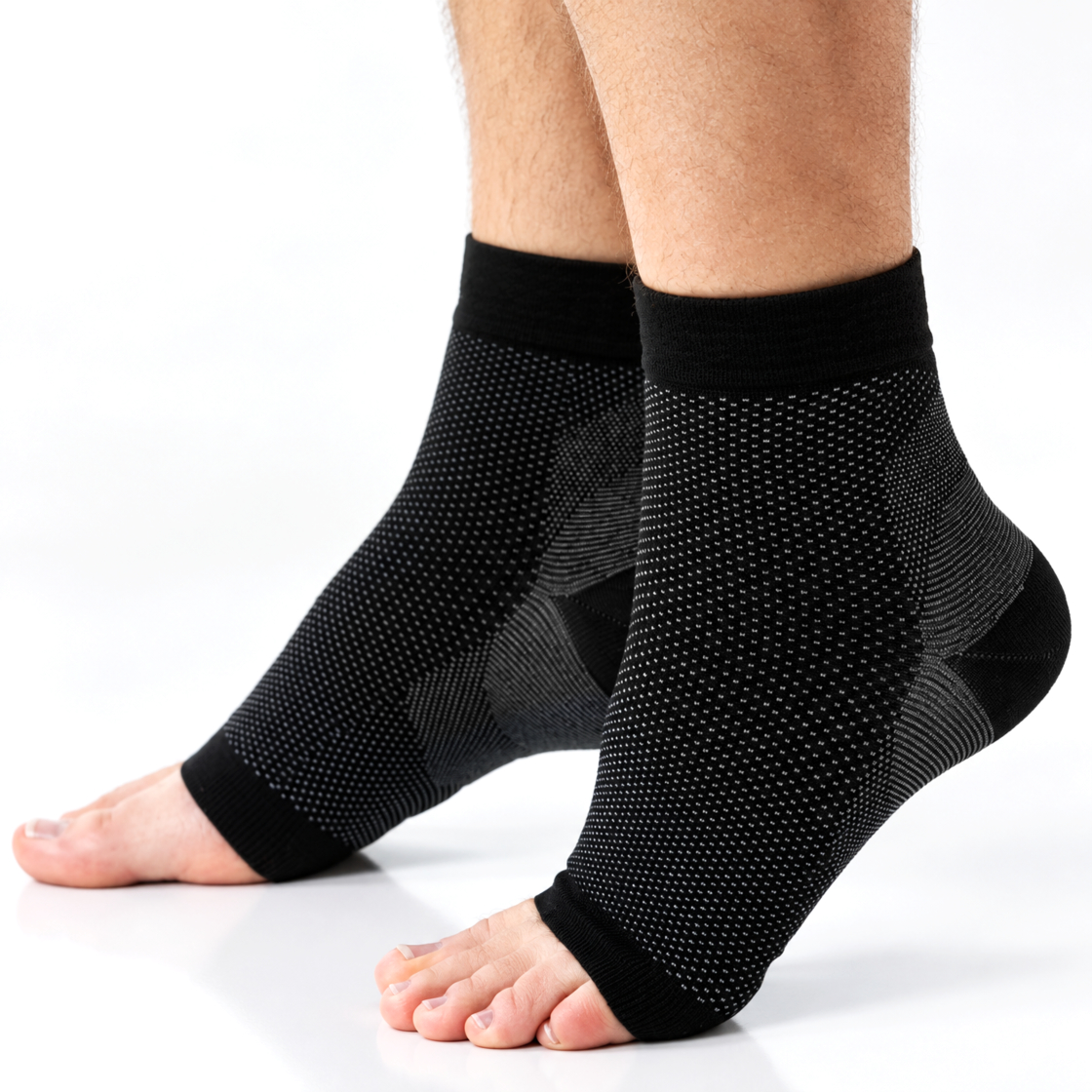


Arch Support Compression Socks for Plantar Fasciitis
£8.99
- Open-toe, slip-on compression socks for men and women, in two UK shoe sizes: S/M and L/XL.
- Made for plantar fasciitis, where the band under the sole of the foot is irritated at the heel, and for arch strain.
- Reinforced stitched section around the arch and heel that holds its shape instead of loosening with wear.
- Graduated compression: firmer through the arch and heel, lighter higher up the foot.
- Helps blood and fluid keep moving back up out of the foot during long spells of standing.
- Smooth pressure across the reinforced section, with no tight band pressing into the skin.
- Open toe keeps your toes free and unconstricted, and sits comfortably inside shoes, trainers or slippers.
- Lightweight, breathable knit that draws moisture away from the foot so it can evaporate.
- Non-slip cuffs keep the sock up and the reinforced section over the arch rather than drifting towards the toes.
- Wear directly on bare skin rather than over another sock, so the reinforced section stays against the arch.
- Wear during the day, and take them off before bed; they’re made for the hours you’re upright.
- Wash cool and air dry rather than tumble drying, to keep the stretch in the knit.
- Also recommended for arthritis and gout, Achilles tendonitis, heel spurs and blisters.
- Wear during exercise, longer walks and long shifts on your feet; pull them on before getting up if the first steps out of bed are worst.
- Not a cure and not a replacement for rest. Benefit builds over days and weeks of consistent wear.
- Does not treat or prevent blood clots. Wait until a hot, swollen, tender joint settles before wearing compression over it, and speak to a clinician if symptoms are new or unexplained.
Arch Support Compression Socks for Plantar Fasciitis
A pair of open-toe, slip-on compression socks for men and women, in two UK shoe sizes, S/M and L/XL. They’re for people whose arch and heels are sore by the end of the day, whether that’s long shifts on their feet, longer walks than usual, or the first steps out of bed. The knit is reinforced through the arch and heel in a stitched section that holds its shape rather than loosening with wear. The compression is firmer low down and lighter higher up, and the whole sock is lightweight and breathable, so your foot stays dry through the day and the socks wash easily between wears.
What plantar fasciitis and arch strain can feel like
Plantar fasciitis is irritation of the band that runs under the sole of your foot, from your heel bone to the base of your toes. That band is the plantar fascia, and the sorest point is usually where it anchors to the heel. Arch strain is the same band working harder than it’s conditioned for, usually because the arch drops under your weight and the tissue has to take the extra stretch. The pain usually sits under the heel, often a little towards the inside, and it’s tender when you press on it.
What people tend to notice most is the timing. It’s sharp and stiff when you first put your foot down in the morning, or when you stand up after sitting for a while. A few minutes of walking usually eases it, then it creeps back as the day goes on. If you’ve started to brace yourself for those first few steps, that’s very common with this problem.
The morning stiffness eases within minutes. The ache that follows takes longer to shift.
Those two experiences have different causes. The stiffness first thing happens because the band has been resting in a shortened position overnight and is suddenly stretched as you put weight through it. The ache that builds later comes from the total amount of work the foot gets through in a day. Hours of standing, walking on hard pavements, carrying shopping, or a longer run all add strain faster than the tissue can settle between days.
It’s the second one that keeps the problem going. Because the band is worked again with almost every step you take, it rarely gets a proper chance to calm down. That’s why this can rumble on for weeks and then flare up again as soon as you’re back in your usual routine.
Why the plantar fascia gets irritated
The plantar fascia runs from your heel bone to the base of your toes along the sole of the foot. As you put weight through the foot, the arch flattens slightly and the band tightens. As that weight lifts, the band releases the energy it has stored and helps push you forward. That spring-back is part of what makes walking and running take less effort.
Repeated strain is what this tissue handles least well. When the arch isn’t well supported, or when you’re standing for long shifts, walking long distances, or wearing flatter, softer shoes, the band stretches further with every step. The stretch happens along its length, but the pull gathers at the fixed end, where it anchors to the heel bone.
It’s why plantar fasciitis is classed as an overuse injury rather than something that happens in a single moment. The strain builds gradually at that attachment, faster than the tissue can recover between days, and the irritation grows quietly. Rest helps for a short while, but it doesn’t solve it. As soon as you’re back to your normal day, the same strain starts going through the tissue with almost every step.
Why arch support and graduated compression make sense
If the arch is dropping and the band is being stretched further than it should be, the most direct thing you can do is give the arch some help from underneath. Support limits how far the band has to move under your weight, which reduces the pull on the point where it anchors to the heel.
Compression acts on the blood and fluid side. The pressure is firmer low down and lighter higher up, and that’s what graduated compression means. It helps blood and fluid keep moving back up out of the foot instead of pooling in it during long spells of standing. Pooling is what produces the heavy, puffy, throbbing feeling at the end of a day on your feet. Blood brings oxygen and nutrients to the tissue, and tissue that’s well supplied recovers more readily.
These socks aren’t a cure. They work while you’re wearing them, and the effect builds over days and weeks of consistent use. They don’t replace getting off your feet when you need to. What they do is reduce how hard the tissue has to work during the hours you’re upright, which gives it a better chance to recover.
How these socks are designed to help
The reinforced section around the arch and heel carries most of the support. A stitched pattern stops that part of the knit stretching out of shape, so it holds firm rather than going slack after a few wears. Once the sock is on, it presses evenly against the arch from underneath, and it keeps pressing through a full shift, a long walk, or a training session, because it isn’t gradually loosening as the hours pass.
The pressure is spread evenly across the reinforced section rather than concentrated at one spot, so support sits over the arch instead of pinching. What people tend to notice is less of that swollen, tired heaviness by the evening, though how much you notice varies from person to person.
Your toes stay free and unconstricted while the rest of the sock is applying compression, which makes the sock quick to pull on and easy to check that the reinforced section is sitting where it should be. Open-toe socks also sit comfortably inside shoes, trainers or slippers, so you can wear them through a working day as well as for exercise.
The cuff decides whether the rest of the design does its job. A sock that slides down puts the reinforced section in the wrong place and bunches under the heel, and that’s how blisters and chafing start. The non-slip cuffs hold the sock up and keep the reinforced section over the arch rather than letting it drift down towards the toes mid-session. During vigorous exercise, that’s the difference between a sock that stays put and one you’re forever hitching back up.
These socks are recommended for helping to ease and support a range of foot conditions. The main one is plantar fasciitis. Alongside it, they’re also recommended for arthritis and gout, where a stiff or inflamed joint in the foot may feel easier with gentle, even pressure around it. For Achilles tendonitis, where the calf and heel are under repeated strain, the socks support the foot around and below the sore area rather than the tendon itself. For heel spurs, where a bony point under the heel can be tender, easing the strain through the heel and keeping the sock from rubbing over it can make standing and walking a bit more comfortable. And for blisters, reducing friction and keeping the foot drier helps the skin cope better. One practical note on gout: if a joint is hot, swollen and very tender to touch, wait until it settles before wearing compression over it.
Fit, wear and what to expect
Choose S/M or L/XL according to your UK shoe size. When you pull them on, check that the reinforced section sits across the arch rather than over the ball of the foot. The cuff should feel snug without digging in, and leave it at full height rather than folding it down. Folding the cuff bunches the fabric into a narrow strip, which concentrates the pressure at one point on the lower leg and works against the smooth pressure the rest of the sock is shaped to give. A light mark where the cuff has been is normal for any compression sock and usually fades within an hour or so. If the mark stays, or you get numbness, tingling or cold toes, the fit isn’t right for you. Try the other size, and speak to a GP, physiotherapist or podiatrist if it carries on.
Wear them on bare skin, not over another sock. A second layer makes the sock sit tighter than its size allows and lets the fabric wrinkle, and a wrinkle becomes a pressure point that rubs. It also lifts the reinforced section away from the arch, so the support isn’t pressing where it’s meant to. If you’d rather wear a liner, keep it thin and smooth, and check the fit again with it on.
Wear them through the day and take them off before bed. The socks are made for the hours you’re upright, which is when fluid gathers in the foot and the arch takes your weight. Lying down, neither applies, so there’s nothing for the compression to act on and no reason to sleep in them. If the first steps out of bed are your worst moment, the usual approach is a night splint, which holds the foot at an angle overnight rather than applying pressure, and that’s something to raise with a clinician rather than something these socks do.
Wash them cool and let them air dry rather than putting them through a tumble dryer. Heat is what wears the stretch out of a compression sock, and once the knit has slackened, the graduated pressure it was made to give goes with it.
Wear them when the foot is working hardest. For most people that means during exercise, on days when you’re walking further than usual, and when you’re standing about for hours. If the first steps out of bed are your worst moment, pulling them on before you get up means support is already there as you take that first weight. Expect it to take the edge off the pain rather than remove it.
Give it time, and be consistent. Because the socks work by reducing how hard the tissue has to work, the benefit builds over days and weeks of regular wear rather than showing up after one outing. Wearing them in the situations that usually set your symptoms off is what makes the difference.
When to get advice
If your pain is severe, getting worse, or not settling with support and sensible rest, speak to a GP, physiotherapist or podiatrist. The symptoms described here are common, but they aren’t the only reason a heel can be sore, and a clinician can confirm the cause. The same applies to any new or unexplained symptoms, numbness, or changes to the skin of the foot.
These socks don’t treat or prevent blood clots and shouldn’t be relied on for that. If you have a history of clots, or you notice new swelling in one leg, or warmth and pain in the calf that doesn’t settle, get clinical advice before wearing compression.
And if you’re unsure whether compression is appropriate for you, check with a clinician before wearing it for long periods.
The bottom line
If your arch needs support and your feet are sore and puffy by the end of the day, these socks give you a reinforced arch and heel, graduated compression that’s firmer where it’s needed, and a breathable open-toe fit in one pair. Pick your size, check that the reinforced section sits across the arch, and wear them in the situations that flare your symptoms.
Disclaimer
This page offers general guidance and isn’t a substitute for individual medical advice, diagnosis or treatment. If you’re unsure whether these socks suit your situation, or your symptoms are new, unexplained or more complex, speak to a GP, physiotherapist or podiatrist for advice tailored to you. No particular outcome is guaranteed.
Additional information
| Size | L/XL (Women 6-10/Men 8.5-13.5), S/M (Women 2.5-5/Men 4-8) |
|---|


by James
Great quality and the support and compression that these socks provide is just top notch! 👍👍👍