
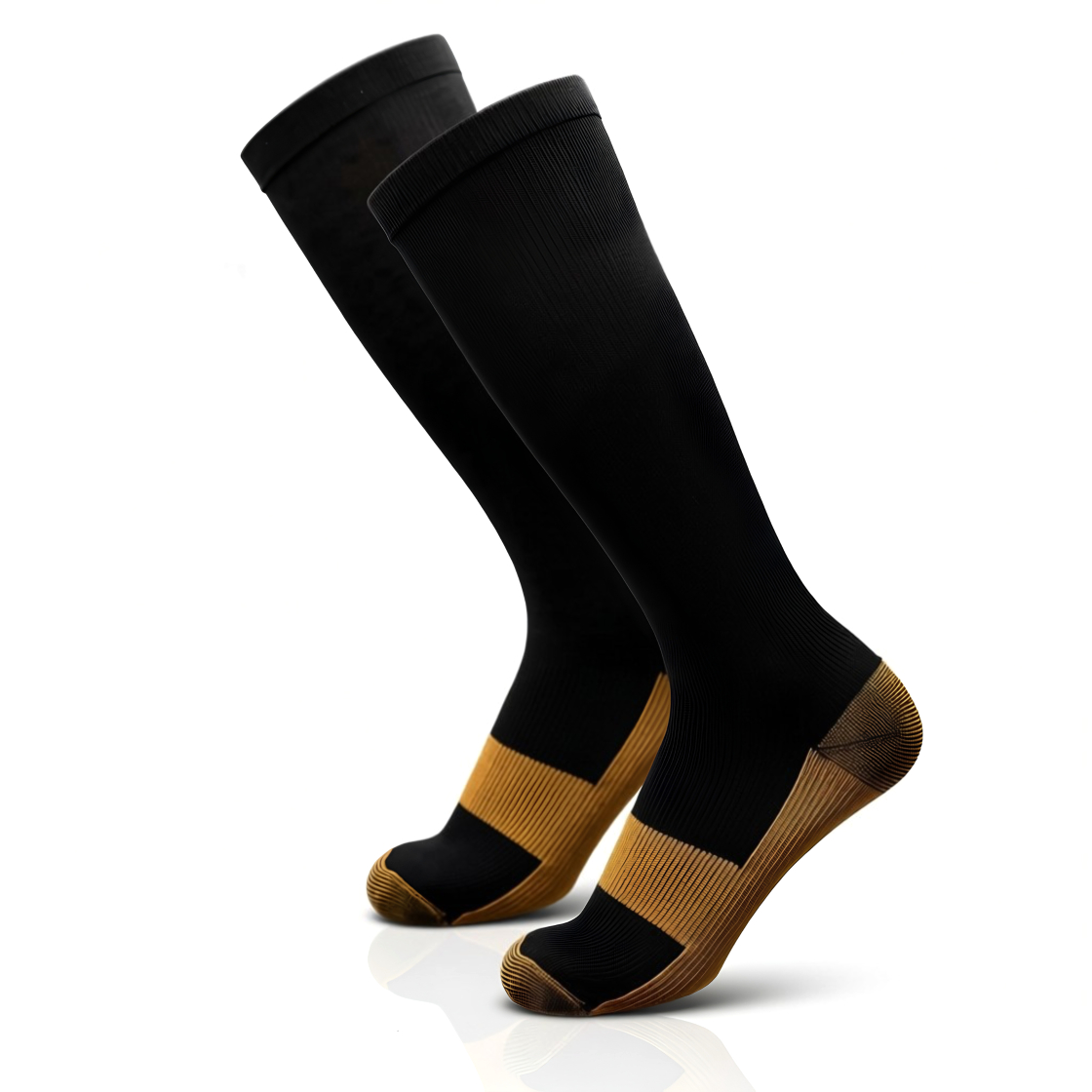
Copper Compression Diabetic Socks
£8.99
- One pair of knee-high graduated compression socks for men and women
- Graduated, mild compression: firmest at the ankle, easing as it goes up the calf
- Wide band at the top that grips gently and stays up without digging in
- Reinforced stitching at the heel and along the arch
- Lightweight, breathable copper-infused fibre that wicks sweat away from the skin
- Copper used to help manage freshness and odour
- Made for adults living with diabetes, neuropathy, sensitive feet, varicose veins, oedema or poor circulation
- Supports the foot and lower leg while you are upright, spreading pressure across a wide area
- Two UK shoe sizes: S/M (women’s 5-9.5, men’s 5-9) and L/XL (women’s 10-13.5, men’s 9.5-12)
- Rolled on over the foot, then unrolled up the leg
- Not a treatment for any condition, and not a replacement for medical care
- Does not treat or prevent blood clots
- Check with a GP or podiatrist first if you have poor circulation or are unsure whether compression suits you
These socks are made for adults living with diabetes, neuropathy, sensitive feet, varicose veins, oedema or poor circulation. They cover the foot, the ankle and the calf, finishing just below the knee.
The compression is graduated and mild. That means the pressure is firmest at the ankle and eases as the sock goes up the calf. The top is wide and grips gently rather than pressing in a narrow line. The fibre is lightweight, breathable and copper-infused, and there is reinforced stitching at the heel and along the arch.
Their job is to make feet and lower legs more comfortable through the day. They do not treat the condition behind the swelling, the altered sensation or the tiredness, and whether they suit you is a question for your GP or podiatrist.
What these socks are for
Diabetes, neuropathy, sensitive feet, varicose veins, oedema and poor circulation are separate problems, and they do not feel the same. Swelling that builds through the day is a different experience from sensation that has dulled. A sock that works well for one will not necessarily be right for another.
What a sock can do for any of them is fairly modest: it can support the foot and lower leg while you are upright, spread its grip across a wide area rather than a narrow line, and keep sweat away from the skin. What changes from one problem to the next is which of these you notice: a calf that feels tight and full, a leg that tires quickly, skin that reacts to pressure, or a foot that no longer warns you when something is pressing on it.
Why feet and lower legs can feel like this
Your feet are a long way from your heart, and the blood in your legs has to travel back up against gravity to get there. Blood does not do that on its own. Inside your veins are small one-way valves that close behind each push of blood, and your calf muscles act as a second pump: every step squeezes the veins and drives blood upwards.
Stand still for a long spell and that pump stops. The valves are left holding the column of blood, the vein walls stretch a little, and fluid is pushed out into the surrounding tissue. It is why the same pair of legs can feel fine at breakfast and heavy by the evening, and why the ankles are usually the first place to look puffy.
A narrow cuff and a broad band behave very differently on a leg. A thin ring of elastic presses all of its grip into one small strip of skin, so the pressure is concentrated in a line. A wide band spreads the same grip over much more of the leg, so no single point takes the load.
The skin on your feet is thin compared with your palms, and there is not much padding under the sole or the heel. Pressure and friction show up quickly there. Add swelling, altered sensation or a stretched vein, and small details stop being small: a seam, a crease, a sock that has gathered under the ball of the foot.
If one of these sounds familiar
Diabetes
The changes that come with diabetes tend to build slowly, and they affect the two things that matter most for your feet: the sensation in them and the blood supply to them. You may notice nothing at all. Or your feet may feel cooler than they once did, or pressure under the ball of the foot may register less clearly.
All of this changes what a sock needs to do. If fabric creases under the ball of your foot or gathers at the heel, it creates a small patch of concentrated pressure, and reduced sensation may not warn you it is happening. So the fit has to take over the warning your feet would normally give you. Reinforced stitching at the heel and arch keeps those two areas sitting flat and staying in shape rather than thinning or rolling into a ridge, and a close fit through the foot leaves less loose fabric to bunch in the first place. Alongside that, it is worth keeping an eye on your feet and having a podiatrist look at anything that changes.
Neuropathy
It can feel like numbness, tingling or burning, or as though ordinary touch has become too much. It usually starts in the toes and the sole of the foot before moving further back.
The nerves carrying signals from your feet are not passing those signals along as they should, so sensation is either dulled or exaggerated. That has a practical consequence for a sock. A narrow cuff presses on one small ring of skin at the calf; with normal sensation you would feel it biting and adjust it, while with altered sensation you may feel it as a broad ache across the calf instead, or barely register it at all. A wide top that grips gently spreads that contact across more of the leg instead of concentrating it in a line. The other consequence is that you cannot rely on feel to tell you the sock is sitting right, so being able to put it on and leave it alone through the day matters more than it would for someone with normal sensation.
Sensitive feet
For some people the difficulty starts the moment a sock goes on. The skin across the top of the foot, around the ankle and between the toes can react to seams, cuffs and rougher fibres, and the sensation is out of proportion to what is actually touching the skin.
Two things usually cause it. One is direct pressure and friction, which a seam or a tight cuff delivers in a narrow line. The other is moisture. Skin that stays damp against fabric becomes more reactive, and a sock that holds sweat close to the fabric keeps the skin damp all day. The material helps with the second: it is lightweight and breathable, and it moves moisture away from the skin rather than trapping it. Combine that with a top that does not sit as a hard ring, and sensitive skin has far less to react to.
Varicose veins
You often see them before you feel them: veins sitting closer to the surface, usually along the calf or the inner lower leg, sometimes looking twisted or swollen. What you feel is more often an ache, tenderness or heaviness.
That heaviness builds the longer you stay upright, and eases when you sit down and put your feet up. It comes from blood collecting in the vein instead of being carried upwards, which stretches the wall and leaves the leg feeling full and tender. Gentle compression from the outside supports the vein wall, so it is not carrying the whole column of blood unaided. A sock that finishes below the knee brings a further advantage, because the top sits under the knee rather than crossing the back of it, where veins lie close to the surface and a tight band is felt quickly. If you are unsure whether compression is right for you, ask your GP or podiatrist.
Oedema
Most people notice it at the end of the day. The ankles look fuller than they did that morning, the skin over them feels tight, and a sock has left a mark that is still visible after you have taken it off.
By the evening, more fluid has gathered in the ankles and lower legs than has drained away, and the tissue there is already under tension. That makes a narrow cuff the wrong shape for a swollen leg, because it presses into tissue that is already stretched and cuts a groove. A wide top spreads its contact across a much larger area, so it is far less likely to leave a line across the calf. Gentle support around the lower leg may also make that fullness feel lighter by the evening. If your swelling is new or getting worse, ask your GP or podiatrist before using compression socks.
Poor circulation
A walk that used to be easy starts to feel like hard work. Cold feet are slow to warm, and your legs take longer to settle once you stop.
Blood carries oxygen and fuel to the muscles and skin, and carries waste away again. When flow is reduced, that exchange slows, so the same walk or the same flight of stairs asks more of your legs than it should. Mild compression gives the lower leg some outside support, which may make time on your feet feel more comfortable. The top matters here as well. A narrow band puts pressure on the vessels directly beneath it, and a leg already receiving reduced flow is better off without that concentrated load. The wide top holds the sock in place without pressing on any one strip of skin. If you have poor circulation and you are unsure about compression, check with your GP or podiatrist first.
Why a compression sock can help
A compression sock applies mild pressure from the outside. The tissues are supported while you are upright, and the veins are not left to carry everything unaided. That sits alongside keeping active, footwear that fits properly and any advice you have been given by a clinician. It does not replace any of them.
The difference between a compression sock that helps and one that gets taken off after an hour comes down to a few details. One that slides down gathers at the ankle and puts a ridge under the foot. One with a hard band at the top simply replaces a sock that slides with one that digs in. You want something that stays where you put it, spreads its pressure across the foot and calf rather than in a single line, and is comfortable enough to keep on all day.
How this pair is designed to help
The top is the part most people notice first. It is wide, and it grips gently across a strip of skin much broader than an ordinary sock top, so it keeps the sock up without digging in or restricting the flow of blood down to your feet. Because it sits below the knee rather than behind it, there is no tight band across the back of the joint and nothing partway down the calf to fold over. If you have tried compression socks before and given up because of the mark they left or the tightness across the calf, that is the problem this top is shaped to avoid.
Below the top, the compression is graduated and mild. Pressure is firmest at the ankle, where fluid tends to collect first, and eases as the sock goes up the calf. The lower leg is supported where the veins are working hardest against gravity, without the calf being squeezed as tightly higher up. Through the day that gives a steady, supported feeling, and helps ease the aches and swelling that build in the ankle and lower leg over long hours on your feet. Many people find it eases the heavy, tired feeling that arrives after a few hours standing or walking, along with the muscle fatigue that comes with it.
The sock covers the ankle and the whole calf in one continuous piece. There is no edge stopping partway up the leg and no need to keep pulling it back over the calf during the day.
Lower down, reinforced stitching holds the heel and the arch. Those are the two places the foot takes most load, and where a sock is most likely to shift, thin out or gather. Reinforcing them keeps the fabric flat under the sole, so what you stand on stays even rather than bunched.
The fibre is lightweight, breathable and copper-infused. Copper is used here to help manage freshness and odour, and the material wicks moisture away from the skin so your feet and lower legs are not sitting damp through the day.
They are made for both men and women.
Choosing your size and checking the fit
The socks come in two UK shoe sizes. S/M fits women’s shoe sizes 5 to 9.5 and men’s shoe sizes 5 to 9. L/XL fits women’s shoe sizes 10 to 13.5 and men’s shoe sizes 9.5 to 12.
With a compression sock, getting the size right is what makes the compression behave as intended. Too small and you are back to the tight band you were trying to get away from. Too large and the sock will not hold its position; it will roll at the top and gather under the foot, which is the opposite of what you want if your skin is sensitive or your sensation is reduced.
The top should grip without digging in. A faint indentation that fades soon after you take the sock off is normal. A deep mark that is still there later in the day usually means the fit is too tight or the sock has rolled. If your legs tend to swell, try them on earlier in the day when your calf is closer to its usual size, then check again in the evening. If you are between sizes, or your calf shape makes it hard to judge, compare your usual shoe size against the two ranges above.
Wearing them in daily life
Put them on by rolling the sock down to the heel, easing it over your foot, then unrolling it up your leg so the top sits just below the knee. Check for twists, and for any bunching under the sole or around the ankle, before you stand up.
They are made for exercise and sport as well as ordinary daily activity. Wear them when you are on your feet for long stretches, and when you are travelling. If you have not worn compression before, the feel can take a few days to get used to.
What you are likely to notice is a steady pressure through the calf and a little less of the heavy ache by the time the day is done. How much difference they make varies from person to person, and depends on which of these problems you are dealing with.
If they feel restrictive, if the top pinches, or if they leave a mark that does not fade, take them off and check the fit.
Looking after your socks
Wash them on a cool, gentle cycle and let them air dry. Avoid bleach, fabric softener and a hot tumble dryer, because heat and harsh products break down the fibres and the stretch. Replace them when the fabric stops springing back or the top no longer grips, since a worn-out top is what lets the sock slide down.
When to ask for advice
If you are unsure whether these socks are suitable, ask your GP or podiatrist. If you have diabetes, neuropathy, varicose veins, oedema or poor circulation and your symptoms are new or getting worse, speak to them as well.
These socks do not treat or prevent blood clots, and they should not be relied on for that. If you have a history of clots, or you notice swelling in one leg, a change in the colour or temperature of a leg, or new or unexplained symptoms that do not settle, speak to a GP.
If the socks feel too tight, leave a deep mark, or your feet or lower legs feel worse rather than better when you wear them, stop and get advice.
Your next step
Match your usual shoe size to the two ranges above, put the socks on carefully, and wear them as you would any other pair. If you are unsure whether compression is right for you, speak to your GP or podiatrist before you start.
Disclaimer
This is general information for adults in the UK. It is not a substitute for individual medical advice, diagnosis or treatment, and no particular outcome is promised. If you are unsure whether compression is right for you, or your symptoms are new, unexplained or more complex, speak to a GP, podiatrist or another appropriate clinician about your own situation.
Additional information
| Size | L/XL (Women 10-13.5/Men 9.5-12), S/M (Women 5-9.5/Men 5-9) |
|---|

Reviews
There are no reviews yet.