
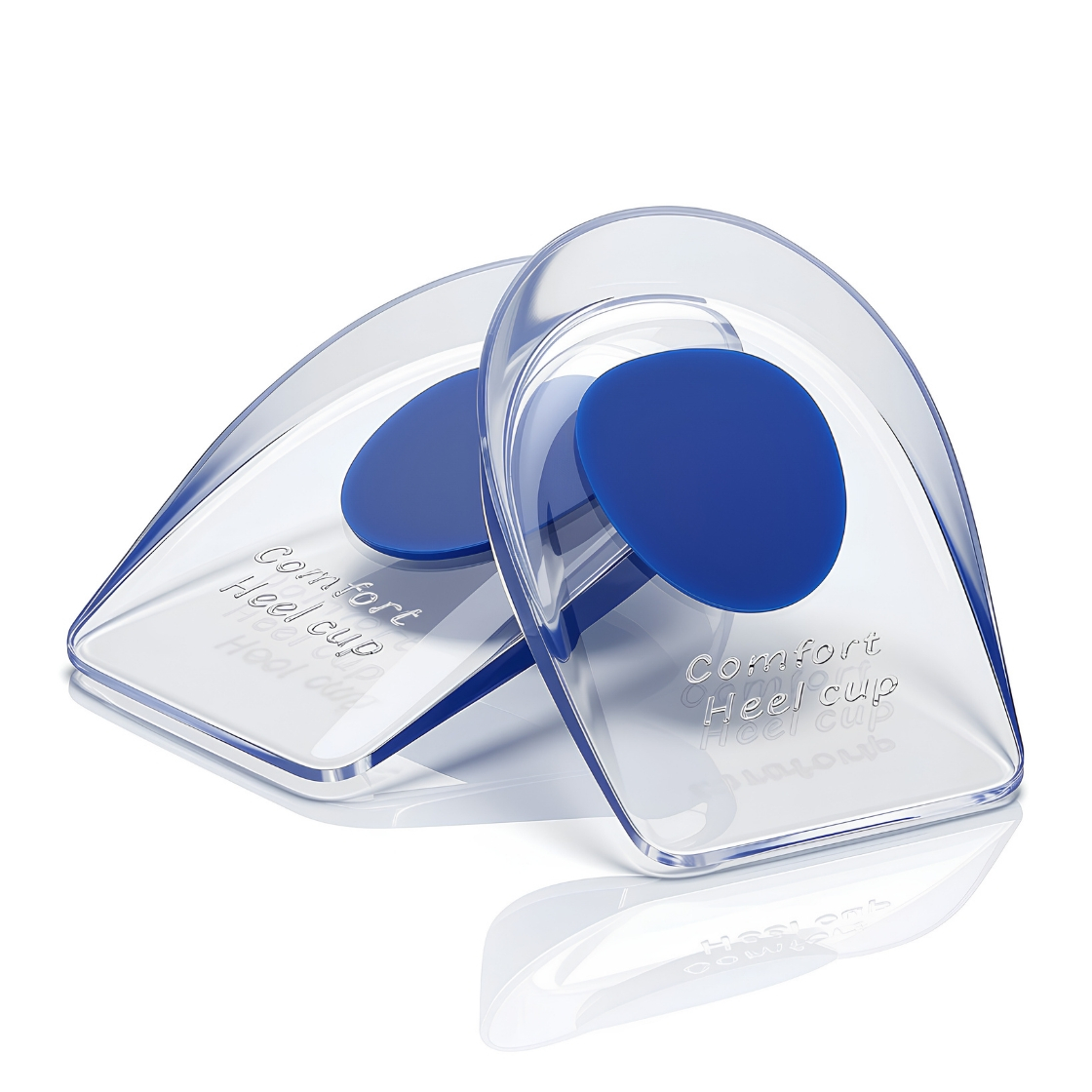
FootReviver™ Orthotic Heel cups for Shoes & High Heels
£7.99
- A pair of heel cups that sit inside your shoe and cradle the heel
- Moulded as a single piece from medical-grade silicone gel, so there are no separate layers and nothing rigid inside
- The gel moulds to the shape of your heel, so the load of each step spreads across the whole heel rather than building on one spot
- Cushions the impact of walking, which matters most on hard ground
- The raised sides and back hold the heel in place and limit the sideways drift and tilt that contribute to sprains and strains
- Arch support built into the same piece helps when the foot rolls inwards too far, a pattern called excessive pronation
- Slim enough to fit inside many pairs of high heels, where a full-length insole would not
- Fits a wide range of shoes, boots and trainers
- One size, designed for most adults, for men and women
- Aimed at heel pain and plantar fascia problems, and also used for heel spurs, Achilles tendinitis, shin splints and knee tendinitis
- Start with an hour or so at a time and build up over the first few days rather than wearing them all day from the outset
- Intended to reduce what your heel has to tolerate while you are in the shoes
- Take them out if they rub, and speak to a GP, physiotherapist or podiatrist if the pain is severe, came on after a fall or a knock, or is not settling after several weeks
If your heel is hurting, you will probably recognise this
Most people with this kind of heel pain describe the same handful of things. The first few steps out of bed are usually the worst. You put your foot down and there’s a sharp, pulling pain under the heel that makes you limp for a minute or two before it eases. Some describe it as feeling like standing on a small stone. Others say the underside of the heel feels bruised, as if they’d walked on it too hard the day before, even when they haven’t. Getting out of the car after a long drive, or walking across the room after a meeting, often brings the same sharp pain back.
Through the day it changes character. The sharp pull settles into an ache that builds the longer you stay upright and eases once you sit down and take the weight off. Pressing the underside of your heel, usually towards the inside edge, feels tender. Walking barefoot on a hard floor tends to feel worse than walking in a supportive shoe, and thin-soled shoes feel worse than cushioned ones. Stairs can be awkward, particularly climbing them. And it can take a while to settle. A few weeks pass, it feels a bit better, you do a bit more because it feels better, and it returns.
That pattern tells you a lot about what your foot is being asked to do and why it isn’t coping. Heel pain of this kind is common and rarely serious, and it usually settles with sensible changes to how load is shared through the heel. A heel cup is one way of changing that, and it works on the band that runs under your arch.
What the plantar fascia is, and why it starts to complain
Running along the sole of your foot, from the heel bone to the ball of the foot, there’s a thick, tough band of connective tissue called the plantar fascia. It isn’t a muscle and it doesn’t contract. Its job is to hold the arch together and to store and return energy as you walk. In practice, the band stretches as your weight comes onto the foot and releases that energy as you push off, so each step costs your calf muscles a little less than it would otherwise. It anchors at the heel bone as well as at the ball of the foot, and that anchor point under the heel is where most of the trouble shows up.
Every step sends load through that band, and like any tissue it has a capacity, meaning an amount of load it’s comfortably used to. It isn’t always about doing something obviously strenuous, which is why the cause can be hard to spot. Tissue generally copes well with gradual, repeated demand. Problems usually come from sudden increases in load. A new job that has you on your feet all day instead of sitting, a shift from carpet to hard flooring, a holiday spent walking far more than usual, a change of shoes, or simply years of standing on feet that roll or flatten in a way that puts extra tension through the band. Having flat feet or unusually high arches shifts the starting point too, because both change the angle the band works at. A flat foot keeps it closer to its stretched limit, while a high arch means the band has less slack to begin with.
Standing still brings a steady load rather than a pulsing one, and this is the part that surprises people. Walking delivers force in pulses, with a brief unloading between steps. Standing doesn’t. If you’re upright at a counter, in a queue or on a shop floor for two hours, the band is held under tension the whole time with nothing to break it up. Walking still puts more force through the heel with each step, so it isn’t that standing is heavier work. The difference is that standing has no let-up at all, and a steady pull with no rest in it will build into an ache just as reliably as a long walk will.
The morning pain makes sense once you picture what happens overnight. When you sleep, your foot sits relaxed with the toes pointed and the band in a shortened position. It adapts to that shorter length and stiffens slightly. The pad of fat under your heel bone, the natural cushion between bone and ground, has had no weight through it for hours. Then you stand up, the band is suddenly stretched from a shortened start, and the heel pad takes your full weight for the first time since the day before. That’s the sharp pull in those early steps, and it’s why the pain eases as the band lengthens and warms through.
The same stiffened, shortened band explains why stairs are hard work, especially climbing them. Going up means pushing your whole body weight upwards through one foot at a time, and that’s the moment the plantar fascia is working hardest. With the toes bent back as your weight comes onto the step above, the band is stretched while it’s also carrying your full body weight, and that combination is what makes the step hurt. Later in the day, once you’ve been moving and it has lengthened, the same step usually feels easier.
The same pattern explains why the problem can go on for weeks or months. The tissue isn’t torn the way a muscle strain is. It’s irritated and struggling to keep up with demand, and it only settles once the demand drops to something it can cope with and the tissue rebuilds from there. That’s a slow process. A good week doesn’t mean it’s over. It usually means you’ve done less on it that week, and if you increase the load again too quickly the pain tends to return.
A heel spur worries people more than it needs to. A spur is a small bony projection that can form where the plantar fascia attaches to the heel bone, and it turns up on scans in plenty of people who have no heel pain at all. It’s better understood as a sign that the attachment has been under steady pull for a long time, rather than as a spike pressing into the sole of your foot. The spur itself isn’t what needs treating. What helps is reducing the strain through that attachment, and that comes from how your heel is supported and cushioned, not from trying to wear the spur away.
How your shoes change the load, and why high heels in particular
Two ankle movements matter most when it comes to what you put on your feet. Bending your foot upwards towards your shin is called dorsiflexion, and that’s what happens at the ankle when you squat down or step forward. Pointing your foot away, toes down, is plantarflexion. A flat shoe lets the ankle move through its full range with each stride. A raised heel holds the foot partway into plantarflexion all day, so the calf muscles and the Achilles tendon, the thick cord at the back of the ankle that connects the calf to the heel bone, spend hours in a shortened position. Irritation of the Achilles tendon is what’s meant by Achilles tendinitis. Held in that shortened position repeatedly, the calf and the tendon adapt to that length and become stiffer and less willing to lengthen. The result is a calf that feels tight first thing in the morning and an ankle that doesn’t bend upwards as far as it should when you walk in flat shoes.
Your heel ends up taking that load because when the ankle can’t bend upwards properly, the foot moves differently. It rolls inwards and flattens as you step through, the arch drops lower than it should, and the plantar fascia takes a bigger share of the strain with every stride. At the same time the Achilles, already tight, pulls harder on the back of the heel bone. A raised heel worn regularly therefore puts extra demand on two of the structures most involved in persistent heel pain, without ever touching the sole of your foot directly.
There’s a second effect under the heel itself. A high heel lifts you onto the ball of your foot and leaves the heel balanced on a much smaller, thinner platform. That means less material between your heel bone and the ground, so less of the impact of each step is absorbed before it reaches you. The same body weight then presses through a smaller patch of skin and fat, so the force concentrates on a narrow area rather than spreading across the whole pad. On a pavement or a station concourse, that difference shows up over the course of a day rather than in a single step.
Balance matters too. A narrow heel gives you a smaller base to stand on, and a raised heel lifts your body weight higher off the ground. Both make the ankle work harder to keep you steady, through a series of small corrections you aren’t aware of making. When the ankle can’t make those corrections quickly enough, on a sloped path, a wet pavement or an uneven slab, it rolls over. That’s the usual way sprains and strains happen in heels.
The knock-on effects travel further up the leg, and it helps to keep them separate rather than lumping them together as leg pain. Pain along the shin, the pattern usually called shin splints, tends to sit along the inner border of the shin bone where the muscles of the lower leg attach. When the foot rolls inwards more than it should, those muscles work harder to control each step, and the pull on their attachment points increases. Knee tendinitis is a different problem. It affects the tendon at the front of the knee, below the kneecap, and it can be provoked when a foot that flattens changes the way the leg rotates as you walk and climb. None of this means you have to stop wearing heels. It does mean the inside of the shoe matters, because that’s where some of the load can be reduced.
Why a heel cup is a reasonable response
A heel cup is a shaped insert that sits in the heel area of your shoe, holding the heel rather than covering the whole sole. It does four separate jobs, and each one works on a different part of the problem.
The first is cushioning. A softer layer under the heel bone takes some of the sting out of each footfall, which counts for most on hard surfaces that offer no cushioning: a shop floor, a station platform, a long queue. You may find a bit less of that bruised feeling by mid-afternoon.
The second is spreading pressure. Your heel doesn’t land on a single point. It lands on the pad of fat and soft tissue built to spread force across the whole heel. When that pad is thin, or the shoe underneath is unforgiving, the force concentrates on one spot and that spot becomes tender. Spreading the load over a wider area is what a shaped insert does, and it’s why the sore patch has less to absorb.
The third is holding the heel steady. A deeper cup keeps the heel in place rather than letting it drift and tilt inside the shoe. That gives the ankle a more secure base and reduces the small, repeated wobbles that contribute to sprains and strains. If you’ve ever felt your foot slide slightly inside a shoe on a kerb or a worn paving slab, you’ve felt the thing a heel cup is trying to reduce.
The fourth is arch support, and to see why that helps you need the idea of pronation. Pronation is simply the foot rolling inwards as you take weight, which is a normal part of walking. Excessive pronation is when that roll goes further than it should, or lasts longer than it should, so the arch drops and the foot works at an angle it isn’t well designed for. The arch flattens further than it ought to, tension through the plantar fascia rises, and the angle at which the ankle and knee move changes, so the effects aren’t felt only in the foot. If you have flat feet, you’re already closer to this pattern. If you have high arches, the opposite shows up: a stiffer foot that absorbs less shock and passes more of it up the leg. A modest amount of support under the arch helps here. This isn’t a rigid orthotic, a shaped insert made to control foot position more firmly, but lighter support that gives the arch something to press against, so the plantar fascia isn’t starting from an already-stretched position. People often feel the difference on the days when the arch starts to tire before the day is out.
This pair is built around those four jobs.
How this pair of heel cups is built
The whole heel cup is made from medical-grade silicone gel, moulded as a single piece. There are no separate layers and nothing rigid inside it. That matters for how it behaves under your heel. The gel compresses as your weight comes onto it and recovers as you lift off, so the impact of each step is absorbed rather than passed straight through to the heel bone.
Because the gel moulds to the contours of your foot instead of staying rigid, more of the heel’s surface stays in contact with it. The load of each step therefore spreads across a wider area rather than concentrating at one point. That’s what helps prevent pressure points from developing, and it’s the reason a sore patch under the heel isn’t taking the full force of every step you take.
The sides and back of the cup are raised. Because the whole piece is gel, that raised edge holds the heel in place and cushions the back of it at the same time. The soft tissue at the back of the heel isn’t pressed against the firm back of a shoe, and the heel is held on all sides rather than sliding and tilting inside the shoe. The raised edge gives the ankle a more secure base to work over, so it isn’t constantly making small corrections. Walking on a road that slopes to one side or stepping off a kerb is where you feel the difference, because the ankle has less to do to hold itself steady while the ground tilts underneath you.
The gel also extends forward under the arch as a modest raised section. It’s deliberately low, enough to give the arch something to press against as you walk through each step, without forcing your foot into a shape it doesn’t have. For someone whose foot flattens heavily on standing, that support helps correct how the foot functions through the step, easing pressure on the arch and reducing some of the strain that contributes to injuries developing in the first place. You’ll feel it most in shoes where your foot has room to spread and flatten, such as soft trainers or a well-worn pair of flats.
All of this is packed into a lightweight, compact shape that fits into a wide variety of shoes and boots. It’s slim enough to go inside many pairs of high heels, where a full-length insole wouldn’t fit or would leave no room for your foot. There’s one size, designed for most adults, men and women alike, and the shape suits people with flat feet as well as those with high arches. The design is aimed at plantar fasciitis, heel spurs, Achilles tendinitis, shin splints and knee tendinitis.
Fitting them, wearing them, and what to expect
Place the cup in the heel of your shoe so your heel drops into the hollow when you put the shoe on. It should feel as though the heel is being held rather than perched on top of something. Check that it isn’t bunched or sitting at an angle, and that it isn’t sliding forward under your arch. That usually means it’s in the wrong position, or the shoe is too roomy at the back.
The cup takes up a little room under your heel, so very snug shoes may feel tighter than they did before. Better to wear them in shoes that already fit comfortably than to force them into something tight.
Give yourself a few days to adjust. Start with shorter periods, an hour or so at a time, and build up as they feel comfortable rather than wearing them all day from the first morning. Some people feel the difference straight away. Others find them strange for the first few wears before they stop thinking about them. If they rub or feel uncomfortable at any point, take them out rather than persevering.
The job these do is to reduce what your heel is asked to tolerate while you’re in the shoes. They don’t treat the underlying problem itself, but that reduction gives irritated tissue a better chance to settle. Plantar fascia pain typically eases gradually over weeks rather than days, and good weeks and sore weeks are normal along the way. The most useful thing you can do is wear them consistently in the shoes you’re in most often, so the demand on your heel doesn’t vary so much from one day to the next. If you’re in heels for work and flats at the weekend, having a pair in both is more useful than having them in one pair only. Spreading your standing and walking more evenly through the day, rather than doing it all in one long stretch and then sitting for hours, works alongside them rather than replacing them.
Looking after them is simple. Rinse with mild soap and water, let them air dry fully, and keep them away from direct heat, which can distort the gel. Replace them when the gel starts to look flattened or worn through in the heel area, because that’s the point where the cushioning stops doing its job.
When to get help
For most people, heel pain is manageable and settles with time and sensible changes. Some situations need a proper look rather than management at home. Speak to a GP, physiotherapist or podiatrist if the pain is severe, if it came on after a fall or a knock, or if it’s getting steadily worse rather than fluctuating. Pain that follows an injury points to a different kind of problem from the gradual, repetitive strain described on this page, and it needs assessing before you start loading it again.
The same applies if the heel hasn’t settled after several weeks of sensible management, or if you notice new or unexplained symptoms such as swelling, numbness or tingling in the foot, or a change in the colour or temperature of the skin. In most cases there’s a simple explanation, and a clinician can assess these quickly and talk you through what’s happening.
Where this leaves you
Heel pain of this kind tends to persist for a straightforward reason. The same tissue is asked to do the same job, in the same shoes, day after day, without much changing. What your heel copes with on a normal working day is what keeps the problem going, which is why a change that sits inside the shoes you already wear is often easier to keep up than one that requires you to replace them.
These come as a pair, with a 30-day money-back guarantee, so you can try them in your own shoes and see how you get on. If you’ve been putting up with a sore heel and want to find out whether a bit of support under it makes a difference, start with an hour at a time in the shoes you wear most and build up from there. If your symptoms are new, severe, or not settling, speak to a GP, physiotherapist or podiatrist first.
Disclaimer
The information on this page is general guidance about heel pain, plantar fascia problems and heel cups. It isn’t a substitute for personalised medical advice, diagnosis or treatment. If you’re unsure whether this applies to you, or if you have new, unexplained or more complex symptoms, speak to a GP, physiotherapist, podiatrist or another appropriate clinician for advice about your own situation. No particular outcome is promised or guaranteed.

by Damon
I prefer these over other insoles because they are light weight easily fit inside the narrowest of my shoes, got really good RIGID arch support which really ease pressure of my flat feet and I just love the extra stability that they give my heels.