
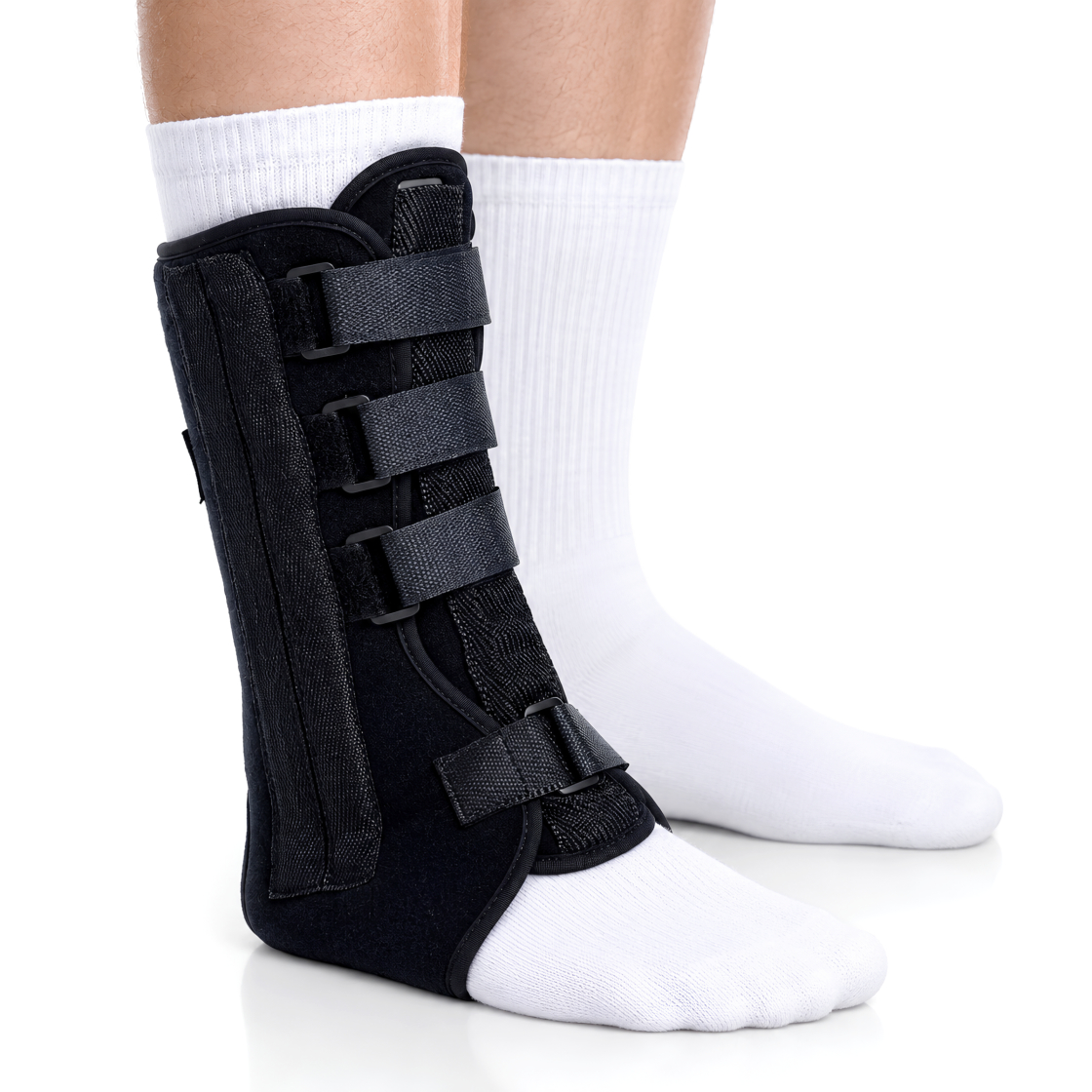

FootReviver™ Ankle Support Splint Foot Brace
£14.99£19.99 (-25%)
- A semi-rigid ankle and foot brace that supports the joint from the sides, the front and the back while you walk.
- For adults with a sprained ankle, Achilles tendon pain, heel or arch pain, or a stiff, unsteady ankle after a fracture.
- Also used alongside treatment for ankle instability, foot drop, posterior tibial tendon problems, ankle arthritis and cuboid syndrome.
- Four metal elements: a splint down the outside of the ankle, one down the inside, a flexible insert at the front, and a splint down the back in line with the Achilles tendon.
- The side splints resist the inward and outward roll that pulls on injured ligaments.
- The rear splint limits how far the ankle bends upwards, which reduces the stretch through a sore Achilles on stairs and slopes.
- Reaches to roughly mid-calf, so the frame has a longer lever and pressure is shared across the shin and calf rather than concentrated at the joint.
- Four straps you adjust separately, so you can tighten where your leg is slimmer and ease off where the skin is sensitive.
- The same straps set the compression, so you can adjust it as swelling changes through the day.
- Open toe and heel reduce rubbing at the bony points. Nothing sits under the sole, so the brace does not cushion the bottom of the foot.
- Breathable materials with a soft inner surface that help manage moisture and odour.
- Three adult sizes: Small (UK 3–5), Medium (UK 5–8) and Large (UK 8–11). Worn on either foot.
- Can be worn over a sock, sits close under clothing, and fits inside roomy shoes. Hand wash and air dry.
- It supports and protects, but it won’t cure the problem or rebuild strength — that comes from exercise. Speak to a GP, physiotherapist or podiatrist if your symptoms are new, unexplained, or getting worse despite wearing it.
When ankle and foot pain won’t settle
Some ankle problems arrive in a second. You step off a kerb, land awkwardly, and feel the joint roll. Others build over weeks or months: a heel that hurts before you’ve taken ten steps, a calf that feels tight every morning, an arch that slowly seems to be flattening. Day to day, the effect is much the same. Walking to the shops becomes something you plan around. Stairs need attention. Standing at work leaves you sore by mid-afternoon. And some people describe something harder to pin down: the ankle feels as though it could give way, or they no longer quite trust it on uneven ground.
For other people the problem starts after a fracture, a spell in a cast, or surgery. The bone has healed, but the ankle still feels stiff, weak or unsteady. Many people reach that point, and it’s usually where a support starts to help.
The FootReviver™ Ankle Foot Brace is a semi-rigid support for adults dealing with foot, ankle and lower-leg problems. Semi-rigid means the brace has a firm frame that resists unwanted movement without locking the joint. It isn’t a cast, so you can walk in it and the ankle keeps moving through a useful range. It limits the inward and outward roll that strains healing tissue, and applies even pressure around the joint while you’re on your feet. It won’t build strength for you, though. Muscle and ligament strength only comes from being used, through the exercises and everyday activity you build up over time, and no brace can do that work on your behalf. That’s why it suits a period of recovery rather than a permanent arrangement. Use it alongside advice from a GP, physiotherapist or podiatrist.
What may be causing your symptoms, and why they keep coming back
Your foot and ankle do two jobs at once. They carry your body weight, and they keep you balanced. Neither job is simple, and both depend on several structures working together.
Ligaments are strong bands that connect one bone to another. They are the passive restraints of the ankle — the straps that stop it going further than it should. When they are stretched past their limit or torn, you have a sprain.
Tendons connect muscle to bone. When a muscle contracts, it pulls on the tendon, and the tendon moves the bone. Tendons handle steady, repeated load well. What causes trouble is a sudden jump in how much load they’re asked for, which is why a new running programme, a long day of hill walking, or a change from soft to hard flooring can set off tendon pain.
Cartilage is the smooth lining on the ends of the bones inside a joint. It lets the surfaces glide over one another. It can be damaged by a single injury or worn down over time.
Nerves run through and around the ankle in narrow spaces. If something presses on a nerve — swelling, a stretched ligament, a flattened arch — you get symptoms that feel quite different from joint pain: tingling, burning or sharp shooting sensations rather than a dull ache.
There’s one more piece to this, and it explains a lot about why a sprained ankle can still feel unreliable months after the pain has gone. Your body knows where your ankle is without you looking at it, because nerves in the ligaments, the joint lining and the skin report back continuously on position and movement. Clinicians call this position sense, or proprioception. Injury disrupts it. The signals become less reliable, the ankle feels vaguer and slower to respond, and you stop trusting it — often before the pain has eased, and sometimes well after.
When any of these structures is irritated, your body responds with pain and swelling. That part is familiar. What happens next is the part people rarely notice. You start to protect the area without really deciding to. You shift weight onto the other leg. You take shorter steps on the affected side. You stop pushing off properly, so you lift the foot clear instead of rolling over the ball of your foot. This is a sensible short-term response, but it’s a different way of walking, and it has consequences. The calf on that side works less. The ankle stiffens into the range you keep using and loses the range you’ve stopped using. The other leg takes more of your weight. The original injury eases, yet the stiffness, the weakness, the dulled position sense and the changed way of walking all remain — and that combination is what keeps symptoms going long after the tissue has healed.
This is why resting and waiting is often not enough on its own. Rest settles the first few days, but the ankle then needs protecting while it heals and gradually returning to normal movement and load. A support that limits the movements which aggravate the injury — harmful twisting, excessive bending — while still allowing a natural walking motion can be a sensible part of that plan. It lets you stay on your feet, and staying on your feet is what keeps the muscles and joints around the ankle working rather than stiffening up.
There is a standard first response to a soft-tissue injury, known as P.R.I.C.E.: Protection, Rest, Ice, Compression and Elevation. A brace adds two of the five. It gives protection, by limiting unwanted movement, and compression, by applying gentle, even pressure around the ankle. It doesn’t replace the rest, the ice or the elevation, and none of the five replaces a proper diagnosis.
Pushing through ankle pain rarely works out well. The structures that hurt are the same ones responsible for keeping you steady, so an ankle that isn’t holding properly is an ankle that’s more likely to be injured again. Easing the symptoms early, then building strength and control back up, usually gets you walking normally sooner.
Why a semi-rigid support helps
The word ‘brace’ gets used for everything from a soft sleeve to a full cast, and those do very different jobs.
At one end is a compression sleeve or an elastic bandage. These are soft, comfortable and easy to wear, but they offer little resistance to a joint rolling over. At the other end is a cast or a walking boot, which holds the ankle still so that bone can heal. A cast isn’t something you walk around in normally, and it isn’t designed for that.
A semi-rigid brace sits in the middle. It has firm structure — in this case metal splints — that resists unwanted side-to-side movement and excessive bending, without locking the ankle completely. You can still move through a natural walking range. That way the harmful part of the movement is limited and the useful part is left alone.
It works because of where an injury is most vulnerable. Ligaments and tendons are most stressed at the end of their range, not in the middle of it. Roll your ankle far enough inwards and the outer ligaments reach the limit of what they can take; that last part of the movement is where damage happens. A support that stops the ankle travelling that far keeps the tissue away from the point where it’s weakest, while the middle of the range — where walking actually happens — stays free.
Healing tissue needs two things at once, and they pull in opposite directions. It has to be shielded from the movements that stress it, and it also needs to be used. A support that blocks the damaging direction while allowing normal walking gives you both, which is why a brace can be worn through a working day rather than only at rest.
Swelling is the second thing a brace helps with. Swelling is part of the injury response, but swelling that hangs around makes an ankle feel heavy, stiff and reluctant to move. Gentle, even pressure around the joint discourages fluid from pooling there while you’re up and about.
Then there’s feedback. External pressure adds to the information your ankle is already sending about where it is and how far it has moved, partly covering for the position sense that injury has dulled. Add the physical restraint on top and you’re more likely to use the ankle rather than guard it. Staying active through recovery generally works better than withdrawing from it, provided the activity is sensible and within what the ankle can tolerate.
What a brace can’t do is give you back control of the ankle. That comes from gradually asking it to do more — usually through exercises set by a physiotherapist or other clinician. A brace is a supportive tool during that process, not a replacement for it. Worn on its own, it will feel more secure, but the ankle will be just as weak when you take it off.
How the brace is built, and what each part does
The brace reaches to roughly mid-calf, so it supports the lower leg as well as the ankle. There’s a reason for that height. Straps need a firm surface to pull against, and a brace gripping only the narrow band of the ankle joint has very little to hold on to. Running up the calf gives the frame a longer lever, so less strap tension gives the same restraint, and the pressure is spread across the shin and calf rather than concentrated at the joint.
Inside that frame are four metal elements. One splint runs down the outside of the ankle and one down the inside. A flexible insert sits at the front, against the shin and the top of the foot, and a further splint runs down the back, in line with the Achilles tendon.
The two side splints limit rolling most directly. They resist the inward roll that stretches the outer ligaments in a common sprain, and they also limit the outward roll that loads the structures on the inside of the joint. With the front insert and the rear splint also in place, the ankle is held in position instead of rolling into the angles that hurt. Through the middle of the range the joint still moves, so walking still feels like walking.
The front insert holds the ankle nearer a neutral angle, so the foot isn’t left pointing too far down or bending too far up. The insert bends a little, so you can press it into shape with your hands before you fasten the straps, which helps if your foot naturally rests at an angle.
At the back, the rear splint limits how far the ankle can bend upwards. That matters most going uphill, on stairs, or in the first steps of the morning, when the Achilles is at its tightest and each extra degree of bend puts more stretch through it.
A padded shell sits over the frame, and four adjustable straps sit over the shell. One runs around the top of the foot and the front of the ankle; the other three go around the lower leg and calf. Because each strap moves on its own, you can tighten where your leg is slimmer and leave more room where there’s more soft tissue or where the skin is sensitive. That’s how you avoid the usual problems: a loose patch that lets the brace shift, or a single tight band that digs in.
The straps also set the compression, and swelling changes through the day and across a recovery. A fixed fit is either too loose by evening or pinching by morning. Being able to tighten or ease the straps lets you keep the support right as things change, and lets you move pressure away from any one spot if a strap starts to rub.
Leaving the toes and heel uncovered does a specific job. Rubbing and chafing develop where a support meets a bony point, and the toes and heel are where those points are. Keeping both open removes the two most common sources of friction, and it lets air move through so the foot isn’t sitting in trapped warmth all day. The toes stay free to move as you walk. The trade-off is that nothing sits under the sole, so the brace won’t cushion the bottom of your foot. If your pain sits mainly under the heel or the arch, you may need something underfoot as well — this one supports the ankle and heel from the sides and the back.
The materials let air through and help manage moisture and odour. The inner surface is soft against the skin, so the foot and lower leg stay drier over a long stretch of wear, and the shape is slim enough to sit under clothing without showing.
Conditions this brace is often used for
Each of these is a different problem with a different mechanism, and the brace does something different in each. In every case it is one part of a wider plan that may include exercises, changes to activity, footwear or other treatment. If you’re not sure what’s causing your symptoms, get a diagnosis rather than guessing.
Sprained ankle
It usually happens in a second. You land, the ankle rolls inwards, and there’s a sharp pain on the outside of the joint. The ligaments there — most often the ones running from the outer ankle bone down to the foot — have been stretched past their limit, and some fibres may have torn. Bruising often appears a day or two later and may track down towards the toes, which looks alarming but is normal.
A sprain is worth taking seriously, because those ligaments are the ankle’s passive restraints. If they heal loose, or if the muscles around the ankle don’t relearn their timing, the ankle becomes easier to sprain again. That’s how a single injury turns into a repeating one.
Two things happen each time you walk on a fresh sprain. The first is that every time your foot lands on anything less than flat — a kerb edge, a pavement that slopes across its width, the last step of a flight of stairs — the ankle is nudged towards that same inward roll, and the healing ligament is pulled at the one point it can least take it. The side splints limit that roll, so the ligament isn’t repeatedly pulled back open. The second is the swelling that builds through a day of being upright, which makes the joint feel thick and slow to move. Tightening the straps as the day goes on keeps useful pressure around the ankle, rather than a fit that was right first thing and loose by the evening.
Achilles tendonitis
The first few steps out of bed are the worst part. The back of the heel and lower calf feel stiff and sore, then loosen as you move — and tighten again after sitting. There may be tenderness you can pinpoint on the tendon itself, and sometimes swelling or warmth over it.
The Achilles tendon connects the calf muscles to the heel bone, and it takes a large load every time you push off. That’s why overuse sits behind most cases: a sudden increase in running, walking or hill work, or a change of footwear. Tight calf muscles and flat feet both raise the strain through the tendon.
Achilles problems range from an irritated tendon to a damaged one. At the mild end it eases when you manage the load. If you keep pushing through, it can get worse, and in the most serious cases the tendon can rupture, which needs urgent medical assessment.
The brace changes how much work the tendon does with each step. Going up stairs, coming off a kerb or walking up a slope asks the calf to push hard through a stretched tendon. The rear splint limits how far the ankle bends up at the top of each step, so the tendon is stretched a little less far and the pull through it drops. There’s a second effect a few hours into the day. Time on your feet brings a little swelling to the ankle and lower calf, and by late afternoon the back of the heel can feel tight and heavy. Steady pressure from the straps up the calf limits how much fluid gathers there, so the tendon ends the day less swollen and less tight. Neither effect repairs the tendon — the calf work your clinician sets is what does that. What they do is make the walking you have to do in the meantime less painful.
Plantar fasciitis
The pain is sharp, and when it comes is the clue. It’s worst before you’ve taken your first ten steps in the morning, or after a spell of sitting. The plantar fascia is a thick band of tissue running from the heel bone along the sole of the foot to the toes. It helps hold the arch up and springs back as you walk, storing and releasing energy.
The usual driver is repetitive strain — long spells on your feet, a lot of running, hard flooring, or a sudden increase in walking. Flat feet and high arches both change how load passes through the band. Carrying extra body weight increases it further. Left alone, the pain can become constant rather than just first thing, and walking becomes difficult.
Follow where the load goes and the mechanism becomes clear. When you land on a hard pavement, the arch flattens slightly under your weight and the band stretches along the sole. The padded shell wraps the mid-foot and heel from the sides and back. There’s nothing under the sole, but holding the sides of the foot firmly gives the arch more support, which reduces how far the band stretches with each step. What happens at the ankle matters too. An unstable ankle makes you land and push off awkwardly, and awkward push-off loads the heel and arch unevenly. Keeping the ankle from rolling as you push off spreads the pressure across the whole foot rather than concentrating it at the heel, which is why the brace is often used alongside calf and plantar fascia stretching and a change of footwear.
Ankle fracture
An ankle fracture needs a diagnosis before anything else. One or more of the ankle bones has broken — typically the tibia, the fibula, or the talus, the bone that sits between them and the heel. It causes immediate, severe pain, rapid swelling, bruising, and an inability to put weight on the leg. Weakened bone raises the risk, as do falls, road collisions and sport.
A brace has no place on a fracture that hasn’t been assessed, and using one to try to walk on a broken ankle is a bad idea. Get it looked at first.
Where it does help is later — during healing and rehabilitation, once the fracture has been assessed and managed. At that stage two things need handling at once. The bones need to stay lined up, because a healing fracture allowed to shift under load can heal out of position. That’s what the rigid frame is for: it resists movement between the bone ends while still letting you put weight through the leg. The other is the pain of the first steps you take with weight on the leg. Walking after a fracture is uncomfortable partly because the joint is being asked to move again and partly because time in a cast leaves the ankle stiff and the muscles around it weaker. By the time you’re walking again, the ankle has lost much of its own support. A brace that holds the joint in place and carries some of the load through its frame gives the ankle something firm to push against, which makes those first steps easier to tolerate. Timing depends on which bone broke and how it was treated, so this stage should be guided by whoever is managing your recovery.
Bursitis of the heel or ankle
Bursae are small fluid-filled sacs that sit between a bone and the soft tissue moving over it, reducing friction where those two surfaces would otherwise rub. Around the heel and ankle there are several. When one becomes inflamed you get localised swelling, warmth, redness, and pain that’s worse with movement or with pressure from footwear.
Friction and pressure cause most cases here rather than plain overuse — the stiff back of a shoe rubbing against the heel, or long hours standing in firm shoes. A direct knock can set it off too.
That changes what helps. The open heel removes the material that would otherwise sit against the back of the ankle, so the inflamed sac isn’t being pressed on every time your foot moves. Padding around the shell helps at the sides. The rear splint does something the open heel can’t. As the ankle bends upwards, the soft tissue at the back of the heel is drawn tight against the bone beneath it, and the pressure on the sac rises towards the end of that movement. Limiting how far the ankle bends up keeps that pressure lower across a day of walking. What the brace can’t do is change the shoe that caused it, and a stiff heel will keep rubbing whether or not there’s a brace in the way. Sorting out the footwear is usually what makes the real difference; the brace reduces the ongoing irritation while you do that.
Peroneal tendonitis
The pain sits on the outer edge of the ankle, sometimes extending down the outside of the foot. There may be swelling there, a feeling that the ankle is less reliable than it was, and occasionally a popping or snapping sensation with movement. The peroneal tendons run down the outside of the leg, behind the outer ankle bone, and turn the foot outwards. They also help steady the ankle against rolling inwards, which puts a constant demand on them.
Overuse is behind most cases, along with footwear that doesn’t suit the activity and sudden increases in training. High arches raise the risk because they change how load passes through the outside of the foot. Sports with quick changes of direction put the tendons under particular stress.
These tendons sit on the opposite side to the ligaments involved in a common sprain, so the brace has to be set up differently here. Walking across a pavement that slopes away from you, or on ground that tips you outwards, stretches the peroneal tendons as they try to hold the foot level. Supporting the outer side of the ankle and resisting that outward tipping takes some of the demand off them. In practice that means the tension should be felt on the outside of the joint, not as an even squeeze all the way round — so set the outer strap a little firmer than the inner one. If the tendon keeps being loaded this way, it can tear, and the ankle often becomes unsteady as a result. Use the brace alongside a strengthening programme rather than instead of one.
Osteochondral lesion
This is a localised injury to the cartilage inside the ankle joint and to the bone immediately beneath it. It can follow a single ankle injury — a sprain that seemed to settle but left something behind — or come from repetitive stress. The symptoms are distinctive: persistent deep ankle pain, swelling, and a feeling of catching or locking, as though something is briefly stuck in the joint. Some people describe a giving-way sensation that doesn’t feel like the loose, rolling instability of an old sprain.
It needs taking seriously because cartilage doesn’t heal the way bone does. It has very little blood supply, so a damaged patch is slow to repair and can enlarge. Once the joint surface is uneven, the bone underneath takes load it wasn’t designed for, which is how these injuries contribute to joint wear earlier than you’d otherwise expect. Younger, active adults with a history of ankle injury are the group most often affected, though it can occur at any age.
A brace cannot repair cartilage. What it can do is cut down the twisting and sliding that passes through the damaged patch while you walk. Rolling the foot inwards and outwards — inversion and eversion, to use the clinical terms — are the movements that catch a loose fragment and set off that locking feeling, so limiting them keeps the joint surfaces travelling along a more even path. Imaging and specialist advice are what establish the diagnosis and the plan; the brace is a protective measure alongside that, not a substitute for it.
Tarsal tunnel syndrome
These symptoms come from a nerve, not a joint. The posterior tibial nerve passes through a narrow, rigid space on the inside of the ankle called the tarsal tunnel, along with tendons and blood vessels. If the nerve is compressed, you get tingling, burning or sharp shooting pain in the foot and ankle. It’s often worse at night, and it may spread into the sole or the toes.
The condition is uncommon, and easily mistaken for something else because the pain is felt away from the cause. Flat feet, a previous ankle sprain, arthritis, or anything else that narrows the tunnel can raise the pressure on the nerve. People who stand for long periods or walk long distances are more likely to notice it.
Fit needs more care here than anywhere else on this page, and the answer isn’t to strap it tighter. The tunnel walls are bone and tough ligament, so there’s no give in them. Standing for hours already compresses the space. A tightly strapped brace over the inner ankle adds to that compression from outside, on a nerve that has no room to move away from it. The useful effect comes from holding the foot and ankle in better alignment instead, which stops the tunnel being narrowed further as you walk. So keep the pressure gentle over the inner ankle, and let alignment do the work. Nerve compression left unmanaged can cause lasting changes in sensation, which is why it deserves proper assessment rather than a wait-and-see approach.
Chronic ankle instability
The sprains have healed, but the ankle hasn’t settled. You feel it give way on uneven ground, or sometimes on flat ground for no obvious reason. You may turn it repeatedly, and each turn seems to need less provocation than the last. There may be lingering swelling or tenderness around the joint.
An ankle usually stays unreliable for two reasons. The ligaments have healed in a slightly lengthened position, so the passive restraint is less effective than it was. And the protective muscle contraction that should fire as the ankle starts to roll now arrives late, partly because the position sense damaged by the original sprains has never recovered. By the time the muscles react, the ankle has already begun to roll.
Each of those turns loads tendons and joint surfaces that were never built for repeated sudden stops, so leaving it alone has a cost. Here the brace does the job the ligaments would normally do, for as long as you’re wearing it: it holds the ankle while the balance work you do rebuilds a reaction that has become slow to fire. Step off a kerb or cross a slope and the restraint is there before your muscles have caught up. The aim over time is to need it less, not more, and if you find the opposite happening, that’s worth raising with a clinician.
Foot drop
The first sign is usually a trip. You catch your toe on the carpet, or you find yourself lifting the knee higher than necessary to clear the ground. Foot drop means you can’t lift the front of the foot properly — the ankle stays pointing down when it should come up during walking. It can be caused by nerve injury, muscle disorders or neurological conditions, and it’s associated with diabetes, multiple sclerosis and lower back problems in some cases.
The consequences are practical. The foot drags or slaps down. Thresholds, kerbs and the top of a flight of stairs become genuine hazards. Lifting the knee higher to compensate works for a while and then becomes tiring, which changes how far you’re willing to walk.
The brace helps with the mechanical part. The muscle that should lift the foot, the tibialis anterior at the front of the shin, isn’t doing that job properly, so the front of the foot drops between steps. The front insert reduces how far it drops, which keeps the toes further from the ground as the leg swings through and means you’re not relying on an exaggerated knee lift to clear it. Walking takes less effort and the tripping risk drops. Because foot drop can have serious underlying causes, it should always be assessed by a clinician; the brace helps with the practical consequences, but it can’t tell you why it’s happening.
Posterior tibial tendon dysfunction
The arch changes shape over months rather than days. Posterior tibial tendon dysfunction — usually shortened to PTTD — affects the tendon that runs down the inside of the ankle and holds the arch of the foot up. As the tendon stops doing its job properly you get pain and swelling along the inside of the ankle that may extend into the foot, and the arch gradually flattens. Standing on tiptoe on that side becomes difficult.
Middle-aged women are affected most often, though men develop it too. Overuse, flat feet and sudden injury all contribute, and carrying extra body weight raises the load on the tendon considerably. It tends to progress in stages: an inflamed but intact tendon first, then a worn one, and eventually a flat foot that no longer corrects.
The tendon is vulnerable because of the job it does. It works constantly to hold the arch up against body weight — every time you stand, walk or climb. Once it starts to break down it can’t hold the arch as firmly, so load shifts onto the other structures of the foot, the arch drops further, and the tendon has to work harder from a worse starting position. Supporting the arch and sharing the load more evenly across the foot reduces that demand and can slow the progression. Slowing it down is the realistic aim here, since the brace won’t rebuild the tendon. It works best alongside appropriate footwear, arch support and a strengthening programme, rather than on its own.
Ankle arthritis
The usual sign is stiffness after sitting or sleeping. The ankle feels tight when you first get up, eases as you move, then aches after prolonged activity. There may be swelling, and the joint may feel less flexible than it used to.
There are several kinds of ankle arthritis. Osteoarthritis is wear-related and often follows a previous injury to the joint. Rheumatoid arthritis is an inflammatory condition driven by the immune system. Gout is caused by uric acid crystals forming in and around the joint. They behave differently and are treated differently, but they share the effect of making the ankle painful and less able to tolerate load. Older adults, people with a family history, and anyone with previous ankle injury are at higher risk.
The trouble is how much load a worn joint surface will take. Every step delivers load through it, and standing from a chair, going down stairs or walking on hard ground loads it more than sitting does. Supporting the ankle and reducing the load passing through it during walking can ease the ache and let you stay on your feet for longer. Movement is the other half of the picture. An ankle rested into stiffness loses range, while one used within comfortable limits keeps more of it. A support helps you keep within that range.
Cuboid syndrome
The cuboid is a small bone on the outer side of the foot, in the midfoot. A tendon runs underneath it and turns a corner at that point, so the bone takes load every time the tendon pulls across it. Cuboid syndrome occurs when the bone becomes partially displaced — a subluxation — usually after a strain or a specific awkward movement. You get pain on the outer edge of the midfoot, swelling, and discomfort walking, particularly on uneven ground or when pushing off.
Athletes and dancers are most often affected because of the loads their midfoot manages. Flat feet and unsupportive footwear raise the risk. Because the pain sits between the ankle and the little toe rather than at the ankle itself, it’s sometimes mistaken for a sprain that hasn’t settled.
The soreness comes from two places. Every push-off pulls the tendon across the cuboid, and if the bone is sitting slightly out of position, that pull is repeated with every step. The second is how weight is carried. The cuboid sits in the lateral column — the outer line of the foot that takes load as you push off — so a foot that tips outwards puts more weight straight down through that bone. Limiting that tipping keeps the foot level and moves some of the load towards the middle of the foot instead of down the outer edge. It’s usually managed alongside hands-on treatment and activity adjustment rather than by support alone.
Fitting, wearing and what to expect
Start with size. The brace comes in three adult sizes, matched to UK shoe size: Small for 3 to 5, Medium for 5 to 8 and Large for 8 to 11. It’s designed to be worn on either foot, which helps if your problem switches sides or if you need support on both ankles at different times. The ranges overlap at 5 and 8, so if you’re one of those sizes, think about how much room you have to play with — a broader foot, or one that swells through a long day, tends to be more comfortable in the larger of the two. Beyond that, if your size sits right at the top of a range, take the next size up. Straps can be tightened, but they can’t create space that isn’t there.
Fitting is easier sitting down, with the leg resting on a chair, bed or sofa, and the brace laid out beside you with the padded side facing up. Some people prefer to lay it on the floor and lower the foot in from above; either works, and most people settle on one way after a few goes.
Lower your foot and lower leg in so the heel sits in the heel section, the mid-foot rests on the front part, and the calf lies along the padded back. Then fold the sides up around the foot, ankle and lower leg so they wrap snugly. Bring the front panel — the part holding the flexible metal insert — into position along the front of the ankle and lower leg, shaping the insert a little with your hands first if you want a particular angle.
Thread each strap through its buckle, starting with the one across the upper foot and working up the lower leg and calf. Tighten them a bit at a time rather than all at once, checking as you go for a firm, even feel. You’re aiming for secure support, not a tight band that leaves a mark. Numbness, tingling or a throbbing feeling means it’s too tight, so ease the straps back. If one strap creates a pressure point, loosen it and carry the tension on the others instead.
A thin sock under the brace cuts friction and absorbs sweat. If a compression sock has been recommended to you, the brace usually goes over the top, as long as the two together don’t feel too tight.
To wear it inside shoes, choose footwear with some extra depth and a fastening you can adjust, such as laces or a strap. The shoe should close over the brace without needing to be forced, and your toes should still have room to move. If you have to pull hard to fasten it, or the shoe feels tight all round, it isn’t roomy enough to use with the brace. Many people start around the house without shoes, which is a reasonable way to check the fit before adding footwear.
Start with shorter periods and build up. The times of day when your ankle feels most vulnerable are the obvious ones to begin with — a longer walk, a shopping trip, time on uneven ground — and you can extend from there as it becomes comfortable. The first few attempts take a bit of practice; after that it tends to become routine.
The brace is mainly for when you’re up and about. Occasionally a clinician will suggest wearing it for part of the night to hold the ankle in a set position. If that’s been advised, keep the straps no firmer than you would in the day, and check with them first if you already have a circulation problem.
To clean it, hand wash with mild soap and water, rinse, and let it air dry fully before wearing it again. Don’t machine wash or tumble dry — heat and agitation will damage the materials.
The brace supports and protects; it doesn’t cure the underlying problem. Many people find that walking feels more secure and less painful while they’re wearing it, but that’s relief during use rather than healing. Progress depends on the condition, how long it’s been present, and what else you’re doing about it. If you find yourself relying on it more and more over the weeks rather than less and less, that’s worth raising with your clinician.
Safety and when to seek advice
This brace is intended for use alongside professional exercises and advice. It isn’t a substitute for medical diagnosis or treatment, and it shouldn’t be used to try to manage a serious injury on your own.
If you suspect a fracture or have a severe injury, if your pain is getting worse despite using the brace, or if you notice swelling, numbness, tingling or weakness that’s new and not settling, speak to a GP, a physiotherapist or a podiatrist. Getting the diagnosis right first is worth more than anything you wear afterwards.
Is this brace worth considering for you?
Ankle and foot pain tends to hang around because two things are happening at once. The tissue that was injured needs protecting while it heals, and the ankle needs to keep moving so it doesn’t stiffen into the range you’ve stopped using. A brace that blocks the damaging direction of movement while leaving ordinary walking alone lets you do both, and that’s the reason a semi-rigid support is worth considering if your symptoms match what’s described here.
In everyday terms, it keeps the ankle from rolling on uneven ground, on stairs and across a long day on your feet. It applies gentle pressure that helps with swelling, and it adds enough support that you’re more likely to keep walking than to guard the joint. The walking you have to do in the meantime becomes more manageable, which leaves you in a better position to do the exercises your clinician has set.
If that sounds like your situation, check your UK shoe size against the chart before choosing, wear it over a thin sock with the straps firm rather than tight, and give yourself a few shorter spells of wear before a full day. If your symptoms are new, unexplained, getting worse, or more complex than anything described here, speak to a GP, physiotherapist or podiatrist before you start.
Disclaimer
The information here is general guidance about ankle and foot problems and about how a semi-rigid brace can support recovery. It isn’t individual medical advice, and it can’t diagnose your problem or replace assessment and treatment from a clinician. If you’re unsure what’s causing your symptoms, or if they are new, unexplained, getting worse, or more complex than the situations described here, speak to a GP, a physiotherapist or a podiatrist. No outcome is guaranteed, and the brace is intended to work alongside professional advice rather than instead of it.
Additional information
| Size | Medium, Large, Small |
|---|




by Dom
This ankle brace is seriously amazing! It’s been a game-changer for me. I had a bad motorcycle accident way back in ’64 and my left ankle has been giving me grief ever since. I’ve tried orthotics and all sorts of things, but nothing really worked until I found this bad boy. It’s a bit of a chunky monkey, but it’s totally worth it. The brace keeps my ankle from rotating and causing my arch to collapse, which has been a major source of pain for me. I can even wear it with my trainers and boots! I’m not gonna lie, I was a little skeptical at first, but this thing really does the trick. Now I can walk without worrying about my ankle giving out on me. It’s been a lifesaver, for real. If you’re dealing with ankle pain, I highly recommend giving this brace a shot. It might just change your life!