
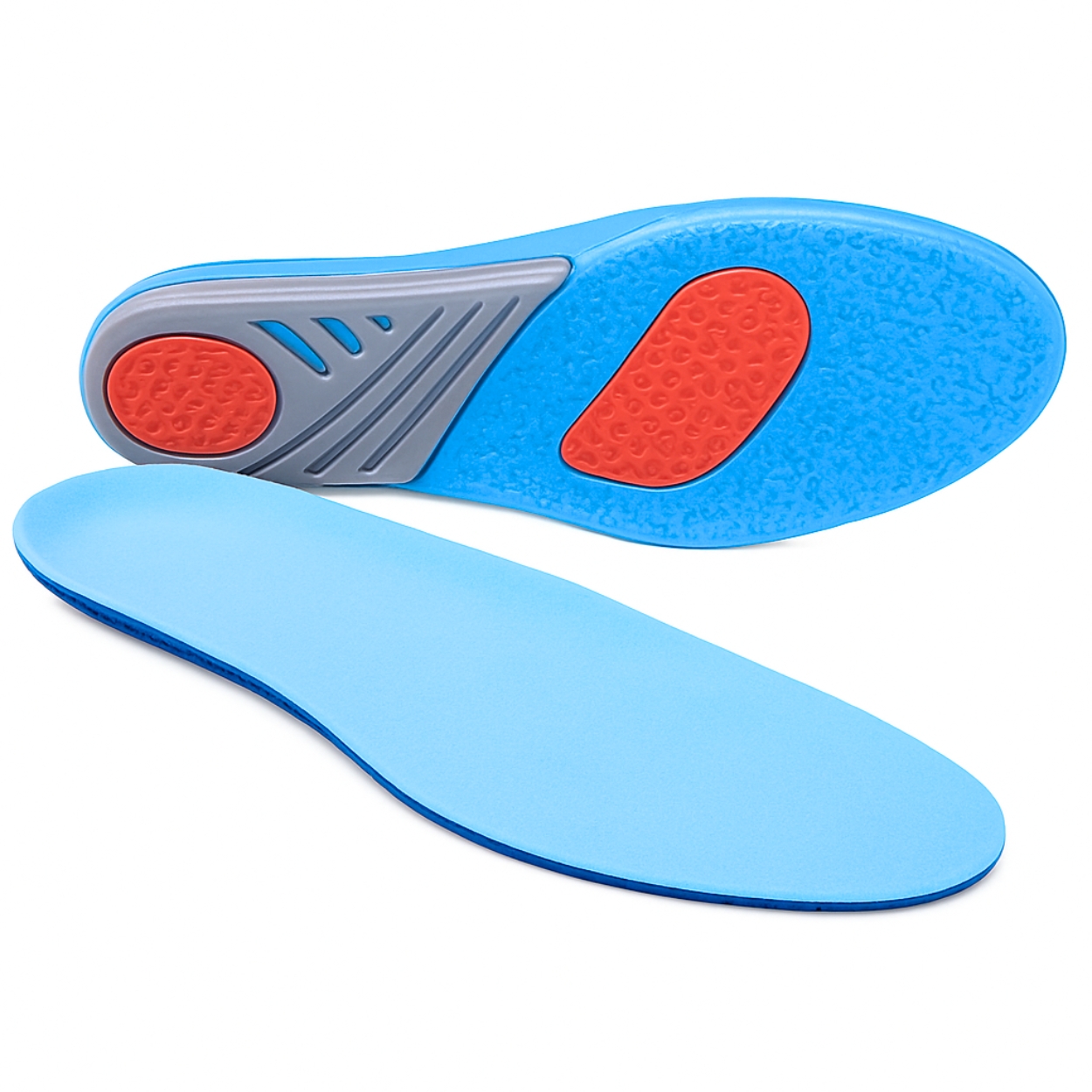


Orthotic gel insoles for Metatarsalgia
£9.99£12.99 (-23%)
- Relief for ball‑of‑foot pain and metatarsalgia: Pain under the ball of the foot can make every step feel heavier – whether it’s a dull ache by the end of the day, a sharp, burning pain as soon as you start walking, or that constant sense of “standing on a stone”. Metatarsalgia usually means the soft tissues beneath the metatarsal bones are under more pressure than they can comfortably manage, especially on hard floors or in shoes with little cushioning. When that keeps happening, the discomfort tends to build rather than fade, so changing how this area is loaded is often more effective than waiting for it to settle on its own.
- Engineered to spread pressure more evenly with every step: FootReviver gel insoles are designed to change how pressure and impact move through the foot from heel strike to push‑off, not just to cushion one sore spot. A full‑length layer of shock‑absorbing silicone gel softens impact across the whole foot, while a reinforced heel base with a gentle curve along the outer arch helps keep the heel centred and the rearfoot steady. Under the ball of the foot, a flat, slightly firmer metatarsal pad supports and shares load across the metatarsal heads instead of letting one or two tender areas take most of the strain. Together, these features ease the tissues irritated in metatarsalgia by reducing sharp pressure points and helping the forefoot work in a more balanced way.
- Slim, everyday‑shoe‑friendly support: The result is support that fits easily into your usual footwear: a slim, trim‑to‑fit insole that sits inside most everyday shoes without feeling bulky or forcing a larger size. It combines cushioning with structured support in the areas that typically take the most stress. It suits both men and women and is particularly useful if you spend long periods on your feet, walk or run on hard surfaces, or have started to notice ball‑of‑foot pain affecting daily comfort. If that sounds familiar, the main product description explains how metatarsalgia develops and how this FootReviver design helps address the underlying overload rather than simply masking the discomfort.
- Based on what clinicians look for in effective insoles: FootReviver gel insoles are built around the same principles clinicians look for when recommending insoles to help manage forefoot pain: even pressure distribution, stable heel support, and cushioning that doesn’t collapse under load. They’re designed to support healthy foot mechanics and reduce strain on sensitive tissues, offering a practical, evidence‑based approach to everyday comfort.
- Trusted comfort, guaranteed: Made from high‑quality medical‑grade gel and backed by a 30‑day money‑back guarantee, FootReviver gel insoles provide a straightforward, low‑risk way to ease forefoot strain and restore comfort step by step.
Understanding metatarsalgia – when the ball of your foot is overloaded
What metatarsalgia feels like — and why it happens
Pain under the ball of the foot is often mistaken for ordinary tiredness, but it usually points to a more specific cause. This is often metatarsalgia — soreness and inflammation beneath the metatarsal heads, the rounded ends of the long bones that connect to the toes. It refers to discomfort that develops when repeated pressure and impact are placed on a small area of the forefoot over time.
People often describe the pain as burning, bruised, or sharp under the ball of the foot. It may start as a dull soreness by the end of a long day on your feet, become a sharper pain when you first begin to walk, or feel as though there’s a small stone under the front of the foot even when you’re not wearing shoes. The soreness may sit under one or two metatarsal heads or spread more widely across the front of the foot. Hard floors or thin‑soled shoes tend to bring it on sooner and make it more noticeable.
For some, the pain appears only during activity; for others, it lingers afterwards or flares when standing up after sitting. It can worsen in certain shoes, when walking faster, or when standing still for long periods. The common feature is that the same area under the ball of the foot is repeatedly taking more load than it can comfortably manage. When this continues day after day, the soft tissues under the forefoot become increasingly sensitive, and everyday movement starts to be limited by soreness in that part of the foot.
How the forefoot works — and what goes wrong when it’s overloaded
The front of the foot is built to do two main things. First, the metatarsal heads and the soft tissue beneath them support body weight at the end of each step as weight rolls forwards from the heel. Second, together with the toes, they help push the body forwards into the next step. In a healthy, well‑balanced foot, this load is shared between the different metatarsal heads, the fatty cushioning beneath them, and the toes, and that loading lasts only for a brief moment in each step.
As you walk, the heel makes contact with the ground, the arch and midfoot take the load, and then, for a short time, the metatarsal heads and toes carry more weight as you push off. They act as a strong but flexible platform — taking load and then passing it on as the other foot takes over. Problems start when this short phase lasts too long or carries too much load, or when one or two metatarsal heads take more pressure than the others because of foot shape or how the foot moves when walking.
If the arch lowers too soon after the heel touches the ground, if the foot is very stiff and doesn’t absorb shock well, or if footwear provides little cushioning or support, the ball of the foot ends up doing more of the braking and stabilising than it should. When the arch lowers early, the foot stays rolled slightly inwards for longer. The midfoot loses some of its spring, and more pressure shifts forwards under the second and third metatarsal heads. Over time, this repeated early flattening increases strain on the soft tissue under the ball of the foot. Instead of sharing the load for a moment and then passing it on, the forefoot becomes a point where weight arrives too soon, stays too long, or presses on too small an area. The deeper tissues beneath those metatarsal heads are then exposed to more strain with each step, and over time this gradual overload is what leads to metatarsalgia.
Clinicians frequently recommend our FootReviver insoles to help redistribute pressure and reduce this overload. Our designs are shaped to support the metatarsal heads evenly and cushion the forefoot during push‑off. Each insole is developed with clinical input to match the way the forefoot naturally moves. That’s why our FootReviver insoles are trusted by clinicians across the UK. Our range includes cushioned insoles and metatarsal pads designed to relieve forefoot strain and restore the natural timing of heel‑to‑toe movement. They’re designed to reduce pressure while allowing natural movement. Each design reflects what clinicians look for — reliable support that feels natural underfoot. That’s the standard behind our FootReviver gel insoles.
Who’s most at risk — and what drives forefoot pain
Anyone can develop pain under the ball of the foot, but some situations make it more likely. People who spend long hours standing or walking on hard floors — such as in retail, healthcare, warehousing, hospitality, or teaching — often place repeated load through the same areas under the forefoot. Without proper cushioning or support, the metatarsal heads and the tissues beneath them absorb most of the impact and work harder to maintain balance throughout the day.
Regular runners and brisk walkers, especially those who train on roads or other firm paths, are also at higher risk. Each stride pushes strongly through the forefoot. If training volume increases quickly, shoes are worn out or thin‑soled, or recovery between sessions is limited, the ball of the foot can start to feel increasingly bruised or sharp, sometimes before any other area becomes uncomfortable. Sports or activities that rely heavily on forefoot work, like certain racquet sports or dancing, carry a similar risk because they load the forefoot in the same way.
Foot shape also plays a part. A higher arch often makes the foot stiffer and less able to spread impact evenly, so the heel and the ball of the foot absorb more force each time you land. Flatter feet can cause the arch to drop and the heel to roll slightly inwards, which often sends extra load forwards under the second and third metatarsals. A relatively long second metatarsal, bunions, or toes that are starting to claw or hammer can all change how weight is shared between the metatarsal heads and create small areas that take more pressure and become sore.
Footwear can protect the forefoot — or make the problem worse. Shoes with very thin or hard soles pass more impact straight through to the forefoot. High‑heeled shoes shift more body weight onto the ball of the foot, which can be enough to push an already sensitive area past its comfort limit, especially when worn for long periods. With age, the natural fat pad under the ball of the foot thins, so even normal daily activity can start to feel uncomfortable.
Metatarsalgia can also appear alongside other forefoot conditions such as Morton’s neuroma, sesamoiditis, or turf toe. In these situations, irritation of nerves, small supporting bones, or joint capsules may be made worse by the same overload affecting the soft tissue under the ball of the foot. Sometimes a stress fracture or an inflammatory joint condition can cause similar pain, which is why pain that doesn’t have an obvious cause should always be assessed by a clinician rather than ignored. Over time, this repeated strain is what most often brings people to seek help.
If these situations sound familiar — long days on hard floors, frequent running or walking on firm ground, higher or flatter arches, or shoes that are thin‑soled or often high‑heeled — then metatarsalgia is not simply bad luck. It’s a sign that your forefoot is being asked to do more than it can comfortably manage. The next step is to change how that area is loaded, from heel strike through to push‑off, so the tissues under the ball of the foot are no longer being asked to take more than they can manage. With the right support, most people find the soreness under the ball of the foot eases steadily.
Understanding these causes helps explain why the way you walk can make forefoot pain worse — and why improving that movement often brings lasting relief.
How your walking pattern can drive extra load into the forefoot
Each step follows the same basic pattern. The heel touches the ground first, weight moves across the middle of the foot, and then the body rolls forwards to push off through the ball of the foot and toes. When this happens smoothly and under control, the whole sole shares the work. When control weakens, the ball of the foot often ends up taking more strain than it should.
At heel contact, the heel bone (calcaneus) needs a stable base to land on. If it rolls inwards or outwards too quickly, the lower leg rotates slightly and the arch may drop further than normal. That combination changes how pressure moves across the sole and concentrates weight under one or two metatarsal heads. Step after step, the same small areas take more than their share of the load, and the ball of the foot begins to take the strain.
As weight passes through the middle of the step, the arch works like a bridge and a spring, helping to control how weight moves forwards. When that control is lost — whether the arch gives way too easily or stays too rigid — the timing of weight transfer changes. More load reaches the forefoot earlier and stays there longer, leaving the ball of the foot to carry more pressure than intended.
During the final part of the step, as the body moves forwards into push‑off, the metatarsal heads and toe joints bear much of the body’s weight. If the heel has been unstable or the arch hasn’t been supported, this phase can become uncomfortable sooner than it should. People often adjust their walking pattern without noticing: shortening their stride, turning the feet slightly outwards, or rolling towards the outer edge of the foot to avoid the sore area. These changes may ease discomfort temporarily, but they shift strain elsewhere and can start to irritate the ankles, knees, hips, or lower back.
Over time, the muscles and tendons that try to steady an unbalanced foot can tire. The calf muscles and Achilles tendon may feel tight from working harder to control the forward roll of the body. The inner or outer side of the ankle can start to ache as it compensates for a heel that tends to tip, and the soft tissue under the ball of the foot becomes more sensitive, even during routine activity. It’s often around this stage that everyday movement – standing at work, walking between tasks, or moving around during the day – starts to feel dominated by forefoot pain.
When the heel isn’t well controlled and the arch either collapses too far or stays too rigid, a consistent pattern develops: the ball of the foot becomes the main brake with each step and starts to ache. Easing pain under the ball of the foot is rarely as simple as padding one sore spot. To make a lasting difference, the way the foot moves from heel contact through to push‑off needs to change, so each step feels steadier and pressure is spread more evenly across the forefoot.
That’s why improving the support inside the shoe is often the most effective way to change how the foot behaves with each step.
Why a supportive insole is a sensible next step
Because metatarsalgia usually develops through repeated strain rather than a single injury, it makes sense to look for ways to change how pressure and impact are spread across the foot. A well‑designed insole sits between the sole of the foot and the inside of the shoe and can affect three key stages of each step without requiring any complex fitting or adjustment.
First, an insole can increase the area over which body weight is carried. A shaped layer under the foot allows more of the sole to share contact with the shoe, so the same overall force is spread more evenly. Instead of one or two metatarsal heads bearing most of the pressure, the whole forefoot and the soft tissue between them share the load. That lowers the peak pressure at any single point, which is often where pain begins.
Second, a cushioning insole can soften the rise and fall of impact forces at heel contact and push‑off. On hard floors or in shoes with thin soles, the transition between the foot and the ground can be abrupt. A shock‑absorbing layer such as silicone gel compresses slightly under weight, slowing the transfer of force into bones and joints. For people who spend long hours on hard surfaces, or who walk long distances, this helps each step feel smoother and less jarring at both the heel and the ball of the foot.
Third, insoles can improve how the heel and arch are supported. By cradling the heel and providing structured support along the arch, an insole can limit how far and how quickly the foot rolls inwards or outwards. It doesn’t alter bone structure, but it helps guide the foot towards a steadier movement. A more controlled roll from heel to midfoot usually means less twisting through the forefoot and a lower chance of collapsing onto one or two metatarsal heads at push‑off.
Clinicians frequently recommend cushioned, supportive insoles to help manage forefoot pain such as metatarsalgia. When more of the forefoot shares the load and sharp pressure points are reduced, walking and standing usually feel easier. Insoles are rarely the only measure used, but they often form a central part of a broader plan that may also include footwear changes, simple strengthening or stretching work, and practical adjustments to time spent standing or walking.
Very soft, flat gel inserts can make each step feel more comfortable for a short time, but they do little to guide how the heel lands or how the forefoot takes load. A properly supportive insole goes further: it cushions impact and subtly changes how the foot and shoe share the load. Our FootReviver Gel Insoles have been developed around this goal – to give the foot a more supportive and forgiving surface to work against from heel to toe, rather than simply adding a soft layer under one painful area.
FootReviver Gel Insoles – built for real movement, trusted by clinicians
Our FootReviver insoles are designed to cushion and guide the foot into a more stable, balanced movement. Each design is developed with clinical input and tested for comfort and durability.
FootReviver Gel Insoles are full‑length insoles that combine a continuous layer of shock‑absorbing silicone gel with firmer support elements in key areas. The design works with the natural pattern of each step, supporting the foot from heel contact through to push‑off, so no single area is left to absorb more strain than it should.
The base of each insole is formed from a single sheet of silicone gel that runs from the back of the heel to the tips of the toes. This gel is soft enough to cushion impact yet firm enough to keep its shape under the loads of daily walking. As weight comes onto the foot, the gel adapts slightly to the contours of the sole, helping to spread contact and reduce hard edges or high points inside the shoe.
Under the heel and part of the midfoot, this gel layer is bonded to a firmer plastic base. This reinforcement creates a stable cradle for the heel, with a gentle upward curve that follows along the outer edge of the arch towards the midfoot. As the heel settles into the gel, the firmer base beneath it encourages a deeper, more supportive heel cup. This combination of a shaped shell and moulding gel helps to keep the heel centred at the start of each step and as the body rolls forwards.
As the arch sits over this reinforced section, the silicone gel above it provides a gentle, contoured layer of support rather than a completely flat surface. The gel adapts to the shape of the inner and outer sides of the midfoot, while the firm base underneath limits how far the arch moves with each step. This combination helps to reduce excessive rolling inwards (over‑pronation) and outwards (supination), supporting a more centred position for the heel and midfoot as the body moves forwards.
At the front of each FootReviver insole, under the ball of the foot, sits a flat metatarsal pad made from a similarly firm, shock‑absorbing plastic material. This pad is broad and low in profile, rather than forming a pronounced dome. It sits beneath the metatarsal heads and the soft tissues just behind them, creating a more even platform across the forefoot so that all of the metatarsal heads and the tissue between them share the load, instead of allowing one or two sore points to take most of the pressure.
The forefoot area around and in front of this pad is made from soft, flexible gel. This allows the front of the insole to move naturally with the toes rather than forcing them into a rigid shape. As the toes extend during push‑off, the gel supports the underside of the forefoot while still allowing a natural toe splay within the limits of the shoe. This blend of firmness under the metatarsal heads and flexibility under the toes helps to reduce peak pressure under the ball of the foot without making the forefoot feel blocked or cramped.
Small ventilation holes are placed in key areas of the insole to allow air circulation under the foot. When used in suitable footwear, these holes help reduce the build‑up of warmth and moisture that often occurs during long days on the feet, keeping the skin cooler and drier.
Even with these built‑in supports, FootReviver Gel Insoles remain slim and light. They are designed to fit most everyday shoes without taking up excess space or forcing a change in shoe size. Trim lines at the toe end of each insole make it easy to shape them to match the inside of the shoe. When trimmed carefully from the front only, this ensures that the heel sits properly in the cradle and that the metatarsal pad lies under the ball of the foot where it provides the most support.
Unlike flat gel inserts that simply add softness, or partial insoles that only support the heel and arch, this FootReviver design combines full‑length cushioning with a defined heel cradle, contoured midfoot support, and a broad, flat metatarsal pad. The result is an insole that does more than just feel soft underfoot: it supports the way the foot moves and helps to share pressure more evenly across the areas most often overloaded in metatarsalgia. Each design is refined through feedback from clinicians and users, and built from medical‑grade materials chosen for resilience and comfort. That focus on real‑world use is what sets FootReviver apart.
How every part of a FootReviver insole supports your foot
Every part of a FootReviver insole has a purpose. The benefit comes not just from the materials, but from how they’re shaped and positioned under the foot. Each section is designed to move with your foot, not against it, easing pressure under the ball of the foot while staying comfortable inside most footwear. Let’s look at how each part plays its role.
Full‑length silicone gel – softer landings, smoother steps
A full‑length gel layer means the entire sole of the foot gets cushioning, not just the heel or arch. As the heel meets the ground, the gel compresses slightly to absorb some of the impact. As weight moves forwards, the same layer continues to cushion the midfoot and forefoot, so there’s no sudden change between supported and unsupported areas.
For people with metatarsalgia, each step on a hard surface feels less jarring, particularly under the ball of the foot. The tissues beneath the metatarsal heads are exposed to less pressure because part of the impact is absorbed earlier in the step, and the remaining load is spread more evenly across the gel surface. Over time, reducing this repeated impact can help the area become less irritated and sore, especially when paired with supportive footwear and a reasonable amount of time on your feet.
Reinforced heel base and gentle outer arch support
Beneath the heel and along the outer edge of the arch, a firmer plastic base provides steady support. When the heel lands, this base helps prevent it from rolling too far inwards or outwards, working in balance with the cushioning gel above. As body weight moves forwards, the gentle curve along the outer arch helps the foot roll smoothly from heel to midfoot.
The gel layer under and around the arch moulds gently to the foot, creating closer contact with the arch. The inner side is supported without a hard ridge, while the outer side is prevented from dropping away. Together with the heel cup, this helps limit excessive inward rolling (pronation) and outward rolling (supination), so the ankle and arch stay within a steadier range of movement instead of repeatedly reaching their extremes.
When the heel and arch are steadier, the front of the foot twists less. Instead of the midfoot dropping quickly and leaving the metatarsal heads to take most of the strain, the whole sole shares the load more evenly. This makes it less likely that one small area under the ball of the foot repeatedly absorbs the main impact — a common cause of metatarsalgia and other forefoot pain conditions. Many people don’t realise how much difference a stable heel makes until they feel it.
A supportive heel cup formed by gel and shell together
The deeper, more secure heel cup is created by the way the gel and plastic shell work together. The rigid base provides a defined shape for the heel area, while the gel moulds around the natural fat pad beneath the heel bone when weight is applied. This allows the heel to sit securely in a shaped cradle rather than sliding on a flat surface.
For heels that tend to move quickly or unpredictably inside the shoe, this contained position improves both comfort and stability. Each step begins from a more stable base, and that control continues through the rest of the step. Over time, this can reduce the likelihood of twisting or collapsing through the midfoot, which in turn helps to ease pressure under the forefoot.
Flat metatarsal pad to share load across the forefoot
Finally, the front of the insole plays a key role. The metatarsal pad in FootReviver insoles is flat and broad rather than sharply domed. Its firmer material forms a stable platform beneath the metatarsal heads and the soft tissue just behind them, while the surrounding gel provides a softer cushion. This lifts and supports the forefoot gradually, avoiding the raised bump that some people find uncomfortable.
When weight rolls forwards onto the ball of the foot, pressure is spread across the width of the metatarsal heads instead of concentrating under one or two that may already be sore. A flatter pad is often easier to tolerate for those who find tall domes intrusive, yet it still redistributes pressure away from over‑worked areas. For many people with metatarsalgia, moving from one sore spot taking most of the strain to several structures sharing the load is key to lasting comfort.
Each component of a FootReviver insole is tested for comfort, durability, and clinical performance. This attention to detail is one reason clinicians across the UK recommend FootReviver for forefoot pain. Together, these features make FootReviver Gel Insoles a trusted choice for lasting comfort and support.
Flexible forefoot gel for a more natural toe spread
At the front of the insole, the gel is intentionally more flexible. As the toes extend and spread inside the shoe, the gel follows their movement and cushions them without restricting their natural motion. This helps to avoid the feeling that the forefoot is resting on a rigid base or being pushed into an awkward position.
When the toes can settle into a more natural spread, the spaces between the metatarsal heads are less compressed. This can be especially helpful when pain involves irritation of the soft tissues or small nerves between the toes. A supported yet adaptable forefoot can make the final phase of each step – when the ball of the foot and toes carry most of the load – feel more controlled and less sharply painful.
Slim profile, easy fit, and ventilation
A supportive insole needs to be practical for everyday footwear. The slim profile and light feel of FootReviver gel insoles make them easy to fit into a wide range of shoes without needing a larger shoe size. The trim‑to‑fit outline allows careful adjustment at the front so the insole sits flat and the key support areas align with the heel and forefoot.
Ventilation holes within the gel allow air to circulate under the foot where shoe design permits. For people on their feet for long periods, this helps reduce the build‑up of warmth and moisture and keeps the skin more comfortable, particularly under the forefoot where metatarsalgia often makes the area sensitive.
Durable construction for regular use
The combination of silicone gel and reinforced plastic is chosen to provide reliable cushioning and support through repeated use. The gel resists flattening under normal day‑to‑day loads, while the firmer areas keep their shape to continue guiding and supporting the foot. With reasonable care, including appropriate footwear and simple cleaning, these insoles are designed to be part of daily use rather than a short‑term fix.
How these insoles ease ball‑of‑foot pain in daily life
Metatarsalgia tends to become most noticeable during ordinary tasks such as standing for extended periods, walking on hard floors or pavements, or taking longer walks or runs. FootReviver gel insoles are designed with these situations in mind, so the way forces are handled under the foot changes in a way that reduces strain during the activities that fill a normal day.
When standing, especially on firm surfaces, the full‑length gel layer spreads contact across the sole as soon as weight is placed on the foot. Instead of body weight being channelled quickly onto a small area under the metatarsal heads, the heel and midfoot take more of the load. The reinforced heel base, contoured arch support, and supportive heel cup improve stability at the heel, reducing the need for the forefoot to tense and stabilise with every small movement.
On harder ground, the gel continues to soften impact at each phase of the step. Heel strike feels less abrupt, the midfoot is less exposed to sudden hard contact, and as weight moves forwards into push‑off, the flat metatarsal pad and surrounding gel support the ball of the foot more evenly. This makes the transition through the forefoot smoother, with less of the “sharp stone under the foot” feeling that many people with metatarsalgia recognise.
During longer periods of standing, such as at work or during daily activities, the insoles help keep pressure under the forefoot more evenly distributed. The ball of the foot remains one of the main weight‑bearing areas, but the combination of a supportive pad under the metatarsals, cushioning gel, and a steadier heel means no single metatarsal head is as likely to carry the whole burden. This delays or reduces the burning, tired sensation that tends to develop under the forefoot as the day goes on.
Where metatarsalgia is linked to foot shape, such as relatively flat or high arches, the way the heel and midfoot are supported can be especially helpful. By guiding the foot through a more controlled roll and reducing sudden collapses or excessive tipping, the insole lowers the repeated strain placed on sensitive forefoot tissues. The aim is not to create a rigid or artificial gait, but to make the existing pattern more efficient and more comfortable.
These insoles are not a guarantee that all forefoot pain will disappear, particularly where there are more complex structural changes or longstanding conditions. They are designed to be one practical measure within a wider approach that may also involve footwear changes, activity adjustments, and professional guidance. Within that context, many people find they can stand and walk more comfortably and for longer before metatarsalgia becomes noticeable again.
Who FootReviver insoles are best suited to – and when to seek advice
FootReviver gel insoles are designed for adults who experience discomfort under the ball of the foot, have been told they have metatarsalgia, or recognise that long periods on their feet are starting to leave the forefoot feeling tender and overworked. They are particularly suited to people who spend much of the day standing or walking on hard, unyielding surfaces, notice a burning, bruised, or sharp sensation under the ball of the foot during or after activity, or have flatter or higher arches that place extra load on the forefoot.
They can also help where early bunions, mild toe deformities, or general foot fatigue are beginning to alter how pressure is spread across the forefoot. In these situations, supporting the heel and outer arch, and sharing load more fairly across the metatarsal heads, can help to reduce the extra stress being placed on already sensitive areas.
Some situations call for caution. If pain develops suddenly after a clear injury, is severe enough to make weight‑bearing very difficult, or is associated with marked swelling or an obvious change in foot shape, a medical assessment should take priority over relying on insoles alone. People with conditions such as diabetes with reduced sensation in the feet, significant circulation problems, or known inflammatory arthritis should discuss new insole use with a healthcare professional to ensure it is suitable and safe for their particular circumstances.
It’s also advisable to seek advice if metatarsalgia is accompanied by redness, heat, or strong pain at rest or at night, or if there is no improvement despite wearing the insoles in appropriate footwear for a reasonable period. In such cases, there may be additional factors at play that require specific treatment. FootReviver insoles are designed to support better mechanics and comfort, but they do not replace the need for diagnosis or specific medical care when it is needed.
Conditions FootReviver insoles may also support
Metatarsalgia often occurs alongside other foot or lower‑limb conditions that affect how forces are carried through the foot. The full‑length cushioning and targeted support built into this design mean FootReviver gel insoles may also be helpful for a range of related issues by changing how pressure and impact are handled.
Simple to fit, adjust and keep fresh
FootReviver gel insoles are designed to be straightforward to use from the start. They fit easily into most everyday shoes and can be adjusted for a precise fit using the trim‑to‑fit lines at the toe end. In shoes with removable factory insoles, they usually fit best when those are taken out first, giving enough space for the FootReviver insole to sit flat. Once in place, the heel should rest fully in the cradle and the front should lie smoothly without creasing or lifting.
If the insole feels slightly too long, the printed size lines make it easy to trim accurately. Using sharp scissors, trim a small amount at a time along the line closest to your shoe size, checking the fit as you go. The reinforced heel and metatarsal areas are already shaped for support, so there’s no need to cut into them.
The materials are easy to keep clean. A quick wipe with a damp cloth and mild soap is usually enough, followed by air drying at room temperature. They don’t need special products or equipment, and keeping them away from direct heat helps preserve their structure. Allowing them to dry between uses keeps them comfortable and fresh for longer.
What to expect and when to get further advice
Most people notice a difference in how their feet feel soon after they start using FootReviver gel insoles. Standing or walking on hard floors often feels softer and less jarring, and the sharp, pinpoint discomfort under the ball of the foot may begin to feel more spread out and manageable. Over the following days and weeks, many find they can stay on their feet for longer before forefoot pain builds, and that everyday standing and walking feel less dominated by pressure under the ball of the foot.
Everyone responds a little differently, especially where there are longer‑standing conditions, changes in bone alignment or joint position, or additional issues such as inflammatory joint disease. In these cases, insoles work best when used alongside professional advice and treatment, and as part of a broader plan that may include exercises, suitable footwear, and careful management of time on the feet.
Some situations need more than an insole, and it’s important not to ignore them. You should arrange further assessment if:
– Pain is severe, sudden, or follows a clear injury.
– There is marked swelling, redness, or warmth in the foot.
– The foot or toes change shape noticeably over a short period.
– New numbness, tingling, or weakness develops in the foot or toes.
– Pain is present at rest or during the night and is getting worse rather than settling.
– There is no improvement after giving the insoles a fair trial in suitable footwear.
FootReviver gel insoles are designed to support healthy foot function by improving cushioning, distributing pressure more evenly, and providing steadier support at the heel and forefoot. They offer a practical step you can take straight away, while recognising that some situations need individual medical care and direct assessment.
Why choosing FootReviver insoles makes sense
Ball‑of‑foot pain and metatarsalgia often develop when the tissues under the ball of the foot (the metatarsal heads) are repeatedly placed under more pressure and impact than they can comfortably manage. The way the foot moves, the time spent on hard surfaces, shoe choice, and overall activity levels all play a part. A soft pad alone may not solve the problem if the heel is unstable, the arch is unsupported, and the forefoot continues to take most of the load.
FootReviver gel insoles are designed to address these issues from several angles at once. A full‑length gel layer cushions the entire sole, while a reinforced heel base, contoured midfoot support, and gentle support along the outer arch help to steady the rearfoot. A flat metatarsal pad spreads load across the ball of the foot, and the flexible forefoot gel lets the toes spread more naturally. Ventilation holes and a slim, trim‑to‑fit design make them practical for everyday shoes, so support is there during the activities that matter most.
For those who notice that ball‑of‑foot pain is starting to limit what can be done comfortably each day, these insoles offer a simple way to make each step feel easier. With a focus on responsible, evidence‑based design and a straightforward 30‑day money‑back guarantee, FootReviver gel insoles provide the forefoot and the rest of the foot with a more stable, cushioned base to move from all through the day. When used with suitable footwear and professional advice where needed, they can become a key part of a sensible plan to manage metatarsalgia and related loading issues in the longer term. FootReviver gel insoles are a practical, evidence‑based way to reduce forefoot strain and restore comfort step by step.
Additional information
| Size | 3-9, 9-12 |
|---|



Reviews
There are no reviews yet.