
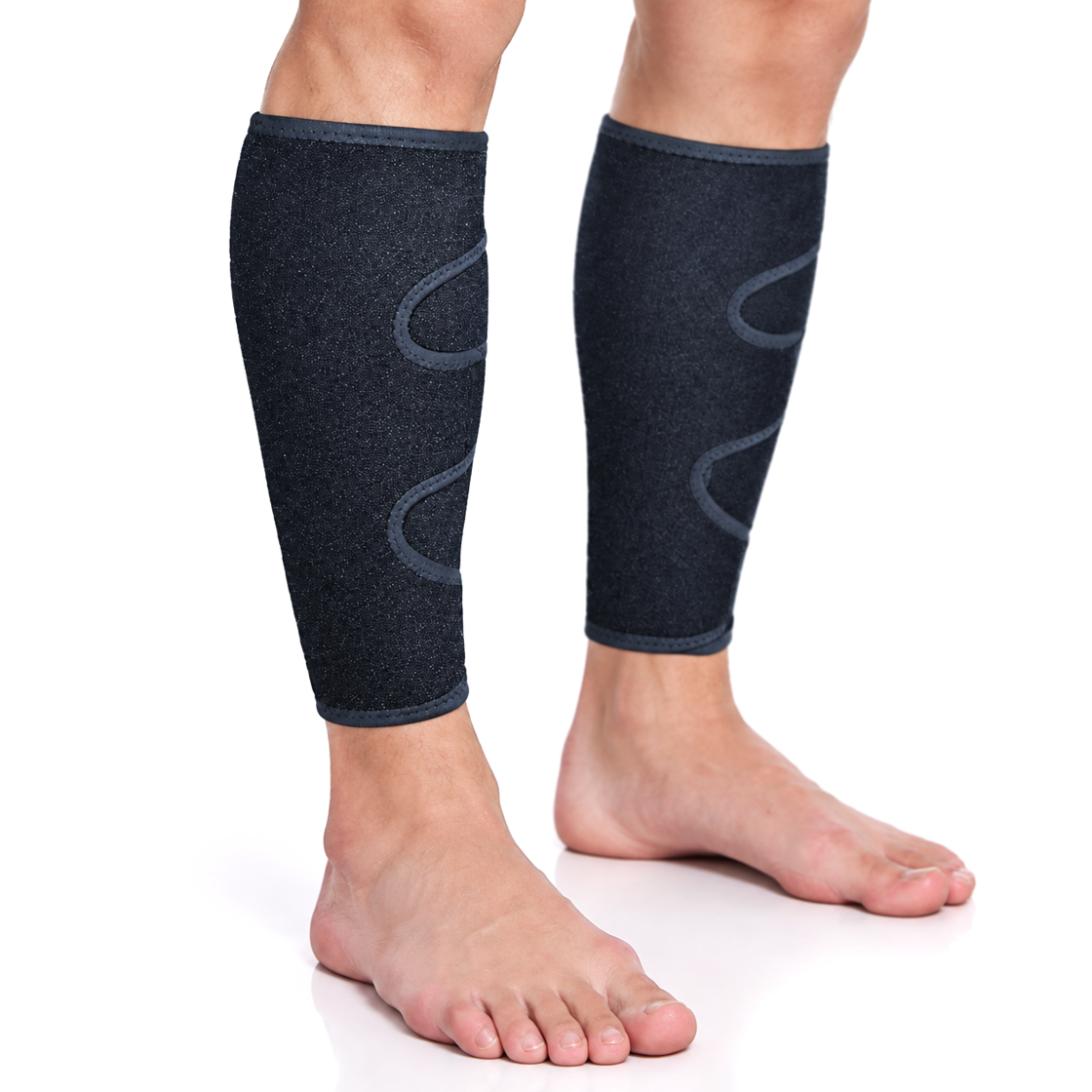
1x Pair of Compression Calf Support Braces For Shin Splints
£19.99
- A pair of compression calf supports — one sleeve for each lower leg
- Made for both men and women, in a universal size adjusted by wrap-around straps
- Neoprene body that holds its shape and stays in place as you move
- Antibacterial, moisture-wicking fabric so sweat is drawn away from the skin
- Hook-and-loop straps that press onto the sleeve, so you set the tension in small steps yourself
- Supports the calf and the sore line along the inner shin during activity
- Compression that helps the calf pump move blood and fluid up the leg
- A layer of material that cushions the calf against some of the impact of each step
- Used to help ease shin splints, Achilles tendonitis, tired aching legs, varicose veins and oedema
- Also worn through long spells on your feet at work, when the legs feel heavy by evening
- Wear them for running, walking and long shifts, and adjust the straps whenever the tension feels wrong
- A support rather than a treatment, with no guaranteed outcome
- Ask a GP, physiotherapist or podiatrist first if you have diabetes, neuropathy, poor circulation, varicose veins or oedema
- Does not treat or prevent blood clots, and should not be relied on for that
What you may be noticing in your shins and calves
It usually starts small. A tightness along the front or inner edge of your shin when you set off on a run, which eases as you warm up and settles once you stop. Then, over a few weeks, it stops easing. The ache lingers into the evening, it’s there when you come down the stairs the next morning, and the first ten minutes of your next run feel worse than the last ten did.
That pattern, pain that builds with activity and fades with rest, is what most people mean by shin splints. Where it sits is consistent. Run your fingers down the inner border of your shin bone and you’ll usually find a length of a few inches that’s tender to press, rather than one pinpoint spot. The ache spreads along it rather than staying put. Early in a run it feels dull and broad; later it sharpens. That’s frustrating, because the pain comes from the very thing you want to keep doing.
Not every shin pain follows that pattern. Two of the alternatives are more serious than shin splints, and neither responds to a sleeve. A stress fracture gives you one small point on the bone that hurts sharply when you press it, along with pain that carries on when you’re resting or wakes you at night. Exertional compartment syndrome brings a tight, burning, swollen feeling in the calf that arrives at a fairly fixed point in a run and takes much longer than usual to settle once you stop. Both need assessment rather than a support.
Pain at the back of the heel, or just above it where the calf meets the heel bone, is more typical of Achilles tendonitis. The Achilles tendon is the thick band that connects your calf muscles to your heel. When it’s irritated, the tell-tale sign is the timing. It’s stiff and sore on your first few steps out of bed, eases over the next ten or fifteen minutes as you move about, and then stiffens again after a longer walk or a run. The tendon itself often feels thicker than the other side when you pinch it.
There’s also a plainer version: legs that simply feel heavy and tired by the end of the day. Nothing is sharply painful. They’ve been carrying more than they’re used to, and sitting down is a relief. That’s common in people who are on their feet for work, or who have recently started walking or running more than they were doing before.
Some people notice more than tiredness. Veins in the calf or ankle become visibly swollen or twisted, often with a throbbing or aching quality that gets worse after a long spell standing and easier once you walk or put your feet up. Those are varicose veins: vein walls that have stretched and now hold more blood than they should.
Swelling follows a different pattern. Ankles and calves that swell as the day goes on, socks that leave a deep mark, shoes that fit in the morning and pinch by evening, skin that feels tight across the ankle. That’s oedema, which means fluid collecting in the lower leg rather than being carried away from it. It tends to be worst at the end of the day and better after a night in bed with your legs up.
Circulation can be part of the picture too, and it’s the one on this page that isn’t about the pump. Cramping in the calf that comes on at a predictable distance into a walk and settles within a minute or two of stopping is the classic pattern, and cold feet, pale or shiny skin and slow-healing nicks on the lower leg can go with it. That isn’t a problem a sleeve solves. Compression over a leg with reduced arterial supply is the one place on this page where getting it wrong matters, so it’s worth having looked at before you add anything to the leg.
Some people are also living with diabetes, or with neuropathy, a term for changes in nerve sensation that can leave feet and lower legs feeling numb, tingly or otherwise changed. These are medical conditions in their own right, and they alter how much pressure or compression is sensible for you.
Judging whether a sleeve is too tight relies on feeling it clearly and noticing when something isn’t right. Diabetes and neuropathy can dull that feedback, so pressure, rubbing or irritation may not register as quickly as they would for someone without it. That doesn’t put a sleeve off limits. It means the decision is better made with someone who can assess your circulation and sensation first, rather than by trial and error on your own.
Two things lie behind most of what’s described above. The first is load: the force your lower legs carry and absorb, step after step. The second is the pump that returns blood and fluid from the leg. Diabetes and neuropathy sit outside both. They don’t cause the ache, but they change how clearly you can feel a sleeve and how much pressure is sensible, which is why they come up again at the end.
Why your lower legs react like this
Think about what happens with every single step. Your calf muscles, the ones at the back of your lower leg, tighten. Your foot points down and you push off the ground. On landing, those same muscles and the tissues around them absorb the impact.
Run, and this repeats with every stride, hundreds of times with every kilometre you cover. Add a hard surface or a hill and the force per step goes up. A different pair of shoes can change where that force lands, which is why an unaccustomed change can bring on trouble even when your weekly distance hasn’t moved. Your body is good at adapting to what you ask of it, but it needs time. Ask for more faster than your tissues can adapt and one of them has to take more than it can.
Here’s why shin splints spreads across an area rather than settling in one spot. The work along the front and inner side of your shin isn’t carried by a single structure. It’s shared between the muscles that run down the leg, the tendon that anchors them, and the connective tissue that binds them to the bone. When the total exceeds what that group has been prepared for, the irritation appears across the group rather than at one point. Press along the bone and you find a tender zone, not a single sore dot. That’s also why it so often appears after a sudden change (a new training block, longer runs, a shift from soft to hard ground, or simply doing more when you’re already tired) rather than out of nowhere.
The Achilles behaves differently. It stores energy as your foot lands and releases it as you push off, which is part of what makes running efficient, and it’s also why the tendon responds to pace and incline as much as to distance. Going faster or climbing a hill raises the force through it with each step, even if your weekly mileage hasn’t budged. You can pick up Achilles pain without having done anything obviously “more”. You just asked the tendon for more per stride than it was ready to give. Tight calves add to this, because a stiffer calf passes more of the work down the tendon.
The calf has another job, and it’s one most people never think about. It acts as a pump. Veins in your legs don’t have much help pushing blood up to your heart. They rely largely on the muscles around them squeezing with each step, with one-way valves inside the veins making sure blood travels upwards rather than draining back down.
Walking does this well. Every step squeezes the calf, the valves hold the blood where the squeeze put it, and the whole column moves up and out of the leg. Standing still is where it stops working. The squeeze stops, but fluid keeps collecting, and the valves on their own can’t do the pushing. A few hours at a counter or on a shop floor is long enough for the effect to build, which is why your calves can feel heavy by late afternoon and noticeably lighter after a short walk.
When that pump is working properly, blood and fluid move up and out efficiently. When you’re static for long periods, or when the veins and valves are under strain, the pump becomes less effective and fluid sits lower down. You get the heavy, swollen feeling by the end of the day. Varicose veins are the same thing showing at the surface. Oedema is what happens when fluid collects in the tissue rather than being cleared.
So your lower leg is being asked to do two things at once: carry force through the shin, calf and Achilles tendon, and return blood and fluid from the leg. When the first job gets harder than the tissues are ready for, you get the tenderness along the shin and the ache that builds through a run. When the second gets less efficient, you get the heaviness and swelling. Neither job is something you can simply switch off. Both can be made a little easier to manage, though, which is what a calf sleeve is for.
Why a compression calf support can help
So what does a calf sleeve actually do? Three things, mainly.
Start with support. A sleeve around the calf and shin holds the area in a more settled position while you move. Rather than muscles and tissue working against a background of movement and fatigue, they get a more stable base. For shin splints, that stability is the benefit. The tissues along the shin are asked to do less of the stabilising work themselves, so there’s less of the strain and pressure that builds into pain over a run. The size of that effect varies from person to person, and it’s a comfort difference rather than a performance one.
The second effect is compression, and it works on the pump directly. A consistent squeeze around the calf encourages blood flow through the lower leg and supports the return of blood and fluid upwards. Your pump relies on the calf being squeezed, and an external squeeze does part of that job for you, including during the long spells of standing when your own muscles aren’t doing the work. That’s why tired, aching legs feel easier in compression, and why it can take the edge off the heaviness that builds during a day on your feet.
This is why the sleeve covers the whole calf rather than relying on one narrow band. A single strap pulled tight across the calf creates one high-pressure line, with the tissue above and below it left unsupported. That’s uncomfortable, and it does little for the pump. A sleeve covering the whole lower leg spreads the squeeze over a much larger area, so the pressure is even rather than concentrated. Even pressure is what makes prolonged wear tolerable. On this pair, the neoprene is what presses evenly against the calf, and the straps are how you decide how firmly it presses.
Then there’s the cushioning. Every impact sends force up through your foot, ankle and lower leg, and a layer of material around the calf stands between the muscle and some of that. Be realistic about the size of the effect. A few millimetres of neoprene won’t change the forces involved in running, but across a long walk, a long run or a shift on hard flooring, a little less of it reaching the calf is something you notice. There’s a simpler effect too. Having the sleeve on reminds you the area is being managed, and that small prompt is often what stops people pushing through the early warning signs that caused the trouble in the first place.
The mistake is expecting the sleeve to do the job on its own. It won’t. What it can do is make the load more manageable while you build your tolerance back up, and help you keep moving rather than having to stop entirely. That’s what it’s for: keeping you going while your legs catch up.
What this pair is made of and who it helps
This is a pair of compression calf supports — two sleeves, one for each leg. Wearing both does something practical. Lower-leg problems are rarely one-sided for long, because when one side is sore you naturally shift work onto the other. Supporting both keeps your movement even, rather than letting the stronger leg take more than its share while the sore one does less.
They’re made for both men and women, and they come in a universal size. Universal means one size intended to fit most adults, with the wrap-around straps doing the work of adjusting the fit to your calf. That arrangement makes sense here, because calf size varies a great deal between people of the same height and weight, and a strap you can draw to your own shape is more forgiving than a fixed measurement. A fixed sleeve that’s slightly off either pinches or does nothing. A strap you set yourself doesn’t have that problem.
The sleeve itself is made from neoprene. Neoprene is a flexible, rubber-like material that holds its shape and gives consistent support without feeling rigid. Two things follow from that in use. It stays against the calf rather than sliding down as you move, so the sleeve still covers the same area at the end of a run as it did at the start. And it holds its shape rather than creasing into a hard fold, which is the usual way a softer fabric ends up pressing hard on one spot.
The fabric is antibacterial and moisture-wicking, meaning sweat is drawn away from your skin rather than sitting against it, and the material does more to hold back the bacteria that cause odour. Dry fabric also stays where you set it. Damp material slips and rubs, and a sleeve that has shifted has stopped doing the job you fitted it for.
The straps do the fitting. They wrap around the calf and fasten onto the sleeve with hook-and-loop fastening, the same principle as the strips on a gym bag or a walking shoe. You draw the strap round to the tension you want and press it onto the neoprene to hold it. Because the fastening surface is the body of the sleeve itself, you can set the tension in small steps rather than being stuck with one setting. When the straps aren’t wrapped round, they lie flat against the outside of each sleeve, so the pair sits neatly in a bag or a drawer.
Supports of this type are used to help ease a range of lower-leg problems: shin splints and Achilles tendonitis, along with varicose veins, oedema, and simply tired aching legs and feet. Diabetes and neuropathy are a different matter again. A sleeve doesn’t treat either, and both change how much pressure is sensible and how clearly you can judge the fit, so they belong in a conversation with a clinician before you start. Poor circulation belongs with them rather than with the list above. It isn’t what these are for, and it’s the one condition here where compression can do harm rather than good if it’s applied to a leg whose blood supply is already reduced.
For shin splints, the sleeve covers the whole sore line along the inner shin rather than pressing on one point of it, which is what you want for a problem spread across muscle, tendon and connective tissue together, and it cushions each landing a little. Achilles tendonitis is a smaller ask. The sleeve adds comfort around the calf, and the honest version is that the morning stiffness usually settles with changes to how much you’re asking of the tendon rather than with a sleeve on its own. Varicose veins and oedema are where compression does most of its work, helping the pump during the long standing spells when it’s idle. And for legs that are simply tired and heavy by the end of the day, it’s that same easing effect after a long shift.
Getting the fit right and what to expect
How to put them on
How the sleeve sits decides whether it works well or becomes a nuisance, so it’s best to get it right the first time.
Slide the sleeve up your calf so it covers the calf muscle and the part of the shin you want supported. There are two edges to check. The lower edge should sit clear of the crease at the front of your ankle, so it doesn’t dig in when your foot bends up as you walk. The top edge should sit clear of the back of your knee, so it doesn’t bunch when the knee bends. Between those two points, the fabric should lie smooth against your skin without rolling at either end. Smooth out any creases as you go. A fold pressed into one spot will be noticeable before long, and it’s easier to fix before you set off than a mile into a run.
Then wrap the straps around and press them onto the sleeve. Start gentler than you think you need. The right tension gives a clear sense of support and a firm, even squeeze, without feeling restrictive. A simple test: it should feel snug enough that you notice it, and light enough that you forget about it within a few minutes of moving.
If it’s too tight, peel the strap back and re-seat it slightly looser. That’s the advantage of the wrap-around design. You can adjust mid-run, mid-walk, or halfway through a shift without taking anything off, and it’s a good deal easier to tighten a strap than to spend an hour adjusting one you set too firm.
When to wear them, and for how long
Most people wear these while running and exercising, which is what they’re designed for. They’re equally suited to long days on your feet, when the squeeze eases that heavy feeling by the evening.
The standing spells are where that matters most. If your working day is spent at a counter, a till or a bench, your calf muscles aren’t being used to push blood and fluid up the leg, and nothing else is doing it for them. An external squeeze takes on part of that job while you stand, which is why the same sleeve that helps across a run also helps across a shift, even though the work it’s doing is different in each.
There’s no fixed rule on hours, but a few boundaries are sensible. Wear them for the activity or the stretch of standing they’re meant for, and take them off when you’re resting with your legs up, since there’s nothing for them to do then. These are not designed to be slept in. Compression worn overnight is a separate decision, made with a clinician and usually with a garment fitted for it, because you can’t adjust tension while you’re asleep and you won’t notice it becoming uncomfortable.
Notice how the fit holds through the session. If you find yourself wanting to loosen the straps partway through, start a touch gentler next time. The sleeve should feel much the same at the end of a run as it did at the start. If it has tightened up or worked loose, the tension wasn’t quite right.
As for what to expect, this is a support, not a repair. It won’t undo months of overload in a week, and it won’t make an irritated Achilles tendon or a sore shin settle overnight on its own. What it does is change the conditions you’re loading your legs in. The first thing to look for is comfort: legs that feel more supported during activity and less heavy afterwards. The deeper change, the one where the tissues actually become more tolerant of what you ask of them, comes from the combination of support, sensible progression and enough recovery between sessions. That part runs on weeks, not days.
So be as patient with your training as you are with the fit. If shin splints flared because you jumped your mileage up quickly, use the sleeve to keep moving while you hold your weekly distance steady for a fortnight rather than pushing on. If your Achilles is sore on hills, keep the hills but take them slower for a while. That’s where a sleeve like this helps: it lets you build back gradually instead of stopping and starting.
Look after them, too. Wash according to the care instructions, let them dry properly, and check the straps still hold firmly. A sleeve that’s lost its grip isn’t giving you consistent compression, and inconsistent compression is the usual reason people feel disappointed with this kind of product.
When to seek help
These sleeves are intended for adults, and they’re a comfort and support product rather than a treatment for a medical condition.
If you have diabetes, neuropathy, poor circulation, varicose veins or oedema, speak to a GP, physiotherapist or podiatrist before you start wearing compression on your lower legs. This isn’t a formality. In each of those situations, how much pressure is appropriate, and whether compression is suitable at all, depends on your own circulation and sensation, and that’s a judgement for someone who can assess you.
The same applies if you have new or unexplained symptoms in your lower legs, particularly anything that has appeared recently and isn’t following the usual pattern of ache that comes with activity and settles with rest. That includes swelling in one leg that has come on for no clear reason, a change in the colour or temperature of the skin, shin pain that is pinpoint and sharply tender under a fingertip, or a tight burning feeling in the calf that comes on at a fixed point in a run. Numbness that is new, or that is getting worse, needs the same attention. Longstanding numbness from neuropathy that has already been assessed is a different matter, and it doesn’t need re-checking for this.
Compression sleeves like these are not a treatment for blood clots and shouldn’t be relied on to prevent one. If you have a history of clots, or you’re worried about any of the symptoms above, get clinical advice before you wear them.
If you’re already being treated for a lower-leg problem, or you’ve been given specific advice about compression, follow that rather than the general guidance here. And if a sleeve feels uncomfortably tight, loosen it rather than persisting. A firmer strap doesn’t give you more benefit. It just makes the sleeve harder to wear for as long as you need to wear it. Checking first is simply how compression gets used safely when there’s a medical condition involved.
A sensible next step
Shin pain that comes on with activity and settles with rest, or an Achilles tendon that is stiff first thing, usually points to more being asked of your lower legs than they’ve had time to adapt to. Calves that feel heavy and swollen by evening point to a pump that isn’t clearing fluid as well as it might while you stand. A pair of compression calf supports works on both: it holds the tissues along the shin and cushions each step a little, and it adds a squeeze that helps the calf pump move blood and fluid up the leg.
Get the fit right, wear them when you’re active and when your legs are doing the work, and give yourself a few weeks rather than a few days. If you have one of the medical conditions mentioned above, speak to a clinician first. If you don’t, and the pattern is the ordinary one, they’re a straightforward thing to try.
Disclaimer
What’s written here is general guidance for adults, not a substitute for individual medical advice, diagnosis or treatment. It can’t take account of your own history, circulation or sensation, and no particular outcome is promised. If you’re unsure whether compression is right for you, or you have new, unexplained or more complex symptoms in your lower legs, speak to a GP, physiotherapist or podiatrist for advice that’s specific to you.



Reviews
There are no reviews yet.